
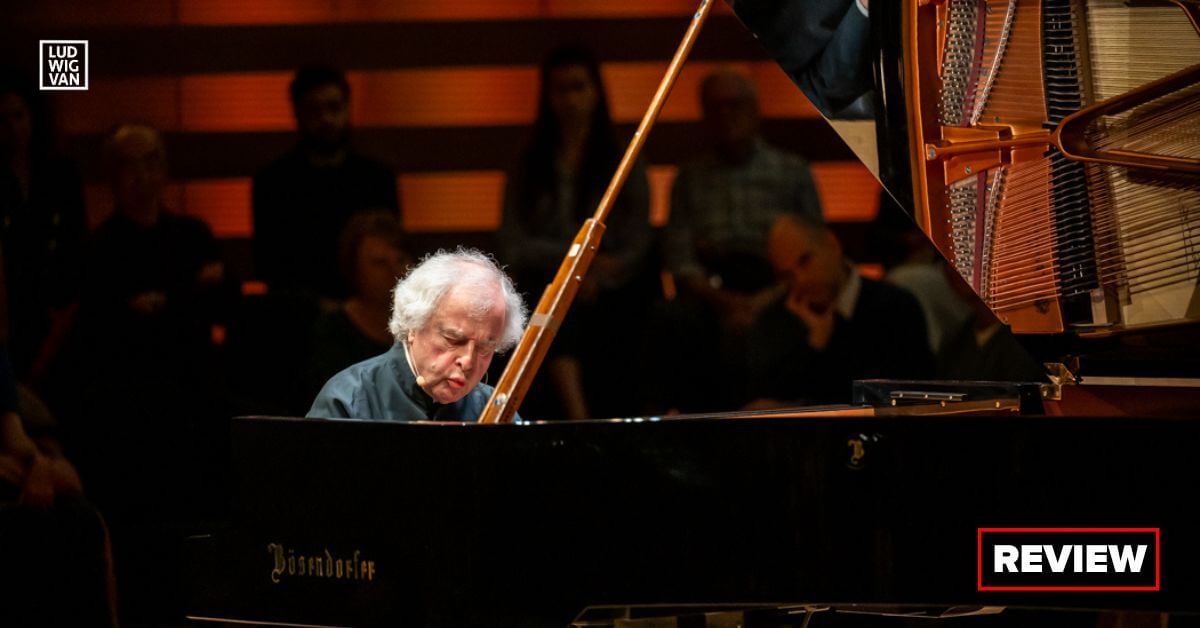
Royal Conservatory of Music: Sir András Schiff, piano. November 2, 2025, Koerner Hall.
There was something almost domestic about Sir András Schiff’s return to Koerner Hall — his eighth visit, and by now more an intimate conversation than a display of technical prowess.
Comfortably predictable yet constantly surprising, it felt a bit like revisiting a favourite uncle, full of charming stories and anecdotes, with a few familiar ones mixed in. He walked on slowly, head bowed and palms clasped at his chest, took a gentle bow, and immediately set to playing the Aria from Bach’s Goldberg Variations. It was pondering without being ponderous, profound yet naturally flowing, allowing moments of polyphonic tension and release to register with unforced clarity.

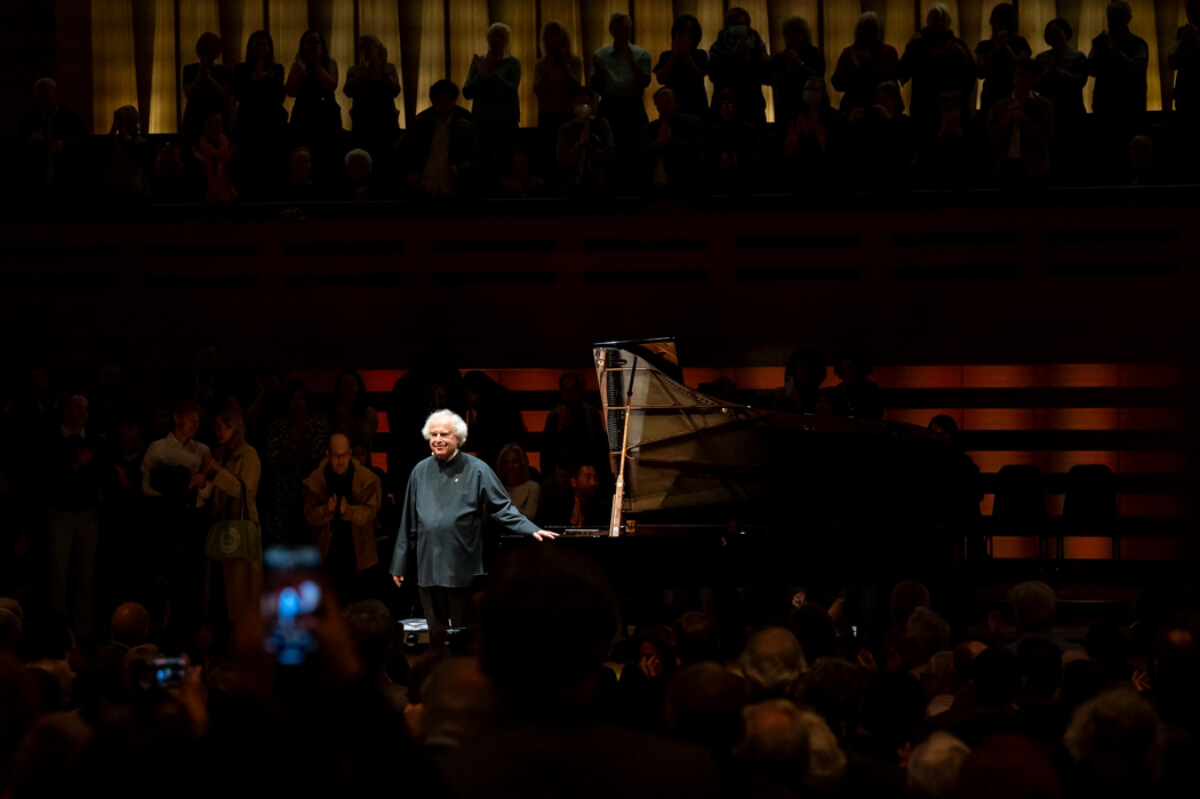
No Program
With no printed program — now standard practice for Schiff’s recitals — the audience might well have expected the entire set of variations, a longstanding calling card of the pianist.
“Don’t worry! I am not going to play the whole thing,” he said wryly to the full house.
Probably nobody would have objected if he had. Instead, he shaped the ensuing nearly three hours of “nothing but very good music” as a reflection on musical lineage — Bach and Mozart in the first half, Haydn, Beethoven and Schubert in the second.
“From there it was all downhill,” joked Schiff, referring to the composers who came after Bach, “the greatest composer of all time — and the great four, Mozart, Haydn, Beethoven, and Schubert.” For those fortunate enough to have attended his previous Koerner Hall visit in 2023, featuring Schumann and Mendelssohn, the intended irony could not have been lost.
They also had the opportunity to rehear Bach’s youthful Capriccio on the Departure of a Beloved Brother, preceded by Schiff’s genial spoken introduction of its main themes. His musical reading was equally full of charm and delightful storytelling. A sense of free-flowing discovery and spontaneity shrouded this and the subsequent G major French Suite, each movement marked by its own distinctive timbre.
In lesser hands the forward-moving tempi might have verged on the rushed, and the near absence of una corda did produce a somewhat monochrome palette. But the finely spun ornaments — especially elaborate in the repeats — prevented any hint of monotony. From the suite, Schiff singled out the concluding Gigue, juxtaposing it with Mozart’s “Little Gigue,” a highly chromatic, almost Schoenbergian polyphonic labyrinth, to illustrate Mozart’s debt to Bach.
Schiff couldn’t resist a political aside either, celebrating the suite as a truly European genre, “I really believe in a united Europe. The Brits did a stupid thing. Imagine if the Gigue decided to step out of the Suite and declare independence!”
The “black” key of B minor was the connecting thread for his next pairing — Bach’s B-minor Prelude and Fugue from Book I of the Well-Tempered Clavier and Mozart’s enigmatic B-minor Adagio, in Schiff’s view both meditations on mortality. The Prelude was solemnly prayerful, searching, as if probing ever deeper shades of black; Schiff’s fluttering pedalling kept the texture limpid. In the Fugue, every complexity of its high chromaticism was savoured, consoled by the flowing countersubject, producing a transcendental narrative arc.
With natural forward momentum, Schiff made as persuasive a case as possible for Mozart’s Adagio, a work that requires unrelenting concentration and conviction – especially when performing both repeats. A radiant Italian Concerto, ever so slightly smudged around some of the edges, closed the first half with exuberance.
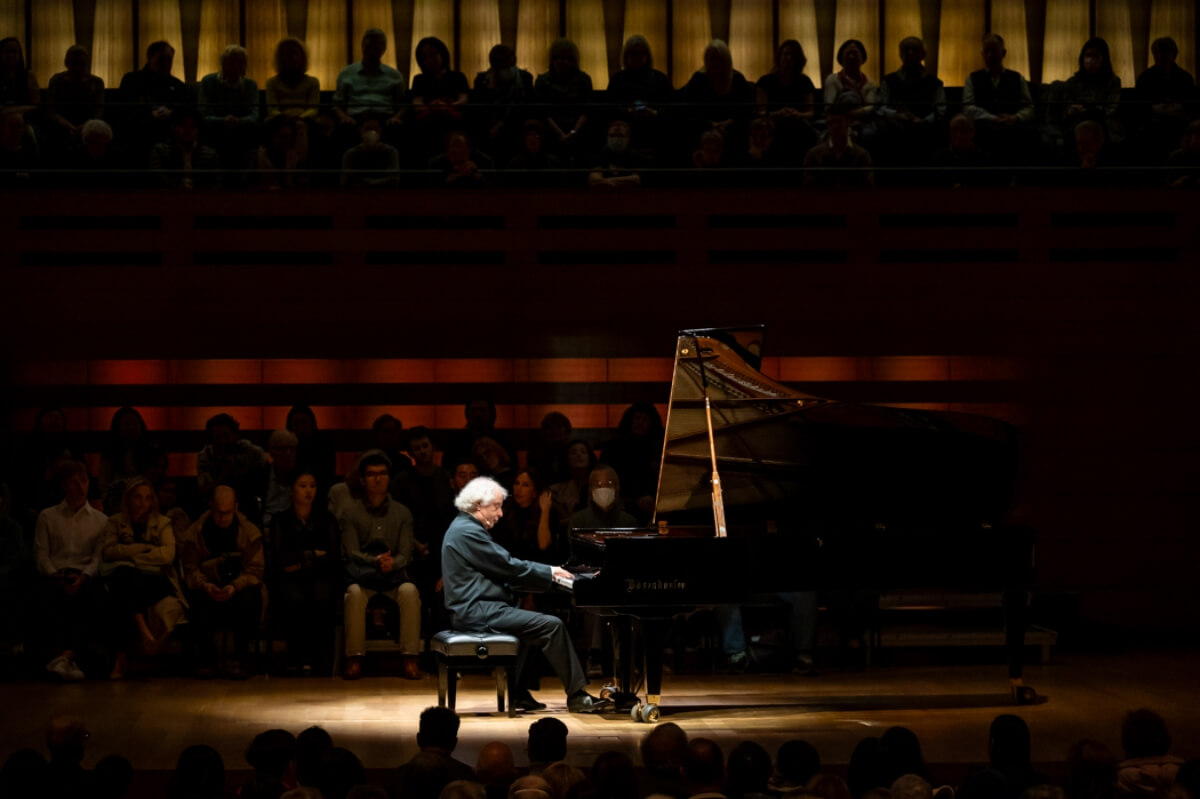
Second Half
For the second half, the Steinway was replaced by a Bösendorfer, offering, as Schiff put it, “a diversity of instruments” and a distinct “Viennese accent.”
Haydn’s F minor Variations were another welcome reprise from his previous visit. Imbued with poetic poise, Schiff subtly traced the shifts from the melancholic minor-key variations to the serenely glowing major ones. The Bösendorfer’s thinner treble and deeper bass allowed him to illuminate Haydn’s polyphonic undertones while bathing them in a veiled dreaminess.
The final pairing of the program continued the theme of late-period composition. As Beethoven’s last work for the keyboard, the Op. 126 Bagatelles stand as a condensed summation of his late style — miniature string quartets in spirit, kaleidoscopic in character, and rich in contrast. Schiff approached them not as trifles but as self-contained narratives, each revealing a distinct emotional landscape. His playing combined deep, resonant attack with quiet, unforced grandeur.
The second Bagatelle, with its mercurial shifts and inward lyricism, felt almost Schumannesque in its duality; the third was meditative, the fourth capricious and storytelling, the fifth pastoral in its calm, and the sixth marked by an air of resignation. Schiff’s command of colour and articulation lent coherence to these vignettes without smoothing away their eccentric edges — a late-Beethoven world rendered in brilliant microcosm.
If Beethoven’s Bagatelles distilled a lifetime’s invention into concise form, Schubert’s Drei Klavierstücke opened a door to the beyond. Schiff’s interpretation emphasised their haunted beauty, with an imposing left hand that brought out an even darker undercurrent. His playing was noble and poetic, yet entirely unsentimental.
The second piece, in particular, emerged as deeply poignant. Its Lied-like opening melody repeatedly interrupted by nightmarish visions and stifled cries; each return of the lullaby theme felt more remote, more unreal — a blurred threshold between dream and death. In the final reprise, Schiff introduced subtle ad-libitum tremolos, heightening the sense of echo and estrangement.
Final Thoughts
The packed audience could hardly have expected an encore after such a satisfying conclusion to such a long program. Yet, Schiff rewarded their enthusiasm with Chopin’s A minor Waltz, delivered with unhurried warmth and understated melancholy — a moment of solace after the spectral Schubert.
Clearly it wasn’t all downhill after the fab four.
Are you looking to promote an event? Have a news tip? Need to know the best events happening this weekend? Send us a note.
#LUDWIGVAN
Get the daily arts news straight to your inbox.