
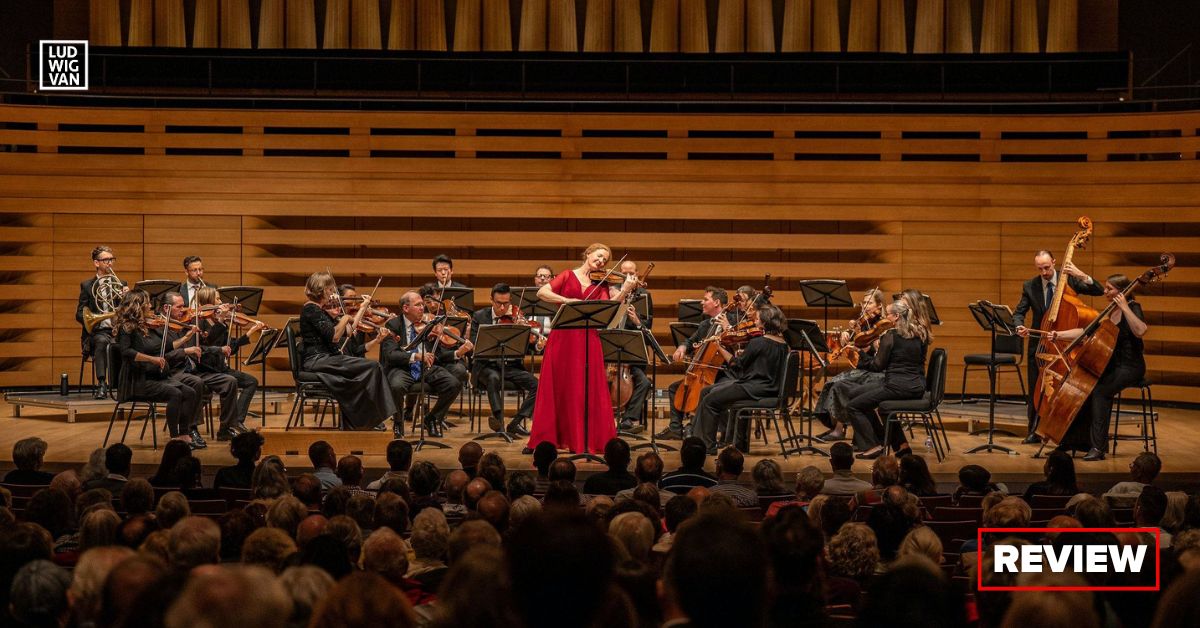
Tafelmusik Orchestra. Mozart: Symphony No. 40; Rondo in B Flat for Violin and Orchestra K. 269 (Rachel Podger, soloist). Schubert: Symphony No. 5. Rachel Podger, director. Koerner Hall on Sept. 26, 2025. Repeated on Sept. 27 and 28.
“Tafelmusik Orchestra, on period instruments.” Such was the rubric atop the list of musicians in the printed program Friday in Koerner Hall. No trace of the B word and no Baroque music on the agenda.
The season-opening concert was nevertheless distinctly a Tafelmusik event that reflected the high level of collaborative listening that prevails among the players, and the positive input of the
Principal Guest Director, Rachel Podger.
I say director rather than conductor as this tall Englishwoman led from what would normally be called the concertmaster chair, seated on a platform that rendered her a little more visible to the other 26 musicians on stage. Of course she gave upbeats and downbeats but otherwise exerted her influence mainly by example and osmosis.
None of this is unusual in the realm of Baroque performance but it is still uncommon to hear Mozart’s Symphony No. 40 (in the clarinet-free 1788 version) and Schubert’s Fifth (1816) without a conductor wielding a baton or otherwise gesticulating from a central podium.
Mozart No. 40
All the more remarkable, then, were the energy and clarity of the outer movements of the Mozart. Phrases were pithy and stresses had oomph. The much-admired development sections sounded like the great adventures they are.
Strings reminded us that warmth is not necessarily denied ensembles that avoid vibrato. Some listeners might have preferred a little more traditional dominance by the first violins. I enjoyed the democracy (including the occasional unexpected prominence of individual winds).
Perhaps the steady six-eight pulse of the Andante could have used some of the give-and-take that remains the prerogative of a conductor. Still, with a toughly muscular Menuetto, the performance fulfilled the Sturm und Drang demands of the score.
Schubert No. 5
All this praise went double for the Schubert, which was much more than the genial bouquet it is sometimes taken to be.
As in Mozart, tempos were fleet but not rushed. There was a natural slowdown at the end of the Andante con moto, rather than a “Baroque” sudden stop. The Menuetto marched forward boldly, the dance element reserved for the trio.
Both symphonies are economically scored, without trumpets and drums. Colour had to come from within. Nor was the concert very long. Observance of repeats made some amends, as did the inclusion of Mozart’s harmless Rondo in B Flat for Violin and Orchestra K. 269, which Podger played before the Schubert in a sotto voce style.
Final Thoughts
There was an announcement drawing attention to the presence of microphones for the purposes of recording. The relatively dressy crowd complied with a request to keep coughing to a minimum.
Tafelmusik has already recorded the Mozart 40th with Bruno Weil, who was identified in 2006 as a conductor. The comparison will be interesting.
Are you looking to promote an event? Have a news tip? Need to know the best events happening this weekend? Send us a note.
#LUDWIGVAN
Get the daily arts news straight to your inbox.