
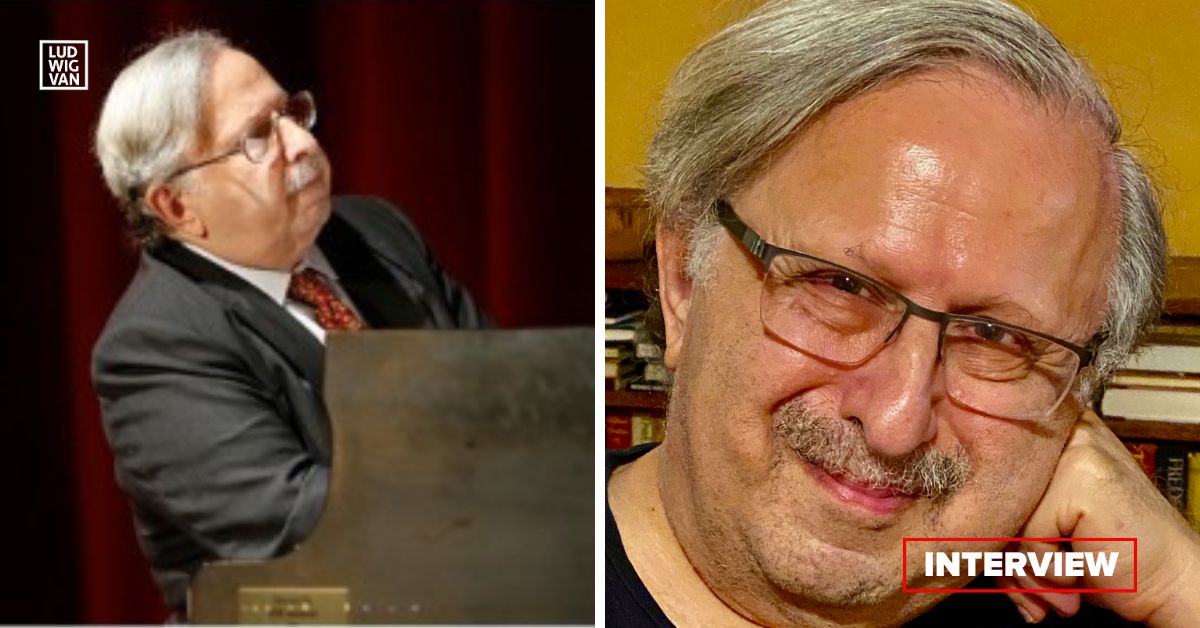
A unique event will take a deep dive into Armenian music, and in particular, Armenian composers. Organized by the Armenian General Benevolent Union (AGBU) Toronto chapter, the event features New York-based pianist, lecturer, author, Şahan Arzruni.
In July 2024, Şahan Arzruni released a CD titled By Women that showcased the work of eight Armenian women composers. He’ll be presenting that program as a lecture/recital on September 28, 2025, at the Lawrence Park Community Church.
Victor Borge and Sahan Arzruni playing List 2nd Hungarian Rhapsody:

Şahan Arzruni
Şahan Arzruni began playing the piano at the age of four in his native Turkey, and gave his first public concert at age five. He moved to the United States to study at The Juilliard School.
As an artist, Şahan Arzruni has recorded more than 20 albums, many of them for The Musical Heritage Society. He focuses largely on the music composed by the recognized masters of Western classical music for younger pianists, including works by Kabalevsky, Bartok, Khachaturian and others, as well as music by Armenian composers.
He’s given command performances at the White House, as well as British, Swedish, Danish and Icelandic Courts, and made numerous appearances on television, including The Tonight Show Starring Johnny Carson. In the 1960s, he played straight man to musical comedian Victor Borge.
We asked the artist and author a few questions about his work, and Armenian music.
Gayane Chebotaryan, a composer and musicologist, was born in 1916 in Rostov-on-Don, Russia, and studied at the Leningrad Conservatory. She’s one of the composers featured in his recording and lecture.

Şahan Arzruni: The Interview
LV: How did you come to be interested in the work of the composers on your By Women CD?
ŞA: Presently, I am preparing a chronicle of Armenian piano music which will be presented in eight discs. One of the recordings would have been devoted to the compositions of Armenian women composers.
The idea of women making music was not a novel idea for me, after all my aunt was a pianist and a composer. Koharik Gazarossian, also a native of Constantinople, was an accomplished pianist and a composer whom I knew well. In the Armenian culture, women are not second-class citizens.
After all, the first woman composer in the world was an Armenian, Sahakdukht, who lived in the early 8th century and her music is still chanted in the Armenian church. As I was making research in preparation for my CD I found 38 Armenian women composers. We are after all only six million people. That’s quite a proportion!
LV: What distinguishes Armenian composers from others? Are there distinctive elements of style?
ŞA: The essence of Armenian music is Middle Eastern, not Western. That’s the essential difference. The traditional Armenian music is based on modes rather than Western scales; it is founded upon time cycles rather than Western meters. Even the musical notation is different: the laid out Armenian music looks like stenography, rather than notes placed on a staff as in Western music.
LV: Are there one or two interesting anecdotes or details that you can share about the composers you showcase?
ŞA: Sure. My meeting with Aram Khachaturian. In 1972, I was about to record the two albums Khachaturian had written for young pianists. When I found out that Khachaturian was in New York at the time, I wanted to play the pieces for an authentic performance.
On a Sunday morning, I picked him up from his hotel and came to my apartment. The moment he entered my unit he complained of the heat. He made me open all the windows to cool the place down. Then he looked around and asked where my “royal” was (grand piano), adding, “if you were a good pianist, the government would have given you one.”
At the end of our three-hour session, I was playing a composition called “In the Folk Style”. He didn’t like the way I was interpreting it. He pushed me aside and demonstrated it on the piano. “Play it again,” he commanded. I had played only a few measures, when he cried, “You are a bad piano player.”
He was totally frustrated. “Sit,” he said. “Do it again.” Peripherally, I noticed that he took off his jacket, rolled up his sleeves, as if he was getting ready to beat me up. “Play.”
Suddenly, this rugged man transformed himself into graceful maiden and began to dance as if he were a lassie, undulating his wrists and swaying his waist. I immediately got the message. I was interpreting it as if “In the Folk Style” was a dance for boys, whereas it was dance for girls.
LV: It’s my impression that there has been an increased awareness of Armenian culture internationally over the last decade or so — is that your own observation as well?
ŞA: The Armenian people have been around for nearly 3,000 years. During that period their only wealth has been their culture — no gold, no diamond, no petroleum. Their rich music — the liturgical chants, the bardic melodies, the folk songs — their unique language, their singular script, their exquisite illuminations, their monumental monasteries were all they had.
With the modern technology we should be doing much more. We should let the world know who we are. We need to play the right politics to disseminate our culture.
Event Details
Lawrence Park Community Church, 2180 Bayview Avenue, North York, on September 28, at 5 p.m.
The AGBU is a non-profit organization dedicated to education, culture, and other programming.
- Find ticket and other event details [HERE].
Are you looking to promote an event? Have a news tip? Need to know the best events happening this weekend? Send us a note.
#LUDWIGVAN
Get the daily arts news straight to your inbox.