
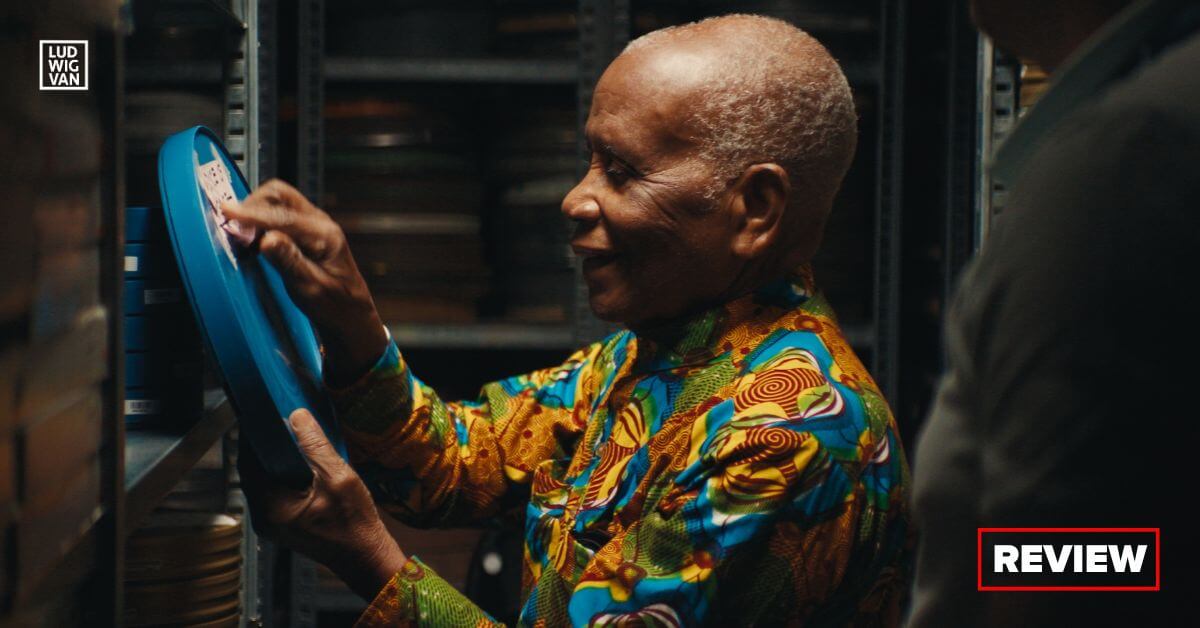
This year, at the Toronto International Film Festival, which is celebrating it’s 50th anniversary, the honour of the opening night slot for its Docs Section was accorded to The Eyes of Ghana.
Directed by two-time Oscar-winner Ben Proudfoot, the film begins with a revelation and convenient metaphor: it’s main subject — the 93-year-old cameraman Chris Hesse — informs us he is going blind from glaucoma.
What other reason might one require to remember, resurrect and reconstruct the past in order to pass on its legacy to the future?
“I’m in the evening of my life,” he declares.
Hesse’s legacy, we soon learn, is written on canister after canister of celluloid, amounting to almost 300 hours of unseen footage from his time documenting the life of the former Ghanian President Kwame Nkrumah.
Described as the founding father of Africa, Nkrumah, who was educated in the United States and influenced by the ideas of W.E.B. Dubois, ruled from 1957 until 1966, bringing Ghana from a nation under colonial power into an independent state, then turning it into an authoritarian regime that saw him being overthrown in a coup d’état.
Hesse, who views Nkrumah’s historical significance to be in line with Lincoln, Mandela and Gandhi, was the son of a priest. He was hired to follow Nkrumah around as he made his way around the world in the pursuit of freeing Africa from its colonial shackles.
Documenting History
Nkrumah’s belief, inspired by his exposure to Hollywood films during his education years, was that countries like America made, and marketed, themselves through films, requiring the creation of foundations such as the Ghana Film Corporation, which Hesse was a large component in sustaining.
Oftentimes, Hesse fascinatingly informs us, Nkrumah would communicate to him through non-verbal gestures, such waving his cane, in order to signal what to or not to be recorded. He was the director of his own archive; a promising young man turned symbol of a movement.
Woven into the exploration of the professional relationship between these two men, Proudfoot also introduces us to the filmmaker Anita Afonu, and Edmund Addo, the theatre manager of the Rex Cinema in Accra, which threatens to be overtaken by land developers.
The Eyes of Ghana, then, in addition to being about a country and a man, is also an investigation into the motivations, and possible uses, in cinema.
Towards the end of the film, for instance, in a lecture with aspiring film students, Hesse is asked about the abuses of power and crimes that Nkrumah is alleged to have carried out while in office.
“I filmed his life,” Hesse says. “It is for you to watch and judge.”
But one of the faults that the film commits is to not allow us to judge these figures for ourselves, mostly owing to Kris Bowers’ emotionally manipulative score, which soars for very banal sequences that are unsuited to it. And as the end credits later explain, it sees Nkrumah, who jailed and tortured his dissenters on mass, as an outlier whose morality can be questioned but never conquered.
“We live in a world of contradictions,” Anita says, as if it were the final word.

Final Thoughts
With colourful, contemporary images framed in Academy Ratio by cinematographers Brandon Somerhalder and David Feeney-Mosier, and edited by Mónica Salazar in a tight, balanced, determined way, The Eyes of Ghana is a moving experience as you watch it, but its effect fade as soon as you walk out of the theatre.
It was only afterwards that I realized that Anita and Edmund were inserted into the film in order that a revival of the Rex can take place, so that Hesse’s recently restored footage from the archives can be screened to the community.
It was only after that I realized only 15 minutes of this footage was shown, but none sustainedly enough or without mediation for us to deduce whether it is in fact of historical note, or if it is merely significant because it survived the ravages of time.
Proudfoot is more concerned with circling around its subject rather than entering into the fold, meaning its narrow mindedness, despite the level of craft that has gone behind it, ultimately reveals itself. This is the kind of film that chose to be a remarkable vision over an index of knowledge that has resisted the tempting impulse to impose an agenda onto its narrative.
The Eyes of Ghana is a balanced, entertaining primer for those unfamiliar with Ghana’s turbulent history, but it leaves one wanting more of the archives, which is where the more compelling story lies — the eyes that remain closed, unfortunately, but hopefully not permanently.
You can catch one more TIFF screening on September 11, details here.
By Nirris Nagendrarajah for Ludwig-Van.com
Are you looking to promote an event? Have a news tip? Need to know the best events happening this weekend? Send us a note.
#LUDWIGVAN
Get the daily arts news straight to your inbox.