

Soulpepper Theatre / Old Times, written by Harold Pinter, directed by Peter Pasyk, Young Centre for the Arts, closes Sept. 7. Tickets here.
The night after I saw Harold Pinter’s Old Times at Soulpepper, I was at another performance where I chatted with two people who we’re also at the Pinter play the previous evening.
Each one of us had a different interpretation of the play, yet we could also see the validity of the other’s viewpoint.
Nothing would have pleased Pinter more.
The Conundrum of Pinter
The nature of this review has to differ from usual fare, because we cannot talk about the Soulpepper production without stating some background facts about Old Times and Pinter.
That’s because a director has to make a clear choice as to what Old Times is about and there are many theories on offer — the reason being that it is universally acknowledged that Harold Pinter is among the most enigmatic and ambiguous of playwrights, and Old Times (1971) is one of his most enigmatic and ambiguous plays.
Old Times is also in certain circles considered to be among the greatest plays ever written, particularly for its psychological depth.
Thus, directors are presented with a puzzle board of directions they can take despite the fact that the audience will not necessarily be able to solve the puzzle that directors present them with.
The Play
Old Times is a three hander.
Deeley (Christopher Morris) and Kate (Anita Majumdar) are a married couple awaiting the arrival of Anna (Jenny Young), an old friend of Kate’s she hasn’t seen in 20 years.
In Pinter, the action is not physical but word play.
Ostensibly, the structure of Old Times is a series of contradictory conversations between Deeley and Anna as they compete, benignly, for Kate’s attention, or on a more sinister level, for control over her, conflicting stories which Kate neither confirms nor denies.
In fact, Kate says barely anything throughout the play until her big monologue at the very end, when she contradicts everything Deeley and Anna have said, and which may or may not be the truth.
In short, Old Times has been described as a play where truth is subjective, and memory is a battleground.
Or as Pinter himself said, “The thing is not necessarily either true or false; it can be both true and false. The past is what you remember, imagine you remember, convince yourself you remember, or pretend you remember.”
Interpretations
The very ambiguity of Old Times has led to a plethora of interpretations about what the play means. Here are just some of the more popular theories in precis form.
Memory is unreliable, making truth irrelevant; therefore, the act of telling is about control.
At the core is the love triangle between Anna and Deeley competing for Kate, and her reaction to that duel. Does Kate make a psychological conquest at the end, or is it a metaphorical killing, or does she actually kill one or both?
What is the nature of Anna — is she real, a memory, or a ghost?
The meaning of the title — that each character clings to a different old time to assist in identity, which leads to multiple competing versions of the past.
Anna and Kate are different facets of the same person.
And lastly, there’s the Freudian take that the play takes place in Deeley’s subconscious and Anna and Kate are manifestations of his mother.
As Pinter himself famously said, “I want the audience leaving my plays with more questions than answers.”

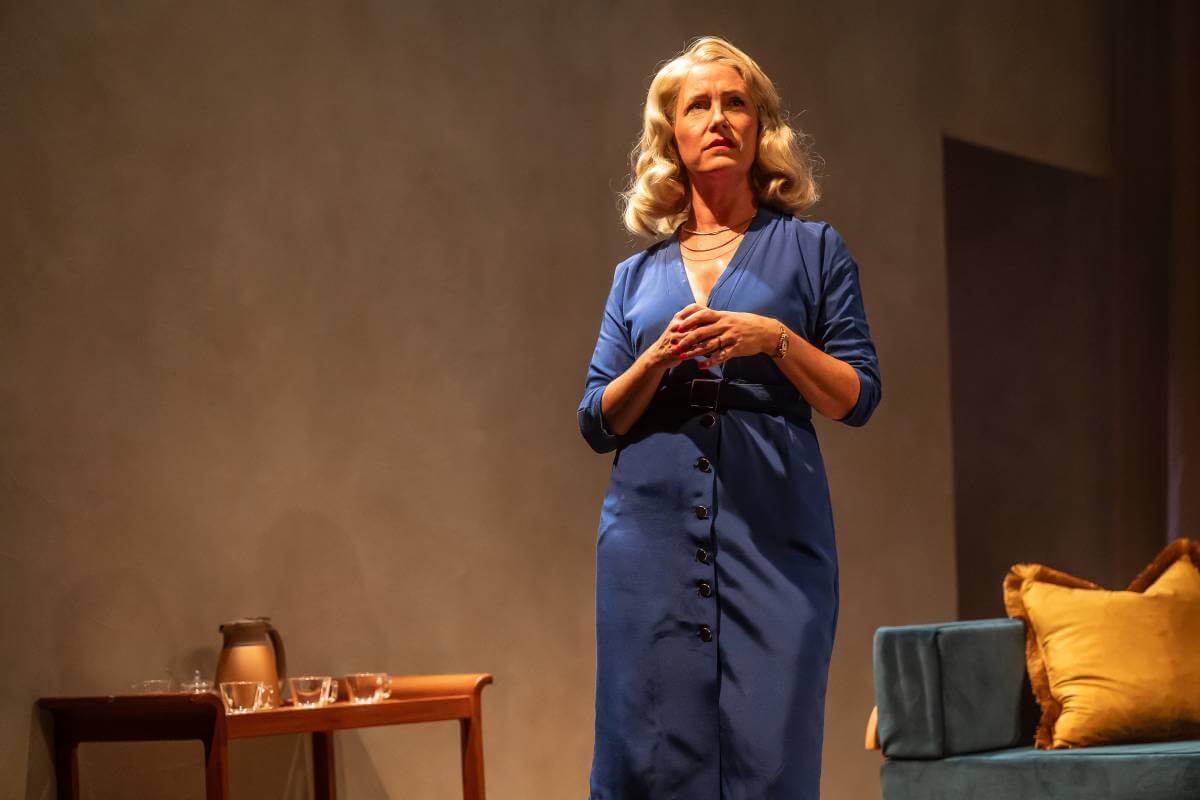
The Soulpepper Production
So finally, after all this preamble, which I hope puts all the readers on the same page, we come to the Soulpepper production directed by Peter Pasyk.
I think Pasyk opted for the Deeley/Anna competition for Kate via the memory battleground, ending with Kate’s metaphorical killing of Anna and her taking control of Deeley.
Pinter’s famous pauses, which are so much a part of the Pinteresque language, are in clear evidence. It’s almost as if Pasyk has said you’re expecting causes, so here they come.
These well-defined stops make the production feel a trifle slow, but it also contributes to the awkward tension in the conversation, and gets the laughs from that awkwardness.
Pinter has remarked that more things happen in his plays during the silences than they do during the dialogue, and Pasyk’s direction does give a subtle nudge in the direction of the buried subtext, particularly between Anna and Deeley.
The song duel between Anna and Deeley is absolutely brilliant and ultimately riotously funny, and kudos to Pasyk for how creatively the sequence is staged.
A parade of standard love songs written by the likes of Cole Porter, Jerome Kern, Irving Berlin and Rodgers and Hart is aimed at Kate like ancient knights wooing fair maidens, with Anna and Deeley trying to outdo each other in their delivery.
There is also the added fillip of a sexual flirtation happening between Anna and Deeley during the song contest, which adds spice to the mix, particularly when we hear of a possible sexual encounter between the two later in the conversation.
Pinter does not specify the songs, only the number (11) and the sequence of who sings when, so more congratulations to Pasyk for the great lineup of oldies and goldies that he chose.
Nonetheless, the play’s emotional, sexual and psychological tensions are not as strong as they should be, and this is where Pasyk falters. While the power shifts between Anna and Deeley are there, they could be more well-defined.
It is clear that Pasyk supports the theory of Kate symbolically purging Anna from her memory causing the end of her existence.
Rather than having Anna just leave the room as in the original stage direction, in this production Anna lies down on the couch assuming the position of a dead body in a coffin. It is a potent and clever image on the part of Pasyk.
And the verdict — while eminently watchable, Pasyk’s production of Old Times is Pinter lite.
The Actors
Christopher Morris is just terrific as Deeley.
By the over-bright tone of his voice and the slight nervous energy he exudes, Morris puts his character on edge right from the start of the play, which makes us edgy as well.
He is particularly good in suggesting subtext.
For example, when Deeley first quizzes Kate about her former relationship with Anna, you can sense when his curiosity is perhaps turning into jealousy. We can also absolutely track his downward slide as the shifting dynamics turn in favour of Anna.
Morris’s combination of both delight and menace in the song challenge is a joy to behold.
Jennie Young gives a more subtle performance as Anna, perhaps a bit too much so, although she is in full throttle in the song competition.
Although designer Snezana Pesic has costumed Young in a shirtwaist dress that covers her up, she still looks sexy and somewhat glamorous in comparison to Kate, but she doesn’t play up the sexy factor enough.
Nonetheless Young is a strong presence on stage and does hold her own against Morris in the memory battleground. For lack of a better word her performance needs enrichment.
Alas, Anita Majumdar, who is an otherwise solid performer, is miscast as Kate.
The character is a passive voice for the most part in terms of verbal output but there is a turbulent inner life going on and Majumdar radiates little of that. When she does speak she sounds monotonal.
The actor does come to life in her final monologue but there is not enough strength in the delivery, and this should be Kate’s triumphal moment, albeit spoken with calm and assurity.
In comparison to her fellow performers, Majumdar seems young and out of place. It doesn’t help that Pasyk has her physically curled up on the couch like a teenager.
The Set
According to the script the setting is a converted farmhouse near the coast which automatically implies a sense of isolation or seclusion. The action is confined to one simply furnished living room.
Pesic is also the set designer and has created that single room in an interesting way.
The side walls are very thick and extend the edge of the stage in straight lines as if to reinforce that sense of enclosure. The mid-century furniture is arranged facing outward so there is an an unrealistic veneer to placement which is more like a lineup.
The back wall is a large picture window which would suit a house near the coast although we don’t see any image behind it, so it acts like a mirror, reflecting back the inner thoughts of the characters within their inner world.
In short, Pesic has provided a very suitable performance space for Pinter’s Old Times.
Imogen Wilson’s lighting is muted until it isn’t. At certain key moments she has placed a blinding flash of light over the characters accompanied by a jolting sound provided by designer Jacob Lin.
This light certainly is a jolt to the audience as well and takes on many meanings such as a wake-up call to reality or, even the image of a deer caught in the headlights, or a sign of a world off kilter.
Final Thoughts
These days there is so much emphasis on new Canadian plays that i.
I leave you with the words that Pinter said to the great actor Anthony Hopkins who was appearing on Broadway in Old Times with the Roundabout Theatre Company in 1984.
Hopkins asked Pinter to explain the meaning of the ending to which the playwright responded, “I don’t know. Just do it.”
Are you looking to promote an event? Have a news tip? Need to know the best events happening this weekend? Send us a note.
#LUDWIGVAN
Get the daily arts news straight to your inbox.