
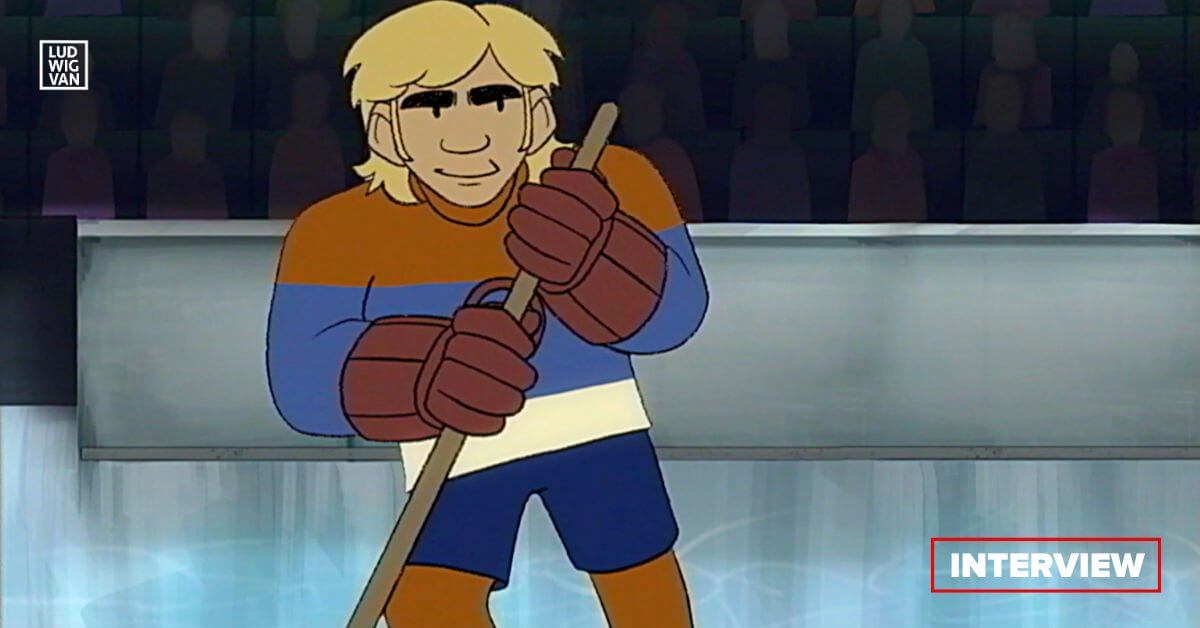
Back on April 14, 1978, a few brawls broke out during a World Hockey Association game between the Birmingham Bulls and the Winnipeg Jets.
During the melee, Birmingham Bulls player Dave Hanson ripped hockey icon Bobby Hull’s hairpiece right off his head. It became an infamous moment in the game’s history. Hull slipped into the dressing room, and came back to play the rest of the game wearing a helmet — something he rarely did.
It’s the incident at the heart of a new animated project by The Canadian Art Song Project titled The Piece Atop His Pate.
The Canadian Art Song Project (CASP)
The Canadian Art Song Project was founded by tenor Lawrence Wiliford and pianist Steven Philcox in 2011 as a two-fold effort: to revive existing art song repertoire, and work with professional Canadian artists to develop new pieces. Their mandate includes promoting Canadian art song written by Canadian composers.
Their view includes reaching out to all Canadians to look to Canadian-made art song to tell our stories. CASP has commissioned works for voice and piano by Brian Current, Marjan Mozetich, Norbert Palej, James Rolfe, Ana Sokolovic, and other Canadian composers.
They’ve made recordings of the genre, and they’re looking to spread the word via the digital world as well. Their first animated video project debuted in 2024, and they’re following up with another that’s based on a classic moment in Canadian hockey history.

The Piece Atop His Pate
The new animation and art song project, The Piece Atop His Pate, is based on a song by the late Jocelyn Morlock. The title of Morlock’s piece, Bobby Hull, tells you the main character, and it comes from her cycle Perruqueries, with a text by writer and former CBC broadcaster Bill Richardson that includes bits from Hockey Night in Canada broadcasts.
It’s part of CASP’s emphasis on telling Canadian stories.
The story is told with an operatic sensibility, and runs the gamut from humour to empathy. The animation design is based on retro TV graphics, vintage Hockey Night in Canada, and cartoons of the era.
The animation is being produced by students from OCAD University through an educational and creative partnership with CASP.
Performers include baritone Keith Lam and Steven Philcox, sought after collaborative piano and CASP Co-Artistic Director. Lam is a Hong Kong born, Toronto-based vocalist who’s performed with Canadian Opera Company, Tafelmusik, Tapestry Opera, Opera 5, the Bicycle Opera Project, Toronto Operetta Theatre, and Jeunesse Musicales, among others.
We spoke to Lawrence Wiliford, Managing Director, Co-Founder & Co-Artistic Director of the Canadian Art Song Project, and Philippe Blanchard, Interim Dean, Associate Professor, Faculty of Art at OCAD University.


Lawrence Wiliford & Philipppe Blanchard: The Interview
According to Wiliford, the song was chosen for a number of reasons. CASP explored various projects with OCAD.
“We wanted to start leaning into Canadiana really hard,” he says. That includes looking at stories that come from different time periods, regions, and communities across Canada.
“This story takes place in Winnipeg,” he adds.
Wiliford was already familiar with Morlock’s music, and the composer herself.
“Jocelyn Morlock was a friend,” Lawrence says. CASP co-founder Steven Philcox was likewise affected by her death in 2023. “Her passing was very, very hard for us both. We’re also looking for a way to celebrate her humour and vibrancy, and quirkiness.”
Would she like the end result?
“I just think she’d be delighted.”
The text for the song uses quotes from Hockey Night in Canada. Wiliford describes it as quirky. “The text is from Bill Richardson. It just felt right.”
The scenario, as he points out, has operatic dimensions.
“It felt right for animation and to explore it. It’s fun. We really miss her.”
For Blanchard, it’s a good working collaboration.
“The pleasure of working with Lawrence in working on the CASP projects is that a lot is left for interpretation,” he says.
It allows the students to use more of their creativity. Lawrence provides leads and suggestions for exploration.
“In this case, there’s a clear narrative to the song,” Philippe notes. The characters are already set, as is the tone. “The tone of the song is quite ironic and satirical. We kind of leaned into that with the visual style.”
He says the students researched the era and the animation aesthetics of the time to come up with a style that was appropriate for the story. Four students talk about their placement in the project here:

Style & Cartooning A Historical Character
“It’s an actual event that took place,” Wiliford adds. “It gave us a context to go very retro.”
Helmets wouldn’t become required of professional players until 1979, and even then, existing players were allowed to play without one until 1997. The fact that Hull would return to the ice in his helmet added another visual element to the story.
They were looking for a specific style from the era. “We leaned into the Hanna-Barbera period,” Wiliford says. That includes their Pete the Puck series, which was commissioned by the CBC, and used to explain hockey rules to young players.
He also let the students use their imaginations.
“The students created their own kind of character.” Thus, Stanley the Stick becomes part of the story.
Wiliford notes that dealing with a real figure from history raises other issues. “Bobby Hull is a tricky figure,” he notes.
Hull certainly had controversial moments in his career, despite his success on the ice. “I don’t think I really appreciated that quite as much,” Lawrence says. OCAD was initially concerned with the hockey player’s notoriety.
“There was a little bit of concern about what this would imply to Bobby Hull and his family,” he says. “That did start raising some concerns.”
The point was to make the fun good humoured, and not about poking fun at someone’s insecurities.
“I understand people feeling embarrassed for all sorts of different reasons,” Wiliford adds. “Lives are complicated. We leaned into satire.”
He consulted with Blanchard on the right tone to set, and how to convey the shame of the situation as an experience viewers share with the character — rather than pointing a finger at him from afar.
“There’s a balance to strike here. It’s a historical moment,” Blanchard says. “I think we struck a balance between empathy and satire and humour.”
Without eulogizing the Hull character, the students looked for ways of making him into someone real.
* As of September 22, 2025, the new animated short is available to view here:

A Working Process
As Wiliford points out, the students didn’t know who Bobby Hull was at first. They began researching the hockey history of almost a half century ago. He notes that art students aren’t always the biggest sports fans.
“It’s a generational thing for sure,” Philippe adds.
The mix of students also creates a fresh perspective.
“What I like about the projects that we do with Lawrence, there is sort of the Canadiana element to it, but it’s interpreted often by international students,” Blanchard says. Those students have a different perspective on Canadian culture.
“It challenges my notions about what is important about Canadian culture in general,” Philippe adds. Some had to do some basic research into the game of hockey itself.
The students learned as they worked on the project.
“It’s the way we approached it,” Blanchard says.
Animation work is quite structured, with each artist having a very specific and narrow role. A lot of research goes into the preproduction process.
“For those student, I think that was a real eye opener,” he says.
More advanced animation students are typically focused on elements like character design. Blanchard say the CASP projects have been very popular with students.
“I think students crave this kind of creative applied project with a real world outcome,” he says.
Engaging the Audience
Wiliford believes that the digital realm has a great deal of potential for art music, and art song.
“I have a very strong opinion that the performing arts need to be engaged in the digital system — and we’re not,” Wiliford says. He notes that most classical music organizations only use video and digital media for PR purposes.
It’s really about finding multiple ways of engaging with audiences, not pitting one way of experiencing the music against another.
“I remember watching Fantasia,” Lawrence recalls. “My daughter listens to the Classical Kids series.”
Older animated shows and movies routinely used classical music, and made it part of current culture. It’s also about reaching people who wouldn’t even consider coming into a concert hall for various reasons.
“What about all the people who come to Canada, and haven’t listened to a classical music in a concert hall?” Wiliford wonders. The short song format CASP has focused on is a good length for storytelling. “I think it’s a relevant idea — and no one else is doing it.”
Focusing on Canadiana helps to build cultural identity.
“These are all the things I’m thinking about,” Wiliford states.
His goal is to connect with viewers on a straightforward level where they’re simply absorbing the story and animated art, and not even thinking about the genre of music.
A Partnership
The collaboration between CASP and OCAD is one that benefits both.
A video launch is anticipated for the fall of 2025, with more details to be announced.
“Philippe and I are talking about further projects as well,” Lawrence says.
You can find out more about the Canadian Art Song Project [HERE].
Are you looking to promote an event? Have a news tip? Need to know the best events happening this weekend? Send us a note.
#LUDWIGVAN
Get the daily arts news straight to your inbox.