
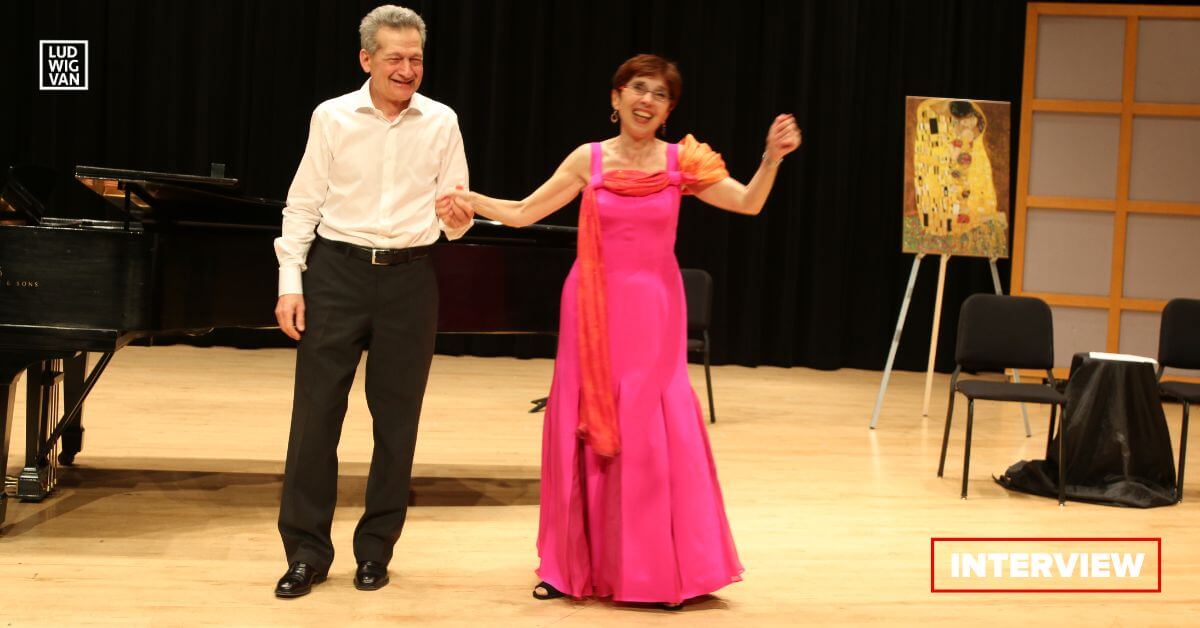
Off Centre Music Salon Founders and Co-Artistic Directors Boris Zarankin and Inna Perkis have announced the programming for their 30th anniversary season. New to the organization is a collaboration with Royal Conservatory of Music’s Glenn Gould School and Taylor Academy.
Founded in 1995 by pianists Inna Perkis and Boris Zarankin, Off Centre Music Salon is a Toronto-based chamber music series known for its themed programming, intimate concert experiences, and dedication to Canadian talent.
The couple built Off Centre as a community, enlarging the concept of presenting chamber music to include a more personal connection, especially for audience members. Their events involve a combination of music, storytelling, and exchanges of ideas.
Here’s a look at the season, and the couple who’ve created a unique environment for music in Toronto’s classical music scene.
Boris Zarankin and Inna Perkis
Boris Zarankin studied at the Kharkov State Conservatory with Regina Horowitz, completing his musical education at the Moscow State Conservatory.
He has performed as a soloist with major orchestras across the world, including the Toronto Symphony Orchestra, Vancouver Symphony Orchestra, Victoria Symphony Orchestra, the Kyiv Philharmonic and the Kharkiv Symphony Orchestra, among others. As a collaborator, he has performed with Jacques Israelievitch, Jonathan Crow, Marie Bérard, Ilya Kaler, Carol Wincenc, Han de Vries, Benjamin Butterfield, Isabel Bayrakdarian, Russell Braun and Michael Schade, and many other artists.
His repertoire includes both traditional and contemporary music, and he has commissioned new works by composers such as Valentin Bibik and Volodymyr Nalyvaiko. He is also a recording artist, and dedicated educator.
Inna Perkis is a graduate of the St. Petersburg Conservatory, where she earned both her bachelor’s and master’s degrees. She is a versatile chamber musician who has collaborated with artists like Ofra Harnoy, Ilya Kaler, Mikhail Gantvarg, Michael Schade, Measha Bruggergosman, and Isabel Bayrakdarian, among others. She has been teaching piano for about 50 years, and continues to work with students, many of whom have gone on to win prizes at the national and international level.
She has performed with Boris as a four-hand piano duo and two-piano duo for over 50 years.

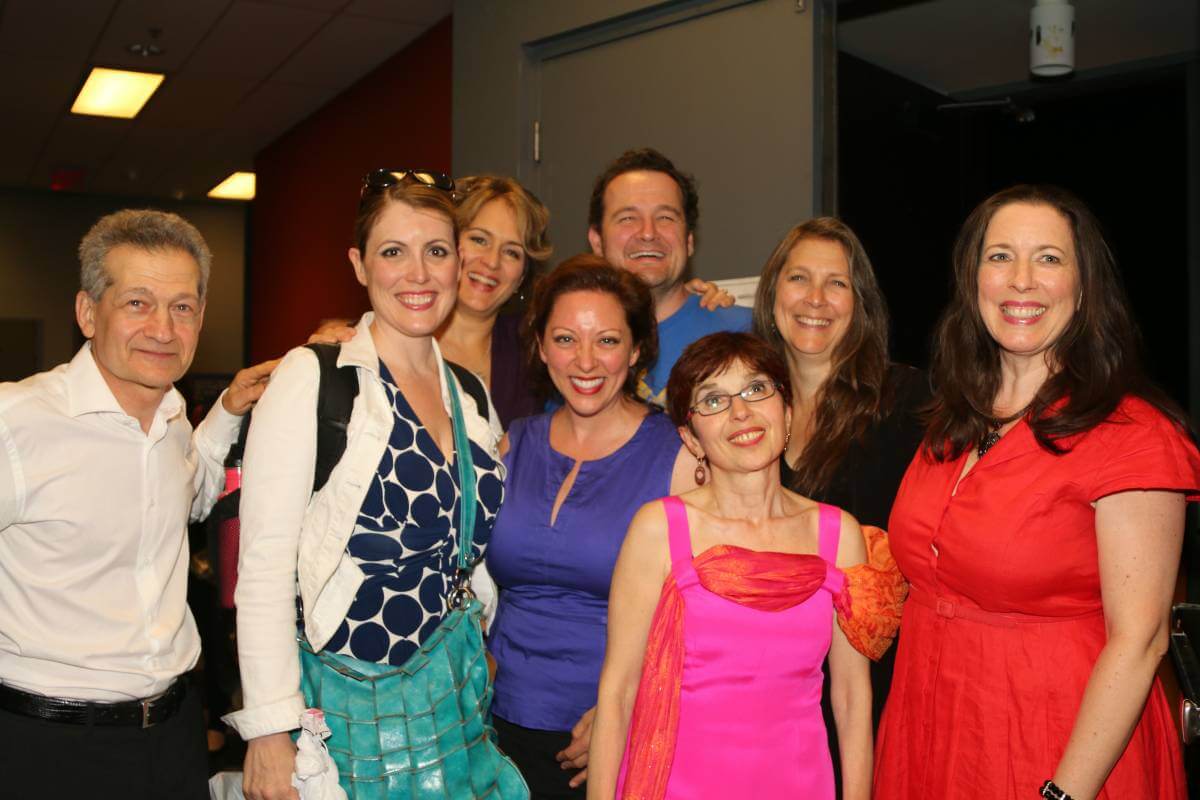
30th Anniversary Season: Dream The Impossible Dream
From Melancholy to Surrealism, with Laughter In Between (October 19, 2025)
Schubert knew a thing or two about unrequited love and sadness, and those emotions come to the fore in his Fantasia for four hands and his Arpeggione Sonata. But, he also had his lighter side, on display in his vocal trios Die Advokaten and Der Hochzeitsbraten. Poulenc’s Bal masqué (for soprano and chamber orchestra), and Ravel’s Tsigane, for vioin and harp (masquerading as a luthéal) complete the program.
Performers:
Tom Allen, host; *Alyssa Bartholomew, soprano; *James Coole-Stevenson, baritone; Nico Dann, percussion; David Eliakis, piano; Lori Gemmell, harp; Sheila Jaffé, violin; *Mira Kardan, cello; *Nicholas Kluftinger, bass; *Jeffrey Liu, tenor; Inna Perkis, piano; Mark Skazinetsky, conductor; Krisztina Szabo, mezzo soprano; Boris Zarankin, piano; Chamber Orchestra (with additional instrumentalists from the Glenn Gould School)
* This will be Off-Centre’s inaugural collaboration with the Glenn Gould School. Names marked with an asterisk * are students from the Glenn Gould School
Life + Death. Genius + Jealousy (December 14, 2025)
Mozart and Salieri — what was their true relationship? Clio, the Muse of History mediates the discussion. Just how did Salieri become an icon of jealousy in the public mind? In life, he was a much loved teacher, and mentor to giants like Schubert and Beethoven. The relationship between the two is examined in Rimsky-Korsakov’s rarely performed one-act opera Mozart and Salieri. Mussorgsky’s Songs and Dances of Death offers more food for reflection.
Performers:
Benjamin Butterfield, tenor (Mozart); Mira Kardan, cello; Peter McGillivray, bass baritone (Salieri); Nancy Palk, actor; Inna Perkis, piano; Brett Polegato, baritone; Kathryn Tremills, piano; Boris Zarankin, piano; Julia Zarankin, host
Film Screening: Chopin’s Preludes: A Life, In Fragments (February 8, 2026)
Chopin’s Preludes: A Life, in Fragments is a feature-length documentary film about what Zarankin’s calls, “the ways that Chopin’s Preludes intersect with our lives. The result is an exciting hybrid film that blends live performance with our own immigrant story.” Off Centre’s founder/pianists Boris Zarankin and Inna Perkis, and filmmaker Marcel Canzona, will participate in a Q&A after the screening.
We’ve Got Rhythm (In 1, In 2, In 3, In 4, In 5, In 6… In Ten!) (March 29, 2026)
As Stravinsky said, “There is music wherever there is rhythm, as there is life wherever there beats a pulse.” Rhythms are explored in this program that includes the Basque patterns of Ravel’s Piano Trio, the dance rhythms in his four-hand arrangement of Debussy’s Prélude à l’après-midi d’un faune, the child-like charm of Mussorgsky’s Nursery songs, and gongs and bronze kettle tones of a Gamelan ensemble. Dancing may be involved…
Performers:
Tom Allen, host; Mira Kardan, cello; Elina Kelebeev, piano; Maeve Palmer, soprano; Inna Perkis, piano Isabella Perron, violin; Boris Zarankin, piano; Ilana Zarankin, soprano
(Erik) Satie-S-Faction Guaranteed (June 7, 2026)
Off Centre’s 30th Anniversary Fundraiser Gala features a huge cast of performers. More details about the program to be announced closer to the date.
Performers:
Tom Allen, host; Colin Ainsworth, tenor; Russell Braun, baritone; Lucia Cesaroni, soprano; Lori Gemmell, harp; Andrew Haji, tenor; Erica Iris Huang, mezzo soprano; Elina Kelebeev, piano; Rachael Kerr, piano; Bénédicte Lauzière, violin; William Leathers, trumpet; Andrea Ludwig, mezzo soprano; Joseph Macerollo, accordion; Clara Nguyen Tran, viola; Maeve Palmer, soprano; Inna Perkis, piano; Adrianne Pieczonka, soprano; Leana Rutt, cello; Mark Skazinetsky, violin; Giles Tomkins, bass-baritone; Liz Upchurch, piano; Boris Zarankin, piano; Ilana Zarankin, soprano
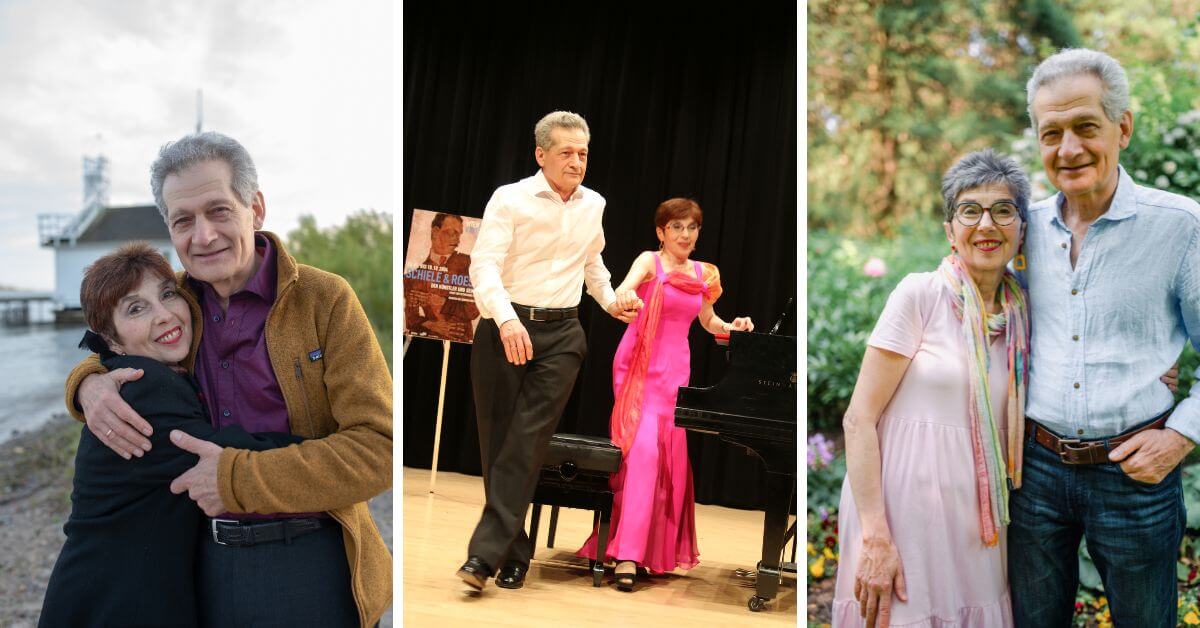
Boris Zarankin and Inna Perkis: The Interview
“We started Off Centre, it’s actually a reflection of us,” Inna says.
“A reflection of our passion and our music,” Boris adds.
“The most intimate form of music,” Inna says.
“This probably all started where we immigrated first — Vienna,” Boris explains. “We experienced music salons there.”
He calls it a seed that was planted, an idea of creating intimate environments that closed the gap between performer and audience. When they found themselves at a crossroads in their careers years later in Canada, they decided to launch their own salon.
“We thought that we are bored just with teaching and occasional playing. We started without knowing that we would last four 30 years,” Boris says. “It was very experimental in the beginning.”
Where did the name come from?
“Why Off Centre?” Inna asks. “Because we are slightly off centre as people,” she laughs. “We wanted to have something that we feel was needed in this city, and was most interesting to us.”
The couple wanted to impart their own passion for the music to their audiences.
“In the 30 years, I think the biggest achievement was […] we made our film,” she says.
The screening of Chopin’s Preludes: A Life, In Fragments is part of the 30th anniversary lineup.
They’re excited about the documentary. “I suspect that we created a new genre,” Boris says. It’s a combination of performance and fragments of their lives, examining how Chopin’s music intertwines with their lives, as well as the composer’s life and philosophies.
Glenn Gould School — A New Collaboration
“We are very excited about this collaboration,” Perkis says of Off Centre’s new partnership with The Glenn Gould School. She says the couple were looking for the right kind of arrangement.
“We went right to the president of the Conservatory and he was very receptive,” Boris notes.
“And he said, of course!” Perkis adds.
The partnership sees students from The Glenn Gould School perform together with experienced professional artists in a concert setting. It’s an invaluable experience for young musicians.
As Zarankin points out, the learning process never stops. “
We as pianists, we are very much influenced by the orchestra, or singers in particular. That’s why we keep learning all the time.,” he says.
“Next year we are going to have an artist in residence,” he adds. Cellist Mira Kardan, a current student at the GGS, is a graduate of the Colbourn Music Academy, and the 2022 first prize winner of the Bellflower[CA] Symphony Competition, and first prize winner at the 2025 Shean Competition.
As Perkis relates, the artist in residence program began with a Japanese student years ago. “None of us spoke English, and that’s how it started,” she laughs. “We can share the emotional content of the music.”
The Programs
“We are very eclectic,” Zarankin says. “It always offers some meat. It could be anything,” he continues. “We work around certain concepts.”
The programs are tweaked and modified, sometimes close to the performance date.
“We are not satisfied in a program until we see it and shift it around,” Perkis says.
“It’s always a combination of big pieces with smaller pieces,” Boris notes. Sometimes it involves the specific artists they want to work with.
Those selections are crucial to maintaining the environment they want to create.
“First of all, salons are gatherings,” Inna says. That includes both artists and art lovers. “It’s paramount who you invite to these gatherings. Music making is very set. It’s a conversation between us on stage and the audience, and the audience between themselves.”
“It should be harmonious,” Zarankin adds. “People shouldn’t hate each other when they are on stage.”
“I think we are lucky because from day one […] for two accomplished pianists to sit together and talk about music…” Inna begins.
“… and not kill each other,” Boris adds.
“It’s not easy,” Perkis laughs. They give artists one stipulation. “Please leave your ego at the door.”
“To be very frank, we are obsessed with quality — not with quantity,” Zarankin says.
Putting it all together is where it gets complicated. “It’s a real art to make a program digestible to the audience,” Inna explains. Their continued success is the proof in the pudding. “For 29 seasons, they give us standing ovations.”
She believes it’s the combination of careful curation with an environment that lets audiences get closer to the music, and music making.
There are also other perks.
“We offer sweets during the intermission,” Boris says.
When putting programs together, they looked for connections. Zarankin goes over the program for the first concert.
“We have Schubert, the king of melancholy you can call him,” Boris says. “Then we have Poulenc, French people call him, this is our Schubert.” But, it’s not all gloom. “We tried to install this moment of comic relief in every concert.” That’s doubly true when the program includes serious avant-garde music. “We know we need comic relief,” he says. “It opens their ears up again.”
If the audience is bored, it’s a curating problem. “I consider it the fault of the presenters,” he says.
Inna says they discovered Schubert’s lighter side in a video examining is early pieces, including Die Advokaten and Der Hochzeitsbraten.
“It really brings up a different Schubert,” she says. “It also connects us to the Poulenc.”
“In principle,” Zarankin says. “[…] what we are doing when we create the program, we try to be listeners. What kind of balance is there? The psychology of the listener is the most difficult part.”
Inna says that the artists they work with routinely know that, even during the last week before the concert, when the most intensive rehearsals take place, last minute tweaks are to be expected.
It’s all part of getting the atmosphere just right.
- Find more details, season passes and tickets for their 2025/26 season [HERE].
Are you looking to promote an event? Have a news tip? Need to know the best events happening this weekend? Send us a note.
#LUDWIGVAN
Get the daily arts news straight to your inbox.