
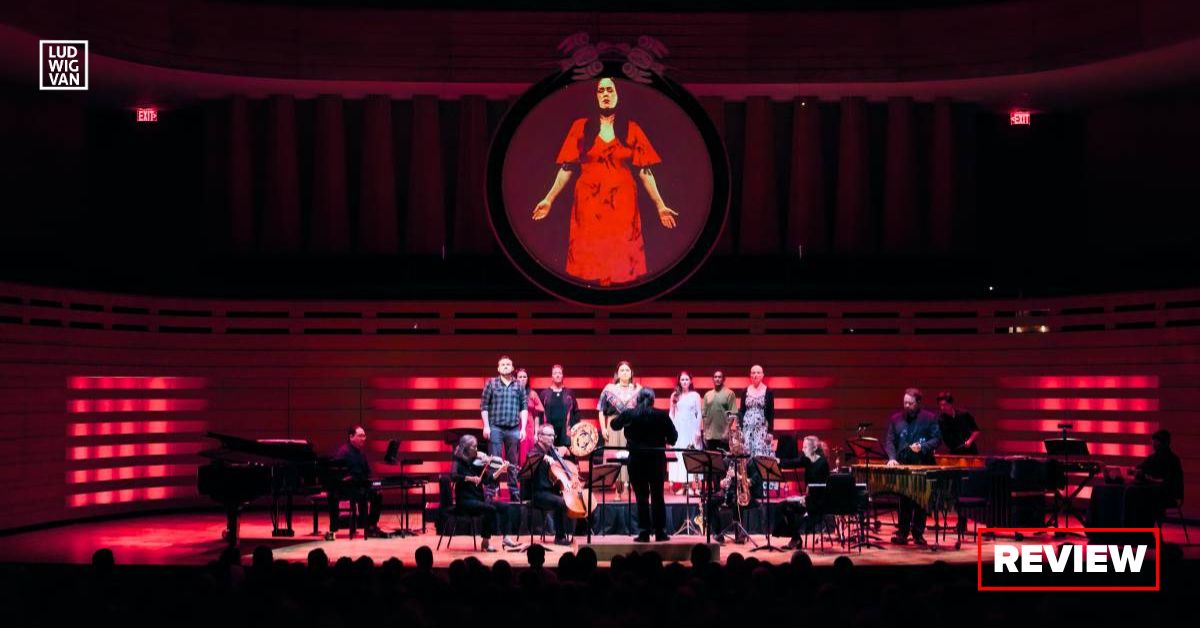
Toronto Summer Music: MISSING (concert performance) — Marie Clements, librettist; Brian Current, composer; Tim Long, conductor; Andy Moro, technical director, with CONTINUUM Ensemble: Leslie Newman, flute; Anthony Thompson, clarinet; Carol Fujino, violin; Paul Widner, cello; Gregory Oh, piano/electric piano; Ryan Scott, percussion; Michael Murphy, percussion. Cast (in order of vocal appearance): Ava: Caitlin Wood; Native Girl: Melody Courage; Jess: Andrea Ludwig; Devon: Asitha Tennekoon; Dr. Wilson: Marion Newman; Angus: Evan Korbut; Native Mother: Michelle Lafferty. July 24, 2025, Koerner Hall.
Gorgeous, shimmering music beautifully performed and sung that lays bare some ugly truths about Canadian society — Missing, a chamber opera by composer Brian Current and librettist Marie Clements saw its eastern Canadian debut as part of Toronto Summer Music last night.
While not entirely sold out, there was a sizeable audience that nearly filled the house and first balcony for the chamber opera, originally written in 2017 as a co-commission of City Opera Vancouver and Pacific Opera Victoria.
The story revolves around a young Indigenous woman who goes missing, and the rippling fall out, from her mother’s grief, to society’s denial and indifference, to the journey of one woman who comes to know her better, and understand. You can find the LvT interview with mezzo-soprano Marion Newman, soprano Melody Courage, and conductor Tim Long here.
It was a performance where everything hit the right note, from the composition itself to the production and performers.

Facts
A note about facts. Indigenous women make up about 4.3% of Canada’s population, but 16% of all female homicide victims, and 11% of missing women. The homicide rate for Indigenous women is about six times that of non-Indigenous women, and that jumps to 12 times if you count both missing and murdered.
There are no government statistics on the matter, but it’s estimated that about 4,000 Indigenous women and girls have gone missing or been murdered between 1956 and 2016.
Production
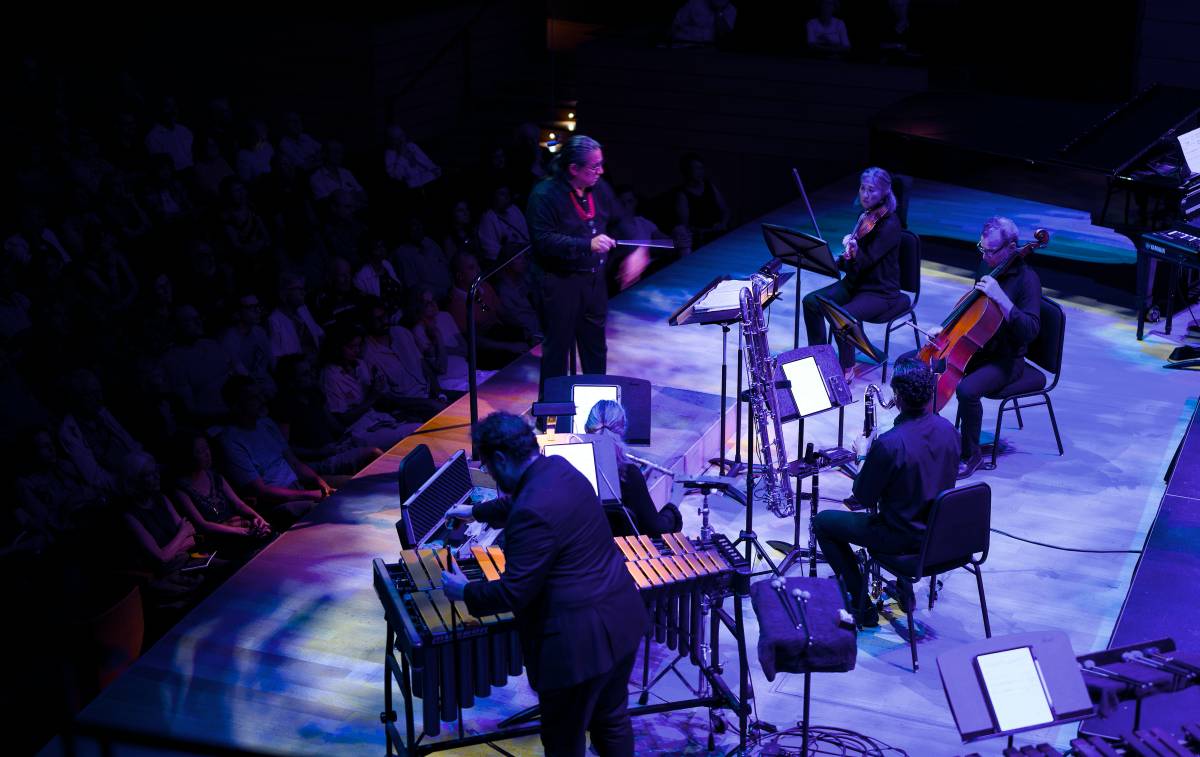
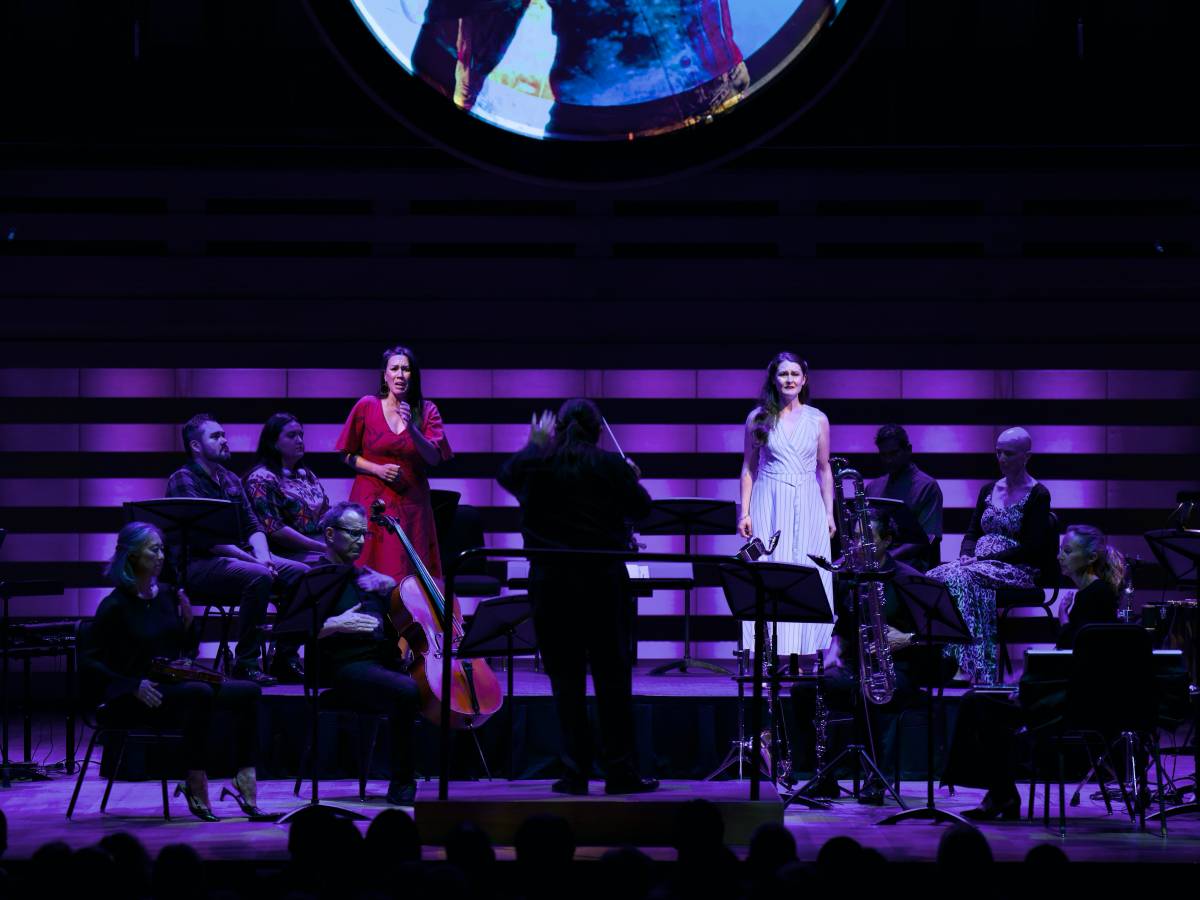
The Continuum Ensemble, with conductor Tim Long, took up the forefront of the stage, with the singers in a curve sitting behind them. As they sang, they’d stand and interact in the centre of the stage.
Just behind them, a round screen displayed a range of projections, new to this production, by tech wizard Andy Moro. They ranged from images of the characters, particularly Melody Courage’s missing girl, along with atmospheric and sometimes abstract elements that reinforced the storytelling.
The visual elements, including lighting, added depth to the concert format.
The libretto is written in both English and Gitxsan, an Indigenous language of the West Coast, with surtitles on the round screen.

Performances
The opera begins with music. Continuum Contemporary Ensemble have been breaking ground as leading exponents of Canadian contemporary chamber music, and they played Current’s atmospheric score with its shimmering beauty without a flaw. At some points, later in the opera, Marion Newman adds the beat of a hand drum, and it flows seamlessly into the music. With the able direction of Tim Long, they made a difficult score sound easy.
The story is set between Vancouver’s Downtown Eastside and British Columbia’s Highway of Tears, the notorious stretch of Highway 16 between Prince Rupert and Prince George where more than 80 women are known to have disappeared and/or been murdered since the roadway opened in 1969.
Projections show the Native Girl, still alive, hitchhiking by the road, already a memory. Ava, a young white woman, is haunted by the fact that she saw the missing woman on the road, and didn’t pick her up. She’s shattered by the experience, and looks for answers.
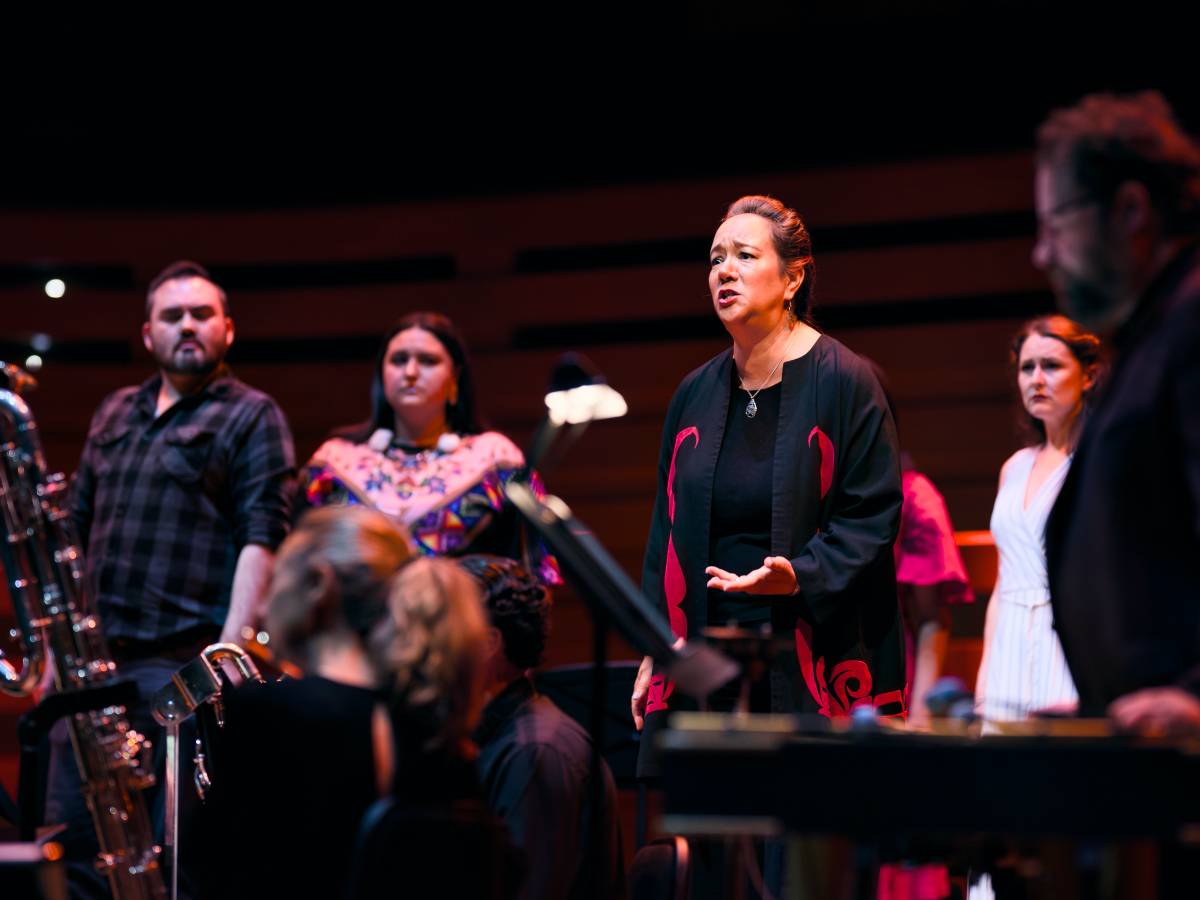
Throughout the story, Ava, who is pregnant, and her relationship with her partner Devon, sung by tenor Asitha Tennekoon, mirror and contrast that of the Native Girl and her partner Angus (Evan Korbut). Native Girl haunts her as a memory and ghost, one she sometimes interacts with. With the arrival of Ava’s baby, she understands the grief of Native Girl’s mother, performed by Michelle Lafferty. Along the way, she learns to speak Gitxsan with Marion Newman’s Dr. Wilson, and argues with Jess (Andrea Ludwig), a white woman who insists that “they” are different, and not deserving of as much attention.
“It’s about decisions,” she declares. What about drinking, and going to bars…? she asks.
Each of the roles adds a piece to the story puzzle, and each of the singers has a time in the spotlight. Early in the opera, Marion Newman’s strong voice passionately counteracts Jess’s disparaging comments. Newman has a powerful stage presence, and a convincing sincerity in her delivery.
Michelle Lafferty has one of the opera’s most affecting moments when she simply cries out in grief, holding her face in her hands. It’s one of the few moments in the piece where the projections show what is happening in real time, focusing on her face. Lafferty remained, head in hands, for several minutes.
Some of Missing’s lovelier musical moments came during duets between Ava and Devon, and Ava and Native Girl.
Caitlin Woods’ Ava is a solid centre for the story to unfold. Her voice quality ranged from strident to soft as the scenes required it, with clear diction and dynamic changes in volume and mood. She conveyed the journey from the opening’s shock and disorientation to understanding well.
Melody Courage had a difficult role as Native Girl, a figure who is sometimes a memory of who she was, sometimes a spectre that looks to connect to the present. She embodied them in a red dress, the symbol of MMIWG (Missing & Murdered Indigenous Women & Girls). We get glimpses of the playful young woman she once was, and Courage and Woods deliver a gut wrenching performance in the scene that describes Native Girl running through the trees in an attempt to escape her attacker, who remains a shadow.
Final Thoughts
Current’s layered score and Marie Clements’ poetic libretto tell a difficult story with an emphasis on its emotional basis, and that’s how the story connects with the audience. The beauty of the music softens the edges of the story just enough to make it absorbable.
There was an immediate standing ovation for the performance. Admittedly, Toronto audiences are known for their propensity to standing Os, but it came with an enthusiasm that couldn’t be denied.
- Opera and contemporary music lovers can enjoy the music anytime with a recently released recording of the opera [HERE].
- You can help the community-led efforts of No More Silence to stop violence against Indigenous women, girls, two-spirited and trans people [HERE].
Are you looking to promote an event? Have a news tip? Need to know the best events happening this weekend? Send us a note.
#LUDWIGVAN
Get the daily arts news straight to your inbox.