
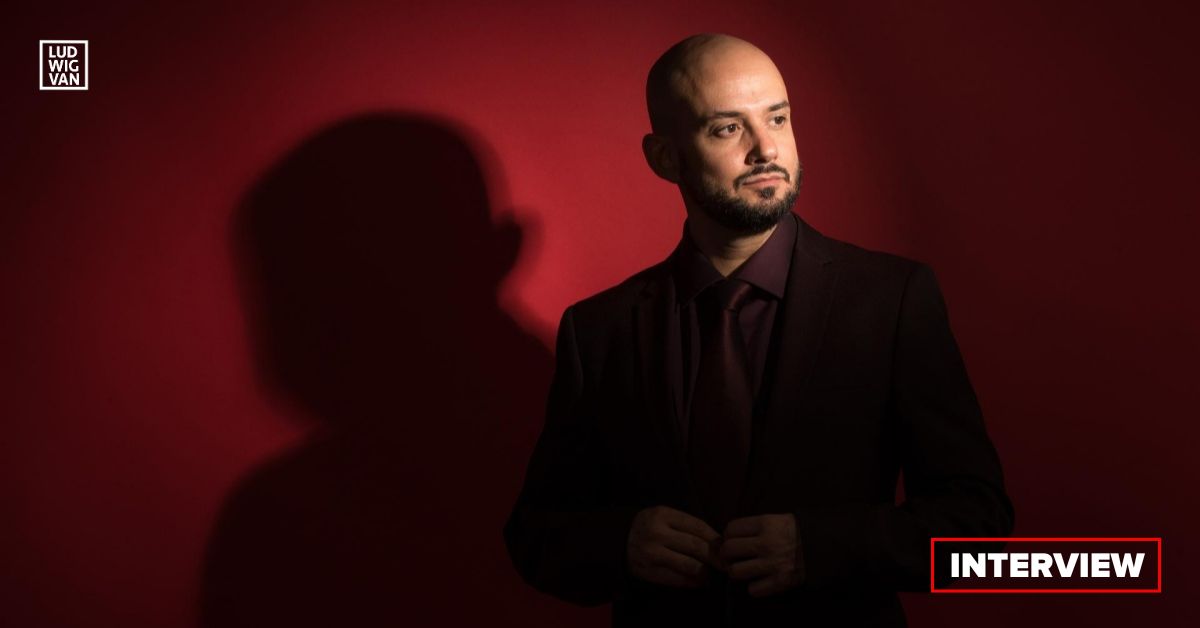
Argentine countertenor Franco Fagioli will be bringing an unusual program of music to Toronto Summer Music for his recital on July 29. The Orchestre de l’Opéra Royal de Versailles, with conductor Stefan Plewniak, will accompany him in Franco Fagioli: The Last Castrato.
The repertoire includes selections by Rossini, Nicolini, Bonfichi, Rode, Zingarelli and Mercadante, all of the songs written in the high register of the Italian castrato tradition, and many of them written for Giovanni Battista Velluti, the last operatic castrato of renown.
In February 2025, Fagioli released the album The Last Castrato: Arias for Velluti. Fagioli, who tends to specialize in Baroque and early 19th-century bel canto opera, has often showcased the repertoire of Italian castrati in his work.
Born in Argentina, Fagioli studied at the Superior Art Institute of the Teatro Colón in Buenos Aires. With a three-octave range, and mastery of technique, he won the Bertelsmann singing competition Neue Stimmen in Gütersloh, Germany, in 2003, and launched his professional career. He became the first countertenor to sign an exclusive contract with the venerable Deutsche Grammophon label.
We caught up with the countertenor, based these days in Spain, and currently on a North American tour, to talk about the music and the traditions embedded within it.
Fagioli sings Non lasciarmi in tal momento from Rossini’s Aureliano in Palmira:

Franco Fagioli: The Interview
The role of a countertenor in classical music isn’t so widely known as the choir classic SATB. How did Franco come to choose the role of a countertenor to pursue?
“It was a lovely shocking experience when I was a child, and I was chosen to sing in Mozart’s the Magic Flute,” Fagioli recalls. He was 11 years old.
“I think that was very strong for me as a child,” he says. “I still remember today the sound of the orchestra tuning.” He listened as the soloists performed their parts. “I think it was about that,” he says of the experience.
He’d begun to sing in school at age nine. “I was singing in the choir.” Before too long, the choir master had discovered his high singing range, and gave him soprano parts that would become the norm for him as a child.
“Even if I call myself a counter tenor because it’s a generic name, I sing in the soprano range.”
He began to study piano performance. “Then I started to study piano, and I was very focused on it,” he said.
But, despite his new emphasis on piano as an instrumental musician, that Magic Flute experience never left him. In Argentina, he didn’t find a context for his vocals.
“There, nobody told me, look, what you are doing is a voice that is used for opera,” he says. “For me, it was like a joke.”
At one point during his piano studies in San Miguel de Tucumán, he was looking to learn The Stabat Mater, a 13th-century Christian hymn to the Virgin Mary. He went to find a music store to buy an album as a reference for the work, and he recounts that there weren’t many devoted to classical music in the small city. He found one, and an album with The Stabat Mater, and as he listened to the soprano and alto voices, he had a revelation.
“[This is] what I do when I think I’m just playing around,” he recalls. “I said, oh my god, I want to do this. I want to do the countertenor path.”
It led to the career he has now. “I “discovered I had a mezzo-soprano register. I could have called myself a male mezzo-soprano,” he says, laughing. “That was how I discovered this path.”
He still traces it back to that early experience with The Magic Flute. “I think Mozart has a lot to do with it,” he says. One of his early recordings was devoted to the work of Mozart.
Once he’d made the switch to studying voice, and moved to Buenos Aires, his instructors focused on teaching him the bel canto technique from the outset. “I didn’t have anything to do with the British tradition of countertenors,” he notes. Instead, he moved straight into operatic repertoire — just like the castrati of old.

The Last Castrato
When it comes to the repertoire he loves and performs, he likes to dive into historical research.
“I love that,” he says. “I love to do deep — to know from where I’m coming.”
The Toronto show, and his last album (released earlier in 2025), focus on the legacy of Giovanni Battista Velluti.
Giovanni Battista Velluti was born on January 28, 1780, and was castrated by a doctor at the age of eight, ostensibly as a treatment for a high fever and cough. Originally destined for a military career by his parents, he was shifted to musical training. He’d become friends with the man who would become Pope Pius VII, and made his debut on stage at the age of 20.
His talent was recognized early on, and many of the composers of the day wrote roles specifically for him, including Rossini (Arsace in Aureliano in Palmira in 1813), and Meyerbeer (Armando in Il crociato in Egitto in 1824).
“The point is that Giovanni Battista Velluti was the last castrato on stage in the 19th century,” Franco explains.
In Italy, castrati existed from about the mid-16th century until the 18th, their popularity peaking between 1630 and 1850. Velluti was an anomaly in his time, and performed performed the last operatic castrato role ever written, that of Meyerbeer’s Armando, in Venice in 1824.
As Fagioli points out, while the art form was in the midst of change, with the heroic tenor replacing the role the castrato would typically take, composers still tended to write the music in a similar style. He cites Rossini and Bellini, who took inspiration from many of the structures and stylistic elements of Baroque opera into the new century.
“You can say that Italian opera has [no] interruption,” he says.
He links the bel canto tradition to the golden age of 18th century operas. “That’s why you will find in that Velluti album that I recorded some arias in the bel canto style,” he says. “There was this huge tradition that was still present in the 19th century.”
While musical traditions continued, however, the role of the castrato did not. It adds a sombre touch to Velluti’s work.

The Castrato Style
“I have this very deep love of 19th century music,” Fagioli says.
He’s released more than 20 albums of music, but says that, even in the early days, he knew an homage to Velluti would take shape at some point in his career.
“Velluti represents the end of a very specific way of the bel canto singing, which is based on improvisation and […] filling the music with the inspiration of the singer.”
The scores created for Velluti by various composers look deceptively simple. On the bare bones that the score provided, the castrato was to add his own embellishment.
Fagioli notes that an examination of the scores written for Girolamo Crescentini, another castrato who lived between 1762 and 1846, offers interesting insights into the art. “It was very interesting to see in the score,” Franco says, “[…] all the parts are written and finished. Then you see the part of the castrato, it looks like a very simple part. The composers knew, the castrato would finish the composition.”
It was a practice that would essentially die with Velluti. Rossini was one of the first to put an end to it in his own work. “All the fermatas are written by Rossini, all the variations,” he said.
It brings out a certain quality in the music. “It’s the kind of melancholy of an era that is changing.”
Still, he sees historical connections that stretch back over the centuries. “For me, Monteverdi and Puccini are deeply connected.”
For the singer, it was a rewarding experience. “It was very challenging. I love to meet the scores,” Fagioli says. “Nowadays, we would not be used to that. Rossini, Bellini, Donizetti — they put a structure to it,” he notes.
“For me, the challenge as an interpreter was to find a way that is mine, and also to homage this practice.”
It’s about connecting the virtuosity of Velluti’s technique to the more expressive style contemporary audiences expect.
“He uses many notes to say one word,” Fagioli laughs. “Nowadays, we need to find a way to go through that — to go more into the emotion.”
- Find concert details and tickets [HERE].
Are you looking to promote an event? Have a news tip? Need to know the best events happening this weekend? Send us a note.
#LUDWIGVAN
Get the daily arts news straight to your inbox.