

In three standout productions at this years Toronto Fringe Festival, the concept of rebirth — both personal and artistic — took centre stage. Whether that was through an investigation of the effects of artificial intelligence on our daily lives to a troubled legacy of an institutional theatre, these shows ask what it means to be born again, and, in the process, what it means to be alive.
Through music, dance and inventive forms, Reborn, Iris (says goodbye) and String of Pearls mine the possibilities and pitfalls of doubling, re-incarnation and possible resurrection.
What emerges from investigating these three shows is not a prescription for change, but a variety of portraits of transformation — by choice, by accident, and oftentimes, by force.
REBORN
Two Minds Productions/Creator: Nina Maria
Theatre Passes Muraille Mainspace
In the pre-recorded announcement that plays before Reborn, a 60-minute musical written by, co-composed and starring Nina Maria, we are informed that the show we are about to see is a work-in-progress and there are parts of it that are still raw and evolving, just like this amorphous world we live in.
Reborn is about a film actress named Cynthia Faux (Maria), who, in the process of filming a movie, signs away her identity to her production company, who can use her likeness for future AI replication, a decision that, along with her own inquiry about identity and womanhood, poetically bedevils her.
Directed by Percy Mullally, with fine lighting design by Danielle Carey, Maria commands the stage in a bewitching black dress and regal shoulder-length carmine gloves. In her aphoristic interior monologues, she delivers her lines with elan.
“The system does not want a heartbeat. They want a metronome.”
In a handful of moody songs (notably “A Crash in the System”), all of which carry the influence of the grand, operatic style of Lady Gaga (co-composed by Mike Kondakow) Maria is utterly rapturous.
I began to wonder how to describe Maria, a performer I was not previously familiar with, and in a satirical video segment later on in the show, an interview on “The Drew Perrymore Show”, the creators beat me to the chase by describing her as “magnetic,” “elegantly composed,” and “like an old movie star.”
Maria is the perfect medium to investigate the power of the second skin technology affords us, and the existential price we pay in that exchange.
“There’s truth in the blur,” one character ironically says — the same goes for this show too.
Rather than hide behind the tried and true (and frankly tiring) scaffold of a narrative, Reborn is a breezy, refreshing staging of pressing ideas about the future, and a showcase for an irreplaceable artist that should be on everyone’s radar.
- Continues to July 12; tickets and more info [HERE]

IRIS (SAYS GOODBYE)
Mixtape Projects/ Creators: Margot Greve and Ben Kopp
Soulpepper Theatre’s Michael Young Theatre
“Maybe we’re deleted,” the chorus sings of life after death. “Or reborn.”
Iris (says goodbye), created by Margot Greve and Ben Kopp, begins with its titular protagonist (Michelle Blight) flatlining and finding herself in the afterlife, which, through Alessia Urbani’s efficient set design, is envisioned as an airport.
With the assistance of a chorus made up of eight perfectly-cast attendants, Iris is ushered into the ways of a transitory realm in which, luckily, she is chosen to be reborn and offered a glimpse into the possible lives, and deaths, she might endure.
What distinguishes Iris from other musicals at Fringe is that of the 20 possible narrative avenues, each audience selects 8 from thematic clusters, making every performance a unique event, though, regardless of the variety, the ending remains the same. The performance I attended included the musical numbers “Chew,” “It’s My Party,” “Insignificance,” “L’Appel Du Vide,” and “Final Rest.”
As Iris studies her counterparts — played by Madelaine Hodges 賀美倫, Sydney Gauvin, and a spectacular Luca McPhee — thrive and, inevitably die, a realization emerges: in life, Iris, a writer and social-climber, appears to have been a narcissist whose behaviour effectively strained her relationships with her sister, her partner and her coterie of friends, who, in one scene, admit the only reason they tolerate her is because of how well-connected she is.
It is in these imaginings — meticulously choreographed by Alli Carry and beautifully brought to life by a live band — that Iris confronts who she was, and wonders if she wants live or face the uncertainty.
At 90 minutes, Iris (says goodbye) is a delightful, crowd-pleasing, well-produced flight that descends through the vagaries of one woman’s life, teeming with heartrending songs and memorable performances perfectly fit for a Mirvish stage.
“Iris is the gin,” the chorus sings, “and we are but the tonic.”
I have a funny feeling this isn’t the last we’ve seen of her.
- Continues to July 12; tickets and more info [HERE]


STRING OF PEARLS
Fuchsia/Playwright: Fuchsia Boston
Helen Gardiner Phelan Playhouse
After a week of sitting in the dark, the future of theatre remains unclear.
How might theatre companies remain relevant to this rapidly changing world and younger audiences coming from disparate backgrounds?
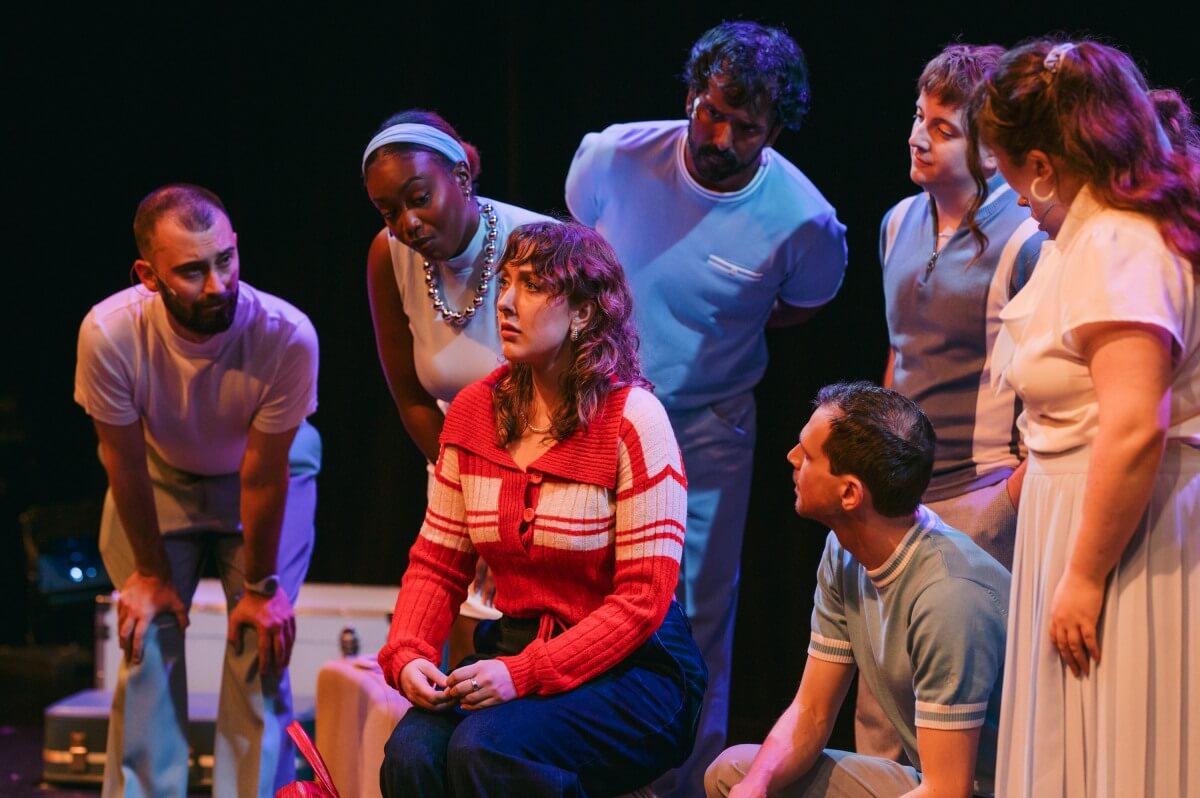
In String of Pearls, directed by Max Ackerman and written by and starring Fuchsia Boston, Richard (Fred Kuhr) has been appointed the artistic director of a flailing theatre company and, as he boisterously announces in his opening remarks addressed to the audience, he fully intends to change things around no matter what.
In a series of brief scenes, we gradually get to know the members of this company, which include two interracial couples: Aaron (Lucas Blakely) and Halle (Boston), the sort of couple who tend to quarrel amongst company, and Jed (Derick Materu) and Saul (Erik Bracciodieta, a comedic force), whose newly-formed bond is not a strong as it initially appears to be.
One of the primary concerns of the play is the function of race in these character’s lives, which is amplified when Richard decides to stage a play from the Antebellum-era that has Halle and Jed playing slaves.
“We can’t make change if we keep opening the past,” Halle urges in a conversation with Richard, who privately asks her not to speak her mind.
As the scenes, each as brief as they need to be, fade in and out, we watch as Richard’s vision gets larger — in one scene, local rappers are invited to the theatre to shoot a music video — and characters crumble against mounting pressures.
At just 45 minutes, String of Pearls doesn’t overstay its welcome, but its brevity works against it; the exploration of racial dynamics feels rushed — gestured to rather than developed or interrogated — and the theme of being “haunted by memories,” as noted in the artistic statement, lacks the emotional weight to resonate.
The play unfolds as a series of scenes, talking points, and sketches of complex ideas that, if more fully explored — and stripped of the spoken-word sequences that feel tonally out of place — might cohere into something insightful and formally audacious, but, more often than not, it leaves us in the dark with it’s intentions.
“He who walks in the darkness does not know where he goes,” Halle states.
Well, it is time for some light.
- Continues to July 12; tickets and more info [HERE]
By Nirris Nagendrarajah for Ludwig-Van
Are you looking to promote an event? Have a news tip? Need to know the best events happening this weekend? Send us a note.
#LUDWIGVAN
Get the daily arts news straight to your inbox.