
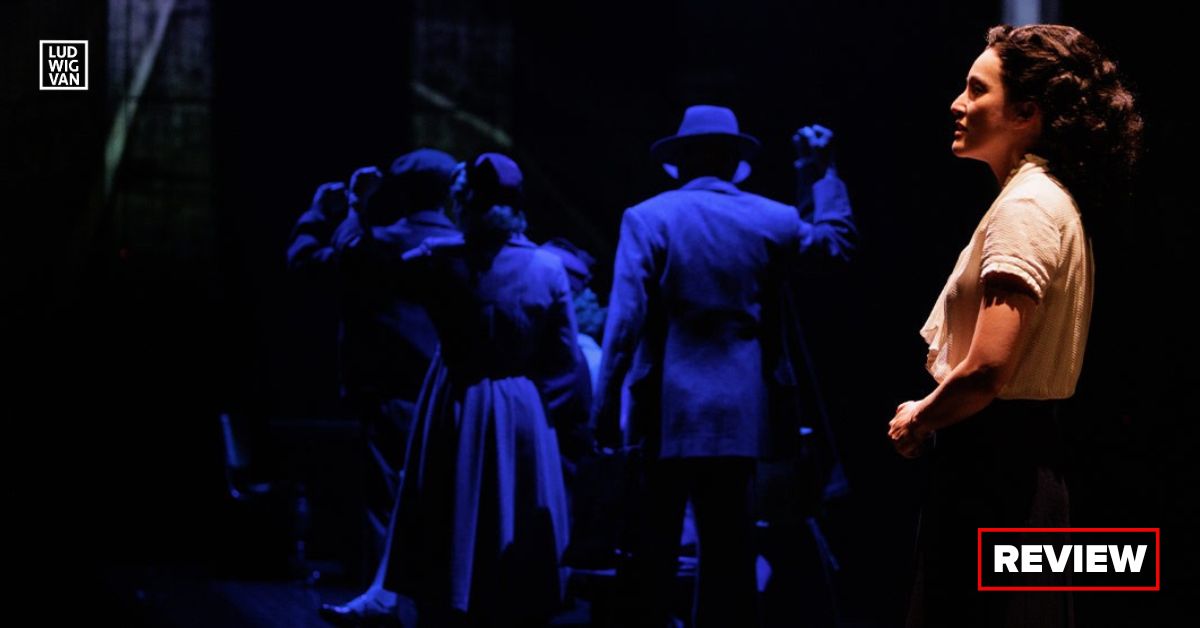
Stratford Festival: Forgiveness. Book by Mark Sakamoto; Adaptation by Hiro Kanagawa; Stafford Arima, director. Yoshie Bancroft, Mitsue Sakamoto; Jeff Lilico: Ralph MacLean. Tom Patterson Theatre, Stratford, ON. Continues until September 27, 2025. Tickets here.
After settling into my seat at the Tom Patterson Theatre, I realized that the two main performers of Stratford’s Forgiveness were already present on the elongated thrust stage.
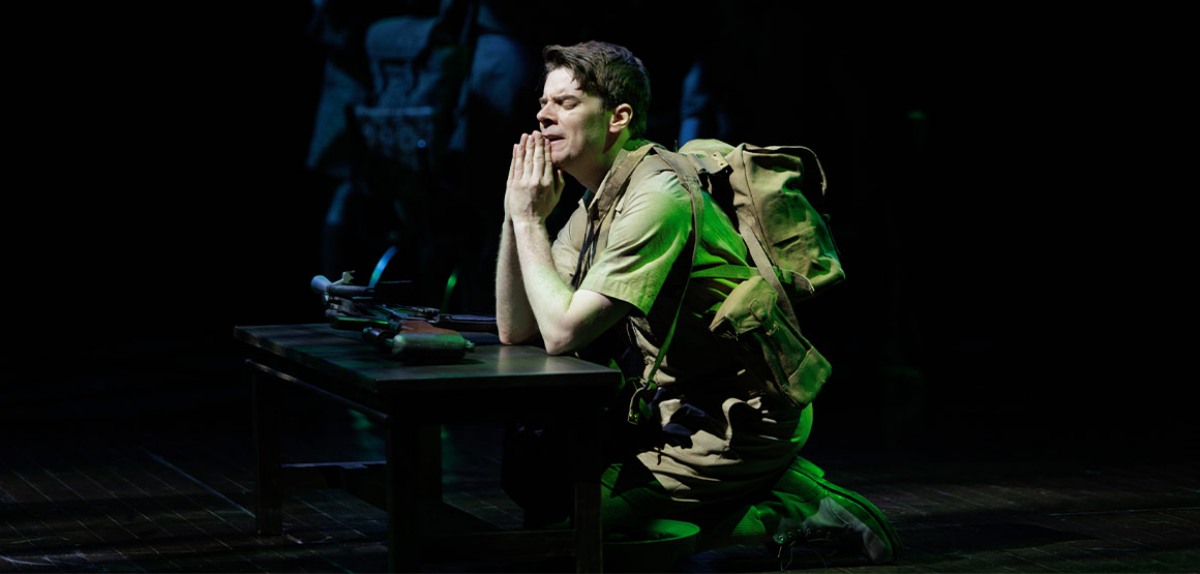
Directed by Stafford Arima, who, in his director’s notes, references the German dramatist Bertolt Brecht as an influence, we are invited to watch Yoshie Bancroft and Jeff Lillico as they study a series of evenly spaced, spot lit objects: a bottle of Japanese whiskey, an unfinished wood hockey stick, a suitcase with family photographs, an army backpack, and a bare manikin.
Over the course of the two-act play, adapted by Hiro Kanagawa from a memoir by Mark Sakamoto, these objects will reappear and, in the context of the story, be given a much deeper meaning, but first we’re made to wonder, to try to piece together the elements, like a memory.
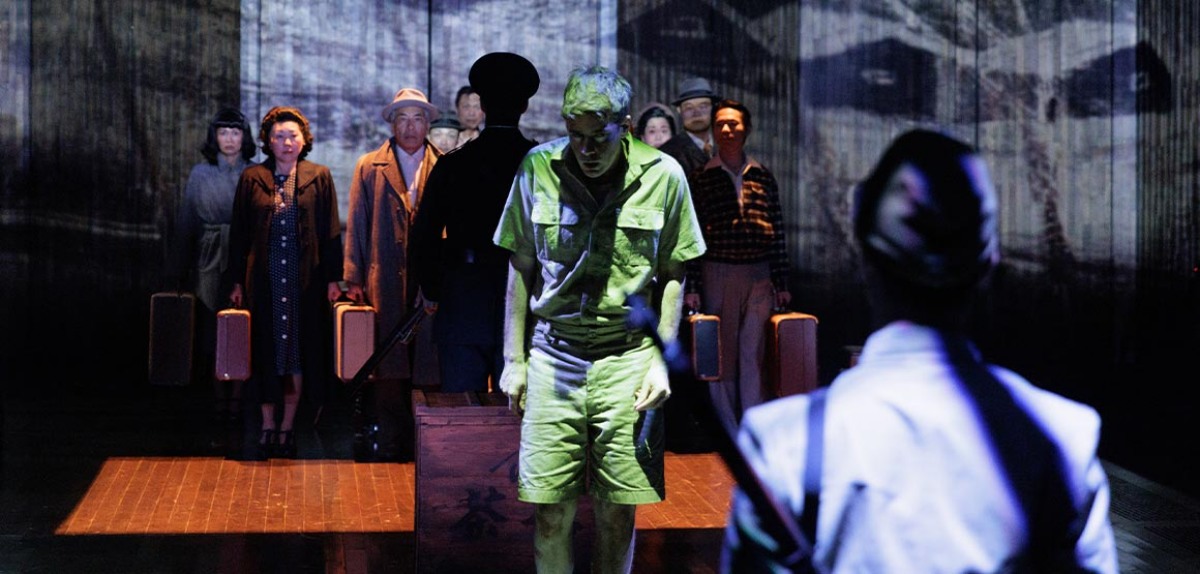
Forgiveness begins — as Sammy Chien’s projections on the walls of the theatre informs us — in Medicine Hat, Alberta in 1968. Mitsue Sakamoto (Yoshie Bancroft) is the matriarch of a Japanese-Canadian family that includes her steadfast mother Tomi (Manami Hara), her loving husband Hideo (Michael Man) and her son Stan (Douglas Oyama), who is in love with a Caucasian woman named Diane (Allison Lynch, who also serves as composer).
The anticipation, and the anxieties, surrounding a prospective dinner to which Diane’s parents are invited — most notably her father Ralph MacLean (Jeff Lillico), a war veteran suffering from PTSD — serves as the inciting event that inspires Mitsue and Ralph to take turns narrating a series of vivid, visualized flashbacks.

The Story
From 1936 to 1949, then, as their respective, distinctive experiences braid themselves together, we witness two sides of the coin of nations at war. Ralph, who joins the army to escape his alcoholic and abusive father, struggles, unlike his comrades, to locate his place in the carnage in foreign lands, which he luckily survives, instilling in him a haunting guilt (which is effectively amplified by Kaileigh Krysztofiak’s lighting design and Olivia Wheeler’s layered soundscape).
Mitsue, on the other hand, is the embodiment of a modern sensibility, with her dreams of becoming a teacher and discovering the love of her life, of defining for herself what it means to be Canadian, despite the fact that the changing world around her incessantly tells her she’s not.
In one of the more horrifying depictions of racism, early on in the first act, Mitsue is talking about boys with her best friend Miyoko (June Fukumura, a radiant presence in each of her supporting roles) when they are cornered by a trio of white boys, who excitedly hurl slurs in their direction, then promptly disappear, the sting of their violence lingering behind.
“It’s so hard to be Japanese,” Miyoko says, a line which Mitsue later reflects upon, and develops, after she passes away from a disease — “But you made it seem much easier.”
It is this inclination to look at the brighter side of things that gives hope to these earnest characters in the times they endure.
The Theme: Forgiveness
For Ralph, Christianity is a salvation, as is this particular passage from the Bible:
“And when you stand praying, if you hold anything against anyone, forgive him, so that your Father in heaven may forgive you your sins.”
It is the first time we hear of the concept of forgiveness, which is then put to the test as the injustices, the indignities, the crimes, the evil accumulates.
But, towards the end of the play, when it became clear to me that Mitsue and Ralph did not intersect in the past — that they would not be, in fact, forgiving each other — I realized I had mismanaged my expectations, assuming there would be a traumatic event shared between them.
Instead, their inevitable encounter has no catharsis or relief, just awkwardness and laughter.
Characters
Throughout the show, since Mitsue and Ralph are speaking to us from their present, we know whatever abuse, warfare or inhumane treatment they face they will survive, meaning that the stakes of the action are only ever superficial, creating that Brechtian distancing effect Arima wished to achieve.
But elsewhere, whether that be in dance sequences (choreographed by Stephanie Graham) or in the fight scenes (directed by Anita Nittoly), Arima also wishes to stun, to delight, to lighten the burden of the subject matter, which is never too dour to begin with.
More stirring emotions are evoked in the peripheries, with the plights of the supporting characters: Mitsue’s father for instance (played by Kanagawa himself) or Ralph’s friend Coop (a handsome, energetic Gabriel Antonacci).
As Hideo, Man exudes an affable charisma that forges a genuine chemistry with Bancroft, strongly rendering the cinematic romance of their relationship and the melancholy of their forced separation; the same goes for the shape-shifting Jacklyn Francis, particularly as Ralph’s mother, whose tender, parting embrace moved me.
Ralph vs. Mitsue
With Ralph — since Lillico’s portrayal of an innocent, sympathetic man makes us wince but never weep — the white audience members, who made up the majority of the audience I watched it with, could easily relate to his outsider perspective of the Asian identity.
With Mitsue — who the spritely, graceful Bancroft brings to life, and carries the show — as we hear about “going light on the soy sauce”, jokes about smelly food and repeated comments on the shape of eyes, the struggles of Asian-Canadians fall into cliches of representation.
In a key scene at the end of the play, for instance, the MacLeans are asked to remove their outdoor shoes and put house slippers on, and when Ralph, who is initially hesitant, instantly takes a liking to it, the audience roared with laughter, leaving an Asian-Canadian like me feeling numb, since I know connections like these, even if temporarily assuaging the anxiety of difference, can never bridge that gap.
When any of us participate in another culture’s customs and traditions, to step into their slippers so to speak, what we seek is comfort, and, if failing to do so, the illusion of understanding. But the truths of any culture — its histories, its alienation, its inner joys — are not easily translated to those who have not lived them.
Forgiveness suggests otherwise — supposing that virtue might melt the differences away and unite opposing parties, making the slippers a substitute for dramatizing the mutual discomfort such moments provoke. The emotional core of the show, then, remains out of reach, blunted by gestures like these, that, though well-intentioned, feel shallow, and reminiscent of the pat, sentimental resolutions found in a sitcom.
It made me wonder, again, who was doing the forgiving.
As the play has it, Ralph comes to terms with his survival and forgives himself. While working in the beet fields pregnant, Mitsue sings “O, Canada” as an ode, and later, as her new life begins, then views it as a lament, bringing herself to forgive the country she feels she belongs that tried to erase her and her people.
Whose Forgiveness?
As an entertaining, educational production, Forgiveness succeeds in juxtaposing two characters and two time periods caught in the stresses of uncertain political turmoil with an epic scope.
But, like a piece of gum, the longer you chew it on it, the more it loses its taste and the memory of it — like those objects at the beginning, which appear but unobtrusively so — changes texture.
As a text, though, authored by the Asian-Canadian imagination, in functioning as a palatable moral lesson to the majority on the ways that racism has operated throughout Canada’s history, it alienates the very minorities it claims to be speaking for, ending on an ineffectual image of a mixed-race, heterosexual couple embracing (in real life, they divorced in 1985).
Forgiveness is an ambitious work of nostalgia whose effectiveness depends on how forgiving of a mood you are in for the spectacles of a reconciliation devoid of a central truth.
By: Nirris Nagendrarajah for Ludwig-Van
Are you looking to promote an event? Have a news tip? Need to know the best events happening this weekend? Send us a note.
#LUDWIGVAN
Get the daily arts news straight to your inbox.