
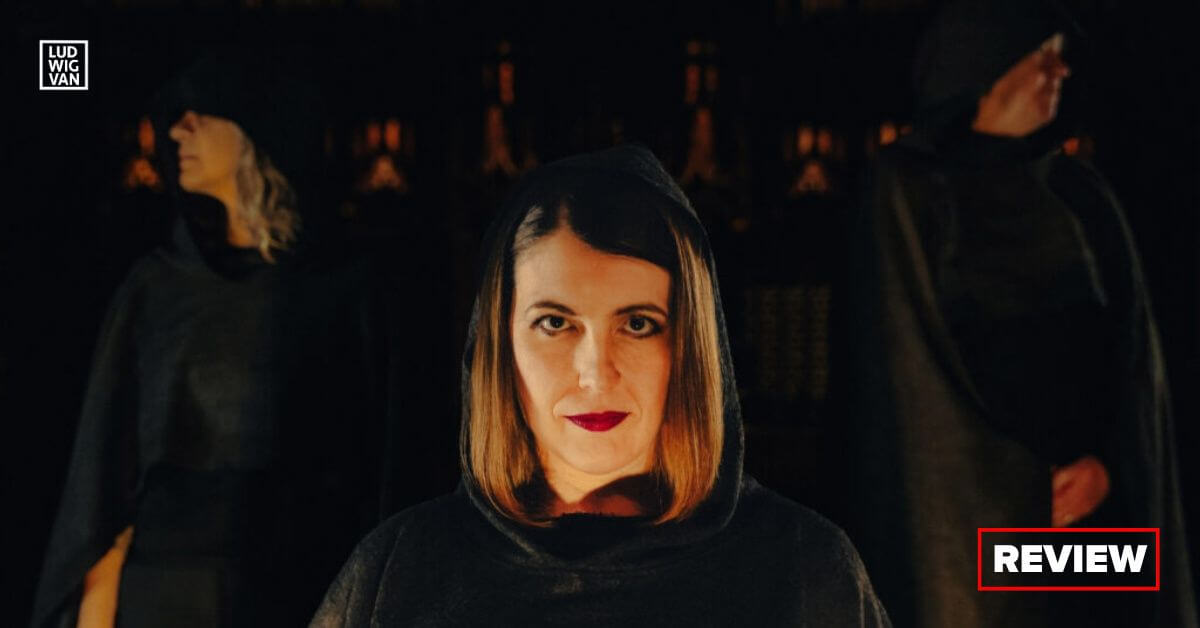
Luminato Festival & Tapestry Opera/Queen of the Night Communion, created and directed by Michael Hidetoshi Mori, music direction and arrangements by Kathleen Allan, with Dr. Jonathan Oldengarm, organ, and Hyejin Kwon, piano, Metropolitan United Church, June 6 & 7.
In the YouTube teasers that creator Michael Hidetoshi Mori made to pique interest in this innovative opera concert, he dropped tantalizing hints that the performance would be about secret societies and ritual ceremonies, and even more intriguing, personal grievances and rebellion.
This was, after all, the Queen of the Night Communion, so it made sense that it was this particular operatic lady who was assembling this clandestine gathering because no one else could possibly have a greater axe to grind then she did.
As Mori told us in both these teasers and the press material, this was opera that was going to be elemental, raw, urgent and transformative. For this communion, the queen was going to gather together the mad, the misunderstood and the magnificent.
Subversive Singing Souls
I’m calling these communion attendees damaged yet angry and even subversive souls. They included matched pairings: two Mezzo Sopranos, Krisztina Szabo and Alex Hetherington (with Szabo in charge of the lot), two Sopranos, Kathleen Allan and McKenzie Warriner, two Tenors, Mishael Eusebio and Ryan Downey, and two baritones, Alexander Hajek and Justin Welsh.
At this point let me say that this octet turned out to be a very impressive group of singers with full rich voices that carried beautifully to the impossibly high ceilings of the resplendent Metropolitan United Church. More to the point, and happily so, they were all superb singing actors which was an important necessity on this program.
Mori is credited as director. Overall, much more could have been done with movement. There were only a few times during the show where the movements seemed fixed or choreographed; much of the time, the singers seemed to mill about without form or reason. I wonder what more impact might have been created with more direction in that area.
The Repertoire
Where Mori did cover himself with glory was in choosing the highly imaginative repertoire. The audience was treated with an astonishing mix of religious anthems, opera arias, lieder, and art songs, some well known, others not.
Also, captivating were Allan’s arrangements that I promise you were absolutely original, even bordering the bizarre, because only occasionally did the music get performed as it was intended.
Take the “Habanera”, for example, which was sung by all eight singers as an ensemble.
Can you also believe that the organ accompanied the arias for the most part, with the piano occasionally supporting the art songs? Imagine the “Habanera” sung to an organ?
Yet the Communion was in a church, so somehow the organ contributed to the strangeness of the gathering, adding gravitas to what could be an otherwise amusing concept.
No one was laughing, however.
The evening began with the singers in the church balcony. First, there was the majestic organ “Recessional” by Karg-Elert, then the ardent music of Hildegard von Bingen. It was the “Flower Duet” that brought the singers down to the front stage through the side aisles past the heavy columns illuminated in purple.
The Setting
In fact, the church was quite dark for this performance with minimal lighting. It was hard to see the faces of the singers which made it difficult to know who was singing, but which added to the mystery I suppose. They were also wearing cloaks with hoods which also obscured who they were and some even had masks.
All four women were singing the “Flower Duet”, and I thought I could even hear some men. It was absolutely gorgeous, because it was like stereo coming from both sides of the church.
Now if a duet from Delibes’ Lakmé seems a might tame for a Queen of the Night Communion, remember the Datura flower lurks dangerously close in the jungle.
Themes
Even though Mori’s repertoire groupings were scattered throughout the evening, in retrospect you could see the cleverness in the programming if one followed his original idea.
We certainly had genuine madness represented in Ophelia’s hysterically rendered “Mad Scene” from Thomas’ Hamlet where the young singer really had to be calmed down. “Now the great Bear and Pleiades” from Britten’s Peter Grimes is very much regarded as a sign of Peter being unstable, and it was also included.
Another grouping were the selections exposing those determined to be deliberately provocative which can certainly cause damage, like the aforementioned “Habanera” from Bizet’s Carmen, and “Lied der Lulu” from Alban Berg’s eponymous opera.
On the other hand, “O Sailor” from Kate Soper’s opera “Here be Sirens” is interesting because the women do question why they are stranded on a rock having to lure men to their death.
For expression of identity crisis and inner turmoil, Mori made some great choices.
Both baritones as Rigoletto bitterly reflected in “Pari siamo” from the Verdi opera that the jester is the same as the assassin Sparafucile who kills with his dagger, while Rigoletto kills with his savage tongue.
The troubled young man in the aria “Last Night” from Gregory Spears’ opera Fellow Travellers is a devout Catholic agonizing over a homosexual encounter.
In Schubert’s “Der Doppelganger”, a man is caught in the psychological trauma of seeing an image of himself locked in the past of unrequited love. Mori effectively staged this by having a male cast member standing on a mounted block in the centre of the church, moaning in agony, his body twisted in pain as the singer, driven with passion, pointed to him in horror.
And then there was the morbid crowd obsessed with death. Needless “When I am laid in earth” from Purcell’s Dido and Aeneas was on the program, as was Rebecca Clarke’s haunting song “The Seal Man” where an innocent young girl is lured to her death by love and drowns at sea.
The atmosphere did begin to lighten as angers dissipated and emotions calmed The charming “Presentation of the Rose” scene from Richard Strauss’ Der Rosenkavalier led to couples dancing, some heterosexual, some not.
A Meditative Conclusion
So where in this mostly dark opera experience did we finally see our misfits and malcontents find their Moxy?
Well, that happened just before the religious ending, when, in tight formation, the octet marched defiantly down the middle aisle of the church belting out the Queen of the Night’s “Der Holle Rache” from Mozart’s The Magic Flute, the organ thundering in accompaniment.
It was quite a moment hearing that iconic aria as a mixed opera chorus.
The meditative ending included the beautiful “Regina coeli Laetare” from Mascagni’s Cavalleria Rusticana and Purcell’s reflective “Evening Hymn”.
The glorious organ Postlude by Charles Marie Widor and the religious ending took us full circle back to the organ Recessional and Hildegard von Bingen,
Why the religious bookends? These participants in the communion might be against the powers that be, and the injustices they cause, but they’re not against the inherent goodness of God, or so I think.
Final Thoughts
For the sheer glory of it, let us praise Dr. Jonathan Oldengarm and the magnificent organ at Metropolitan United Church, the largest instrument of its kind in Canada, and the majesty that it brought to the Queen of the Night Communion.
As I sat through the program, I realized on just how many levels I was enjoying the experience — the excellent singing, the unusual choice of repertoire and the even more unusual way it was performed, the very surprising use of the organ, and more to the point, the originality of the concept behind the concert.
Perhaps the biggest takeaway from the Queen of the Night Communion is the very important role that Tapestry Opera is playing in the creation of exciting new opera experiences.
Are you looking to promote an event? Have a news tip? Need to know the best events happening this weekend? Send us a note.
#LUDWIGVAN
Get the daily arts news straight to your inbox.