
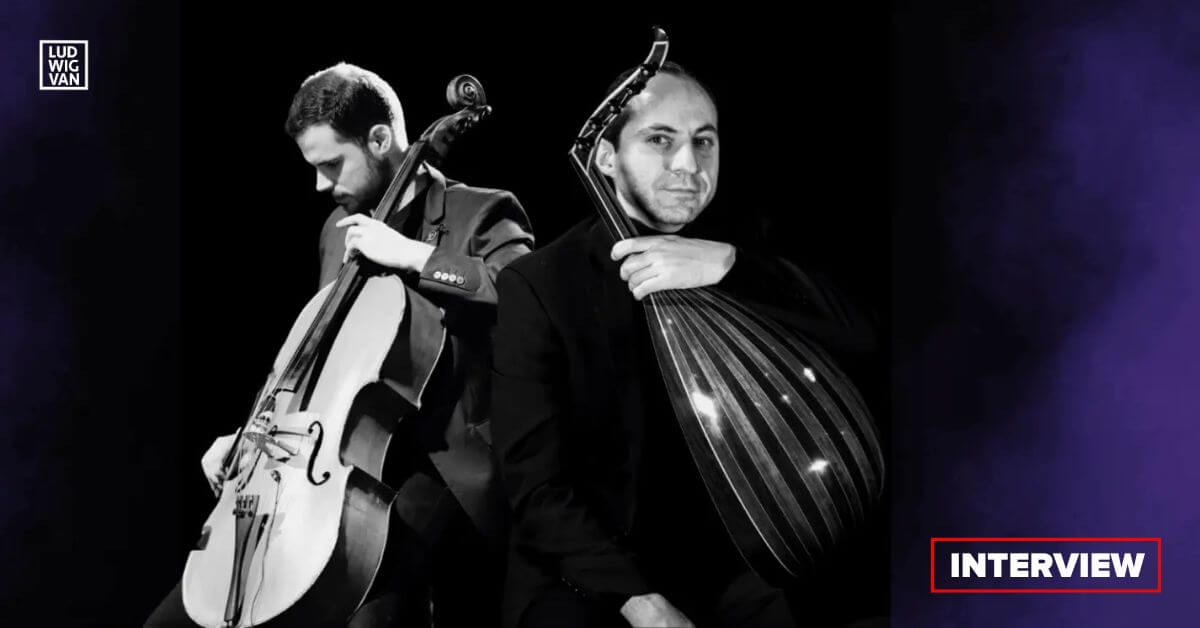
Transposition is the name of a musical project cross-pollinated by both Palestinian and Western classical music. Abdul-Wahab Kayyali, today based in Montréal, is an oud virtuoso. He’s teamed up with GRAMMY-nominated cellist Naseem AlAtrash to perform his original music.
The microtonal music of Arabic maqam and Western harmonies blend in an East-West fusion that composer Abdul-Wahab Kayyali calls neoclassical; the oud and the cello make harmonious collaborators, as it turns out.
The Transposition mini-tour will bring them to Ottawa on June 4, Toronto on June 5, and Montréal on June 6.
Abdul-Wahab Kayyali
Abdul-Wahab Kayyali originally studied the oud at the National Music Conservatory of Amman, Jordan. He also studied with Iraqi oud virtuoso Munir Bashir. As a soloist, he has performed throughout North and South America, in Europe and the Middle East. In 2020,he formed the global music trio Les Arrivants in Montreal, and released a debut solo album title Juthoor the same year.
Naseem Alatrash
GRAMMY-nominated Palestinian cellist and composer Naseem Alatrash is based in Boston. He has performed at venues such as the Kennedy Center, Lincoln Center, and the Monterey Jazz Festival in a career known for bending and blending genres.
Alatrash’s music blends jazz with Arabic music and contemporary influences, classical training with improvisation. Along with a busy solo career, he performs with the Turtle Island Quartet, Terence Blanchard, and Amir ElSaffar’s Rivers of Sound. He is an assistant professor of Cello at Berklee College of Music, and directs ensembles at Tufts University and Longy School of Music.
Abdul-Wahab Kayyali performs Ajam Improvisation, from “Les Arrivants” concert at Carleton College, April 20 2024:

Abdul-Wahab Kayyali: The Interview
How did he come to compose music for the duo of oud and cello? It’s not necessarily an obvious combination.
“I studied the oud at the National conservatory of music at Jordan in the 90s,” Kayyali explains. He began by giving about equal time to studying both the cello and the oud. The latter won out when it came time to make a choice.
“But I love the instrument, and it has a special place in my heart,” he says of the cello.
Kayyali lived in the US for a time, where he met and connected with cellist Naseem Alatrash. The two had discussed performing together, and had plans to begin in 2020 when the world of live music came to a crashing halt with the COVID pandemic.
“I kept holding on to the idea that one day, we’d be able to play together,” says Abdul-Wahab.
On his eventual arrival in Canada, Kayyali wasn’t working as a full-time musician at first. When he made that switch, it put him into a position to apply for funding to develop music for the oud and cello.
The Music
“The program basically consists of my compositions for the most part,” he explains. Most of the material was written over the last few years. “Two were composed specifically for this project.”
The results were initially recorded with another cellist based in Montréal, with a live performance that took place in Ottawa in 2023. “Since then, Nassim and I have been in dialogue trying to get this to happen.” The details finally came together last fall. “We’ve been working on it ever since.”
Despite their longstanding mutual interests, the Canadian mini-tour will be their first. “This will be the first time that we play together.”
Abdul-Wahab Kayyali and cellist Sheila Hannigan perform Kayyali’s Transposition: Duo for Oud and Cello:

Is it the Cello?
There are a few other notable collaborations between cellists like Naseem Alatrash, French cellist Vincent Ségal, and other instrumentalists that venture beyond the usual Western orchestration. Is it something about the cello…?
“I think honestly, if you have musicians that are open — the first thing you need to do, and I try to do this as well, is get out of your comfort zone,” Kayyali says. It’s about coming together to get used to performing in ways outside the usual. “[It’s] using their skill set in a creative way.”
He points out that Alatrash’s background is also Palestinian, so that even though he’s chosen to specialize in a Western instrument, the microtonal music is already in him and his imagination.
“This music does not sound foreign to him,” Abdul-Wahab says. “But I do think that the cello, maybe because of the register, is more forgiving of issues to do with intonation and tonality.”
A violin, he points out, would be more prone to problematic intonation. “I think the cello is a great complement to Arabic music.” The lowest C is the same on both the cello and oud. “For our two instruments, they match very much in register.”
Their differences and contrasts create interest, such as bowed vs. plucked technique, and the rhythmic possibilities of the oud. “I feel like that contrast is also complementary.”
If more and more musicians are using the cello outside the realm of Western classical music, it may just be that they are catching up to its adaptable nature. Surprisingly, there are few technical issues between the cello and oud.
“We tune the same, as long we tune to a particular reference — 440 or 442,” he explains. “We have sheet music, and it’s pretty detailed.” Naturally, that includes differences to the ornamentation and phrasing, along with other elements.
Creating Contemporary Palestinian Music
“I think about it as neoclassical, because it is classically informed,” says Kayyali. That includes both Western and Arabic classical music. “It’s a product of its time,” he adds, “or, I would describe it as contemporary microtonal music. The cello is able to play microtones.”
He treats both instruments as soloists, with passages where they play together. “I tried to find the right mixture and the right sounds.” The goal is to create complementary sounds. “It’s like having a dialogue. I can start a phrase, and the cello completes it. It really has to stand on both legs.”
Along the way, he hopes to showcase both instruments in novel ways. “It’s really trying to present these instruments in ways that they haven’t been presented.”
Final Thoughts
Naturally, in 2025, as a Palestinian, it’s impossible to escape current events. However, he doesn’t want the music to be experienced, or concert attended, solely because of his nationality.
“I want the art to stand on its own two feet regardless of its identity.”
Two of the compositions in the program were written specifically to revolve around the issues of Palestinian identity. “One was before October 7,” he says. The other was written just a few days after, after what he describes as a series of sleepless nights.
“I just had to empty it all on the sheet music in front of me,” he says. “It’s a very difficult time for our community.”
Music and identity, in the end, are inseparable, even as he’d like the music to be judged on its own merits. “This is our way of establishing our humanity,” he says. “I do want people to give the music a chance,” he adds.
“Honestly, the music is not bound by geography. For me, this is the promise of music, of art, is to challenge this idea that humans can be separated by anything.”
Even when it comes to purely aesthetic concerns, purity is another way of expressing exclusion — and sterility.
“Mixture usually produces better results,” he says. “Purity is an evil construct.”
While his primary instrument is the oud, one with a history that stretches back thousands of years, he uses it in a contemporary mode.
“I’m not thinking of it as a relic of the past.”
- Find more details and tickets for the Ottawa concert on June 4 [HERE], the June 5 concert in Toronto [HERE], June 6 in Montréal [HERE]
Are you looking to promote an event? Have a news tip? Need to know the best events happening this weekend? Send us a note.
#LUDWIGVAN
Get the daily arts news straight to your inbox.