
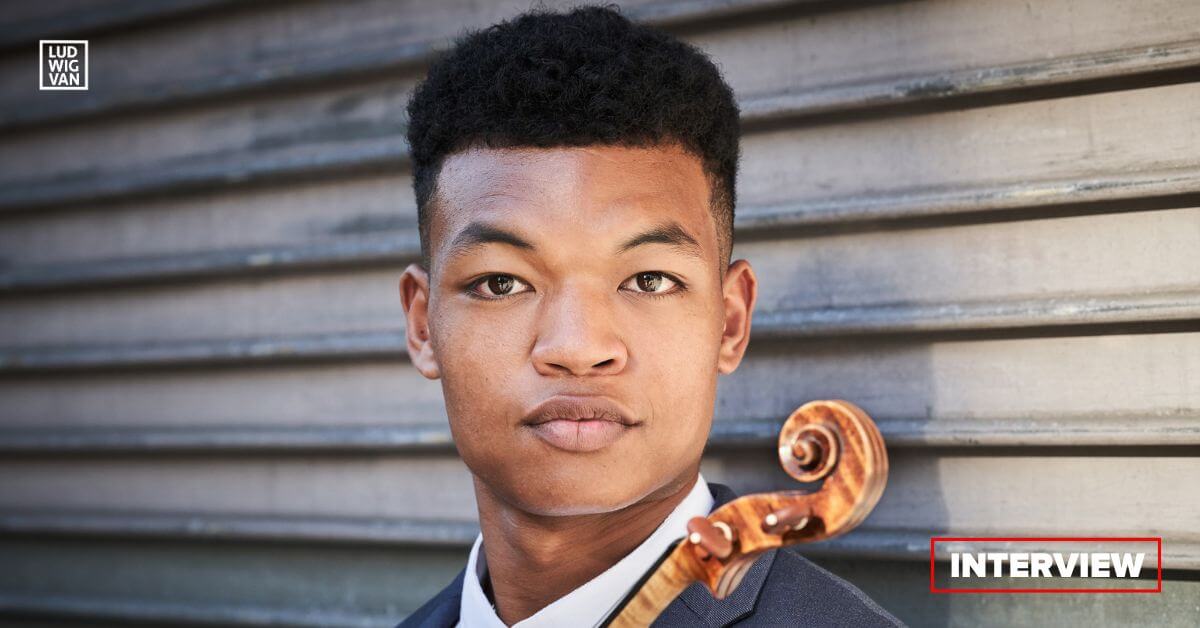
Violinist Randall Goosby will be performing a recital at Toronto’s Koerner Hall with pianist Zhu Wang on April 23. The recital tour of North America and beyond fits in between Goosby’s performances as an orchestral soloist.
They’ll be bringing an interesting program of music that spans a couple of centuries of music.
We spoke to Randall about the violin, and the music he’ll be performing.
Randall Goosby, violin
Goosby’s talent showed itself early, and he began studying the violin at the age of 7. At 9, he made his orchestral debut with the Jacksonville Symphony, and at 13, he performed with the New York Philharmonic in a Young People’s Concert.
From there, he went on to study at the Juilliard School’s Pre-College program with a full scholarship. He earned a Bachelor of Music studying with Itzhak Perlman and Catherine Cho, followed by a Master of Music from the Juilliard School of Music on a Kovner Fellowship, and then an Artist Diploma in 2022.
He was signed to an exclusive contract with Decca Records in 2020 at the age of 24 while still a student.
Highlights of his 2024/25 season include performances with the Chicago Symphony, Minnesota Orchestra, National Arts Centre Orchestra in Ottawa, the Orchestre symphonique de Montréal, and Netherlands Radio Philharmonic, and a tour with the London Philharmonic through the United States. His recital tour with pianist Zhu Wang has interspersed his orchestral concert schedule, with appearances in the US, Germany, and the Netherlands along with his Toronto date.
An avid chamber musician, Randall has spent his summers performing at the Perlman Music Program (which he is a graduate of), the Verbier Festival Academy, and Mozarteum Summer Academy, among others. He’s also taken the time to give back to the community, and has been involved with the Opportunity Music Project and Concerts in Motion in New York City.
Randall performs on the 1708 “Strauss” Stradivarius, on loan from the Samsung Foundation of Culture in Korea.
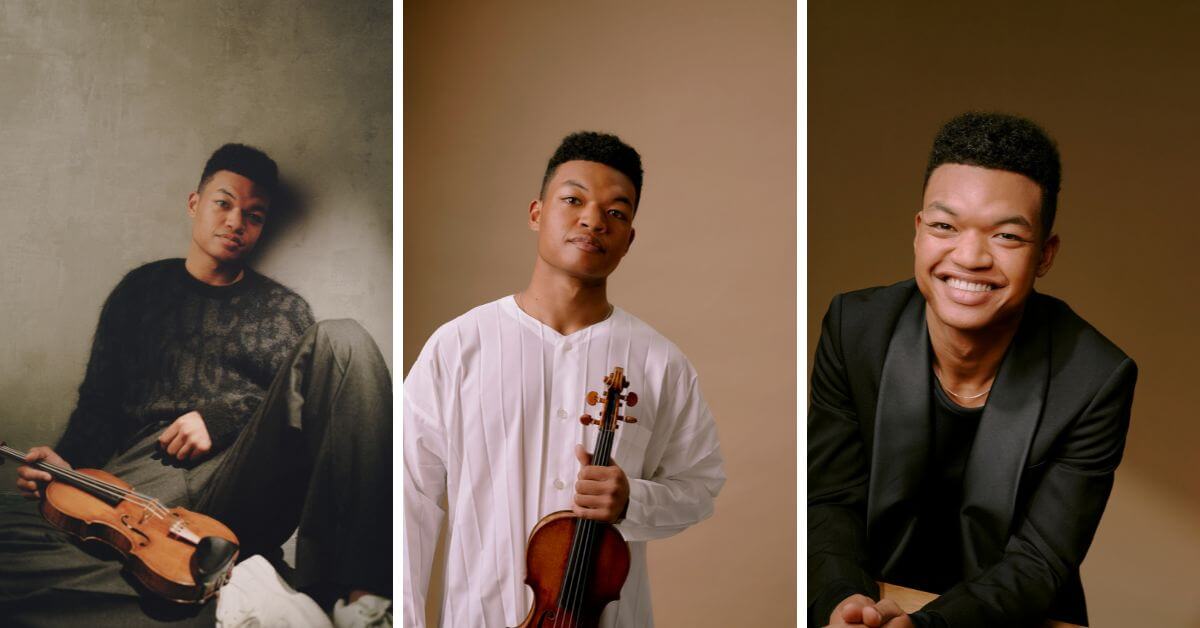
Randall Goosby: The Interview
Why the violin?
“It’s an interesting question,” Randall says. “My Mom basically implored myself and my younger siblings to play an instrument,” he recalls. “I was six years old. I chose the violin.”
His mother was delighted, but not so sure of the next step — how to get an instrument he could play as a child. They found a local music store with a helpful owner.
“He said, you know your son is quite young, and his hands are small,” says Goosby. The music store owner’s theory was that violin was especially difficult for small hands, leading to many kids quitting too soon. He suggested beginning with the piano.
So, Goosby began with the piano, but it was problematic.
“I didn’t take super well to it.”
According to his Mom’s recollection, his interest in learning music quickly began to fade, but was quickly regained when he finally got a violin in his hands.
“My hunger for learning the violin had an opportunity to grow,” he reflects of the delay. It built up his enthusiasm. “I don’t think I considered any amount of playing to be practice,” he says. That spirit continued for years. “I would come home and throw open the case and play.”
While the choice of a small child may seem random, in this case, it was intuitive.
“In some ways I think it chose me.”

Opening Up Classical Repertoire
Goosby has made it part of his musical practice to incorporate the work of historically neglected composers. What does it mean to highlight the work of these under-represented artists?
“Well it means a number of different things,” he explains. “It certainly relates to programming.”
While the usual catalogue of classical music works drawn from the centuries seems vast, it doesn’t take much study to realize how narrow a view the classical canon represents. It’s not a matter of throwing all that out the window. As Goosby points out, those iconic works and composers are still alive for a good reason.
“There’s a reason they’re still revered,” he says. “I think there’s always going to be a place for those works.”
Adding the work of other composers doesn’t take away from that; it creates an environment that’s more appealing to listeners of different backgrounds and cultures.
“I was raised and trained in very traditional [repertoire],” he says. “I didn’t even know composers could be non-white until high school.” Goosby credits his involvement with The Sphinx Organization, which looks to make classical music more accessible to Black and Latino communities, with broadening his horizons.
“With the help of the Sphinx organization, I became aware that composers could really be anyone,” he says.
He would become the youngest recipient ever to win the Sphinx Concerto Competition, which led to a number of key opportunities. Along with those, he became more and more convinced of the value of including as many musical sound worlds and landscapes, and as many stories, as possible into his music practice.
“I’m very passionate about music education.” Sharing not only the music, but the idea of a musical career and music education, particularly to under-serviced communities, can change lives. He’s living proof.
When he has a little extra time to squeeze into his busy performing schedule, he reaches out to local schools and institutions to offer to play.
“To make people aware of what I do and why I do it,” he says, “to spread the love and the joy of music.”

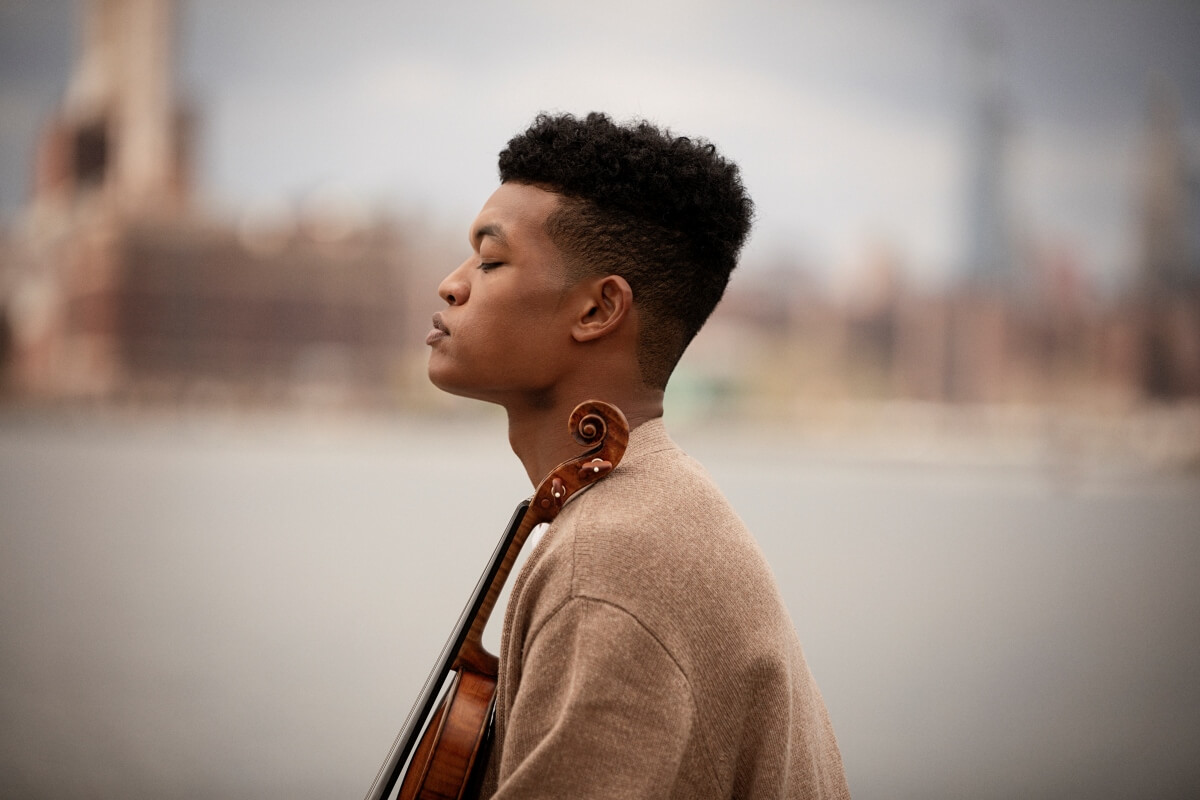
The Toronto Recital
The program for his Toronto recital includes:
- Joseph Bologne, Chevalier de Saint-Georges: Allegro and Rondo gracioso from Violin Sonata No. 3 in G Minor, op. 1a
- Gabriel Fauré: Sonata No. 1 in A Major, op. 13
- Ernest Chausson: Poème, op. 25
- Franz Schubert: Rondeau brilliant in B Minor, D. 895
“It starts with a very early sonata of the Chevalier de Saint-Georges,” he notes.
Bologne’s Opus 1 was completed when he was still quite young, as Goosby points out. He was still finding his voice as a composer, and the piece has a similar feel to early Mozart sonatas. The violin, perhaps surprisingly, has a supplemental rather than starring role.
“We start there and move through the evolution of classical style, and also French style,” Goosby explains of the program. “After that we jump forward about a hundred years to the very beautiful sonata by Gabriel Fauré.
In contrast with the Chevalier de Saint-Georges, whose talent was recognized early, Fauré was in his 30s when he wrote his Sonata No. 1 at the request of a good friend. Zhu Wang and Randall are also great friends.
“We’ve been friends and collaborators for five years now.”
Despite the century in between them, he says Fauré’s sound world is “not too far removed” from Bologne’s.
“After Fauré, we stay in France.”
Ernest Chausson was born into a wealthy family, and studied law to please his family. He was appointed a barrister, but his heart was drawn to the arts.
“It’s probably his best known work,” Goosby comments of his Poème, op. 25. “Its very interesting to think that someone back then would take a really hard pivot and say, I want to go into music.”
The piece was written for superstar violinist Eugène Ysaÿe, who’d actually requested a concerto, but Chausson didn’t feel up to the longer work.
“It’s pretty overtly programmatic,” Goosby explains.
The poem in question is The Song of Love Triumphant by Ivan S. Turgenev. “It’s a fairly dark subject matter.” The poem talks about a love triangle gone wrong, in essence. “If you read the book first, it will add to thematic [appeal],” he says. “It really changed my perception of the piece.”
Musically, it’s quite demanding. “The music really highlights every possible range of the violin,” he adds.
“I would almost say these two French works are farther apart than the two that open the program.”
To complete the program, he turns to the late, late Classical era.
“We have Franz Schubert.”
The program opens with the Chevalier’s earliest work, then two that stem from the middle ground of the artist’s compositional life. Schubert’s piece, as Goosby points out, was written just a few short years before his death.
“There was something that drew him back to this instrumentation,” he says. “It has an extremely intense, dark, stormy introduction.” That gives way to a completely different mood. “It’s full of surprises at every turn […] from the clouds to the dirt. It’s an incredibly dynamic work.”
It’s a logical and appealing finish to the program.
“It’s a fun and in some ways lighthearted way to wrap up the concert.”
As someone who spends the majority of his time as a soloist, he appreciates the opportunities a recital offers. “It’s not often that I get the chance to perform these works. The more music, the merrier.”
Chamber music, without a conductor, is also a different experience for the musicians.
“I think it leaves a lot of room for spontaneity,” he says.
“It’s a healthy kind of volatility.”
- Find more details and tickets for his recital with pianist Zhu Wang on April 23 at Koerner Hall [HERE].
Are you looking to promote an event? Have a news tip? Need to know the best events happening this weekend? Send us a note.
#LUDWIGVAN
Get the daily arts news straight to your inbox.