
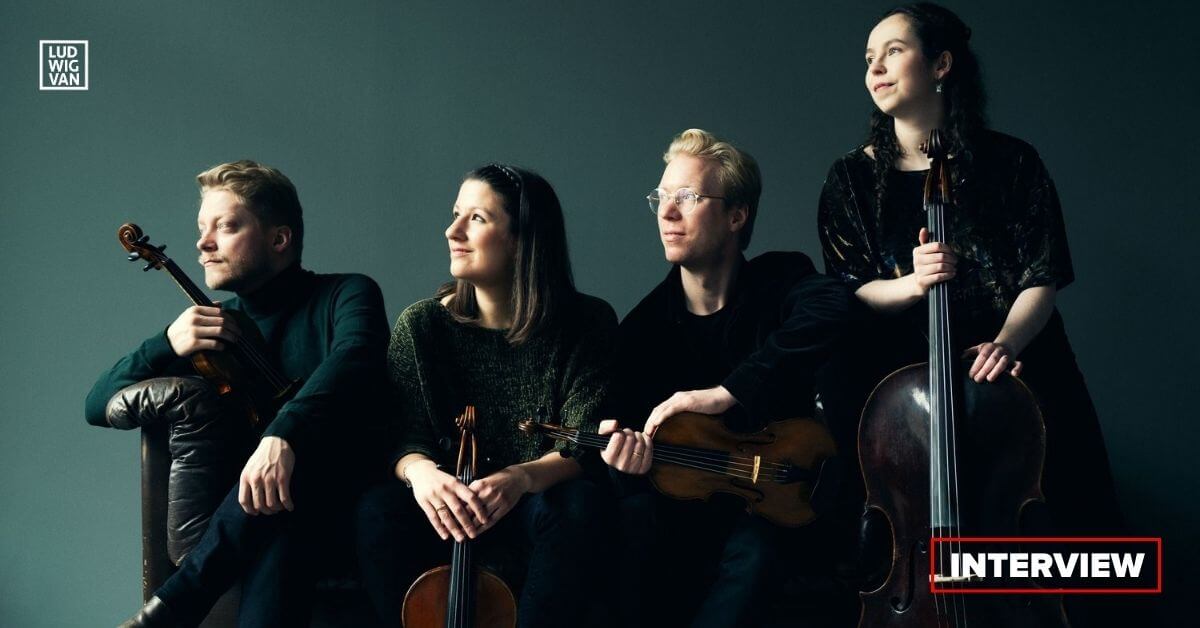
The Marmen Quartet will be kicking off their North American tour in Toronto on March 13, followed by Texas and New Orleans before heading back to Europe. The concert is part of the Music in the Afternoon series at the University of Toronto’s Walter Hall.
Based in the UK, the Marmen Quartet is: Johannes Marmén, violin; Laia Valentin Braun, violin; Bryony Gibson-Cornish, viola; Sinead O’Halloran, cello. 2019 was a banner year for the young quartet with double wins of Grand Prize at the Bordeaux International String Quartet Competition, and joint First Prize at the Banff International String Quartet Competition.
It set their course for a career that has included extensive touring, as well as recording. Their 24/25 season includes recitals in Wigmore Hall, and in Cambridge, UK, Frankfurt, and a week at the Ortús Chamber Music Festival in Cork, Ireland.
Their recent release (January 2025 on the BIS label), titled György Ligeti: String Quartets Nos. 1 & 2; Béla Bartók: String Quartet No. 4, is garnering excellent reviews, with writers noting the energy and vitality of their interpretations.
For their Toronto afternoon concert, they’ll be performing Haydn’s Op 33 No. 2 “The Joke”, Bartók 3, Debussy’s String Quartet Op 10, and “Heal” by New Zealand composer Salina Fisher.
The Toronto performance is long awaited; it was originally scheduled, and then cancelled, during the pandemic.
We caught up with Johannes Marmén to ask a few questions about the ensemble and what they’ll be bringing to their Toronto concert.

Johannes Marmén: Q&A
LvT: The quartet was formed in 2013 while you were studying at the Royal College of Music — did you think you would still be performing together a dozen years later? To what do you attribute your longevity as an ensemble?
JM: When we started the quartet, we didn’t have professional ambitions, we simply wanted to enjoy the rehearsal process and diving deeper into music by Haydn and Beethoven. In a way, I think this feeling of joy in rehearsals and love for the music is what underpins our wish to keep going.
LvT: Your success at two international competitions came just before the pandemic shut everything down as far as touring for some time. Yet, you seem to have recovered your momentum, at least this year. How did you weather the pandemic, and the transition back to live performance?
JM: One of the effects of the pandemic was that our 2020 schedule ended up being spread out across several years, which was in many ways a good thing. Before the competitions, we had worked incredibly hard and barely seen our families for months, so this forced sabbatical wasn’t as disruptive as one might imagine. It was very disheartening work to be constantly dealing with cancellations though, and not knowing when things would be back to was both a mental and technical challenge.
LvT: About the repertoire for your Toronto recital — including a piece by New Zealand composer Salina Fisher. The quartet also commissioned a piece from her during the pandemic. What is it about this composer that draws you to her work?
JM: We love how Salina’s musical language communicates directly and universally, and also that we have a personal connection to her. She is a childhood friend of Bryony’s (our viola player). This particular piece also fits very well into a variety of programes which makes it very versatile and rewarding to play in various different contexts.
LvT: As far as other repertoire, the quartet seems to have a wide range in terms of style and era. What do you look for when it comes to what you would like to add to your repertoire? What kinds of works do you enjoy?
JM: At any given time we have a backlog of pieces that we all love and want to learn. This selection to some extent reflects our preferences or taste as a group. More now than ever though, which of those pieces is next to make it into our repertoire depends on things like recording plans, special performance projects or themes in festival engagements. As a very blanket statement though, we enjoy playing pieces that encourage rigorous discussion, significant amount of rehearsals and stimulating performances!
LvT: For your recent release on BIS Records, you’ve chosen masterpieces from the 20th century repertoire for string quartets. Why these pieces (to put it simply)? What qualities drew you to them? Do you have a plan for future recordings — i.e. focusing on specific pieces or periods?
JM: We had been playing Ligeti’s first quartet for a while when we started discussions with BIS Records. They loved our rendition of it in concert and suggested that we build a debut album around it, and quite logically we ended up with Ligeti’s second and Bartók’s fourth to complete the disc. There are so many qualities in these pieces that we love; the rawness, the boldness, the commitment to pushing boundaries of sound and expression. When it comes to future recordings we already have one album ready for release in 2026, with Debussy, Takemitsu and Ravel. Further down the line we have plans on recording Haydn, more Bartók and hopefully lots of other exciting things as well!
- Find more information and tickets to the March 13 concert [HERE].
Are you looking to promote an event? Have a news tip? Need to know the best events happening this weekend? Send us a note.
#LUDWIGVAN
Get the daily arts news straight to your inbox.