
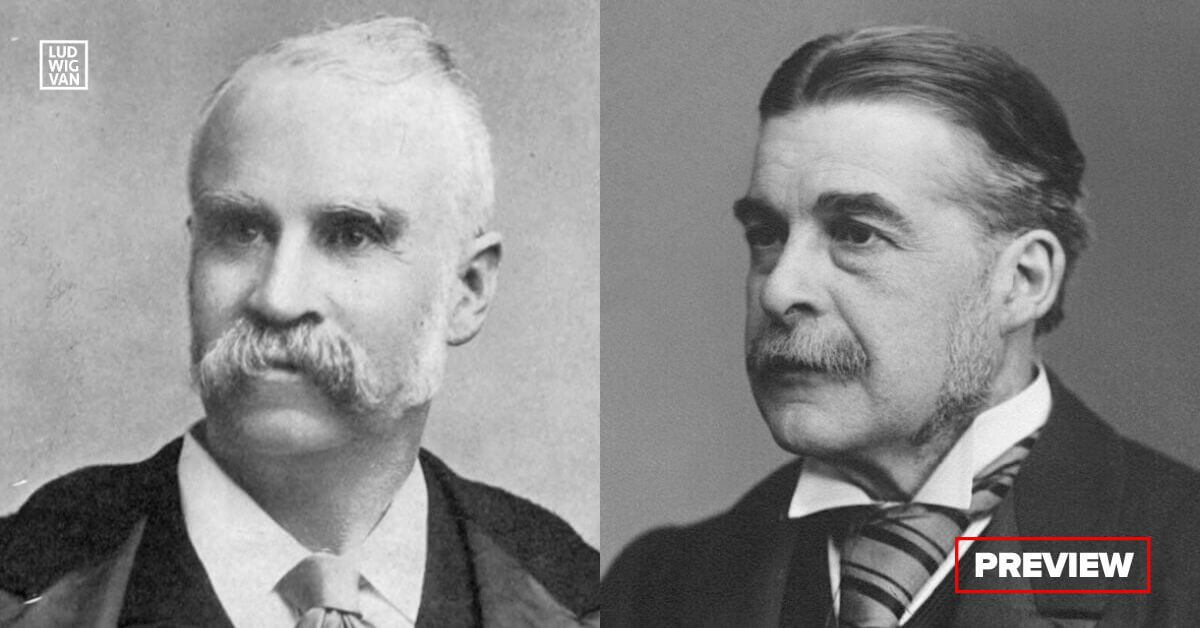
Hamilton’s Bach Elgar Choir is presenting Gilbert & Sullivan’s Trial by Jury, along with other operetta excerpts, at their next concert. Taking place on March 8, the concert also happens to coincide nearly to the day with the 150th birthday of the comic opera.
Gilbert & Sullivan were known for their memorable melodies and witty, observant lyrics. Their comedies may tackle serious topics, but always with a softer edge.
That’s the case with Trial by Jury, which skewers the legal profession.
Gilbert & Sullivan: Trial by Jury
Dramatist/librettist W. S. Gilbert (1836–1911) and composer Arthur Sullivan (1842–1900) teamed up to create 14 comic operas between 1871 and 1896. Gilbert’s librettos created fanciful worlds where anything was possible, and moments of drama and comedy blended together in the story.
Trial by Jury, a comic opera in one act, was first produced on March 25, 1875, at London’s Royalty Theatre. It was a hit on its premiere, and ran for 131 performances in its initial engagement. It was first staged with a companion piece, Jacques Offenbach’s La Périchole, which has since fallen into obscurity.
During the Victorian era, British common law included what was called a Breach of Promise that applied if a man had become engaged to marry a woman, but wanted to back out of the deal. In such a case, his fiancée could actually sue him for damages. As a point of fact, that law was only repealed in 1970.
In the story, The Plaintiff is a woman who’s asking the court for substantial damages because the man she loves has broken a promise of marriage. The Defendant, in his turn, asks the court to make any damages minimal, because he’s broke.
There is much witty arguing, and The Defendant eventually offers to marry them both. That, of course, is illegal, so more arguing ensues. Eventually, The Judge decides… to marry her himself.
We’ll leave the politics of the story, as well as its ending, in the realm of the absurd.
Gilbert had written a quick sketch of such an operetta back in 1868 for a comic illustrated piece in Fun magazine. Gilbert had trained and practiced briefly as a barrister, and he used that experience to pick apart the process with a comic lens. He manages to take on the legal system itself, along with lawyers in particular.
An example of his comic genius from “The Judge’s Song”:
When I, good friends, was called to the bar,
I’d an appetite fresh and hearty.
But I was, as many young barristers are,
An impecunious party.
I’d a swallow-tail coat of a beautiful blue –
A brief which I bought of a booby –
A couple of shirts, and a collar or two,
And a ring that looked like a ruby!
The second half of the concert will present a selection of scenes from the Gilbert & Sullivan repertoire, showcasing the best of their trademark wit and theatrical flair, along with the irresistibly hummable music. Members of the Hamilton Philharmonic Orchestra provide the instrumental accompaniment.
- Find information and tickets for the March 8 performance by the Bach Elgar Choir [HERE].
Are you looking to promote an event? Have a news tip? Need to know the best events happening this weekend? Send us a note.
#LUDWIGVAN
Get the daily arts news straight to your inbox.