
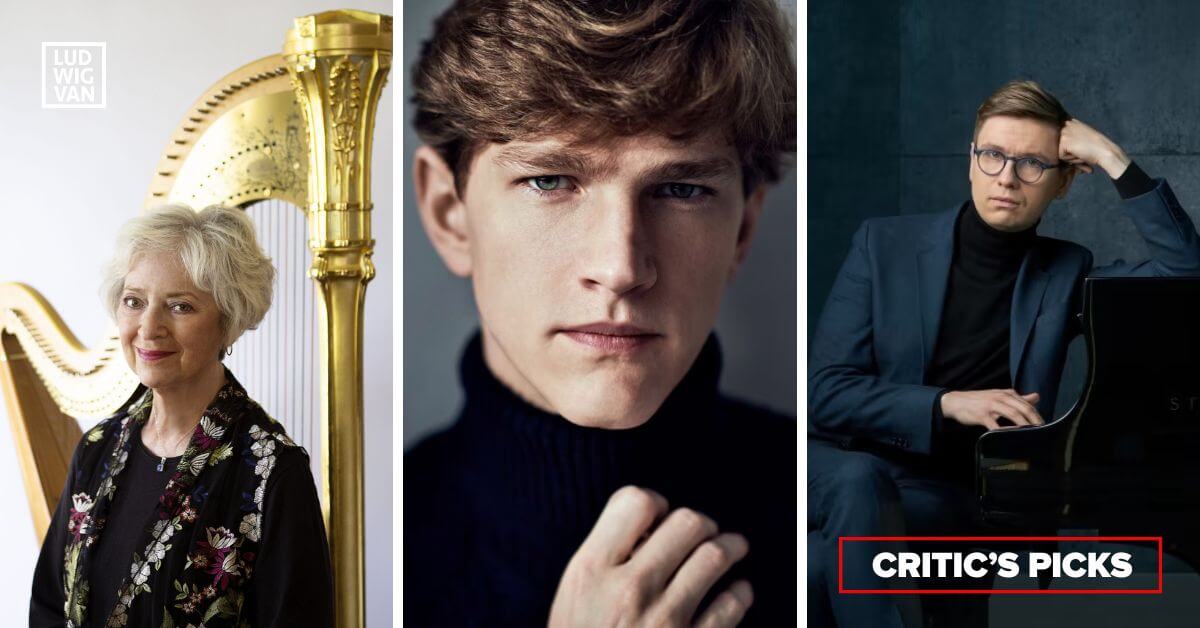
This is a list of concerts we are attending, wishing we could attend, or thinking about attending between February 18 and 23, 2024. For more of what’s happening around Toronto, visit our calendar here.
Royal Conservatory of Music: Víkingur Ólafsson
Tuesday, February 18, 8 p.m.
Koerner Hall, $100+
Superstar Yuja Wang was scheduled to perform with Víkingur Ólafsson for two nights at Koerner Hall. Unfortunately, an illness has sidelined Wang, leaving Ólafsson, of course, a superstar in his own right, to soldier on in a performance of his acclaimed and Grammy-winning version of Bach’s Goldberg Variations. Ólafsson broke through the chart with his Bach recording in 2018, sweeping international honours in 2019: BBC Music Magazine’s Recording of the Year, Berlin’s Opus Klassik Best Solo Recital award, New York Times’ Top 25 classical music tracks of the year, Icelandic Music Awards Performer of the Year and Album of the Year, and was named Gramophone Magazine’s Artist of the Year. There are a handful of seats left, and probably a few last-minute cancellation tickets through the box office on the day of the concert. If you already purchased tickets before the announcement, the RCM also advises: “In addition to hearing Mr. Ólafsson play solo, the Conservatory is also offering patrons a free ticket to either Pierre-Laurent Aimard (Friday, February 28 at 8pm), Schaghajegh Nosrati (Sunday, March 23 at 3pm), Martin Fröst, Antoine Tamestit, and Shai Wosner (Friday, March 28 at 8pm), or Randall Goosby with Zhu Wang (Wednesday, April 23 at 8pm).” Info here.
COC: Free Concert Series: Instrumental: The True North
Wednesday, February 19, Noon
Richard Bradshaw Amphitheatre, Free.
As we continue to examine the concept of national identity, and Canada/Canadian, COC brings us a refreshing noon concert packed with living Canadian composers’ music, a clear nod to the current run of La Reine Garçon. Works by Ian Cusson (composer of upcoming Empire of Wild, eighth mainstage opera commission by the COC), Julien Bilodeau (composer of the LRG), Cecilia Livingston (current composer-in-residence), and the great Ana Sokolović — easily one of the best Canadian composers ever lived/living — will feature Kirsten LeBlanc, the queen of LRG, and the COC orchestra. These works are so difficult to experience live: yes, they are programmed occasionally, but they’re often pigeonholed with so many labels, and often not easily visible beyond the niche interest. Even if programmed, budget constraints, schedule conflicts — so many things — lead to small corners cut, little lines just a hint less-defined. So here’s your chance to see this repertoire live, prepared and played with finesse, no corners shaved, for free. Please do go, and experience these works — and see what you really think about contemporary music. Info here.
St. Wulfric’s Concert Society: Third Annual Concert
Wednesday, February 19, 8 p.m., Heliconian Hall
Pay-What-You-Wish at the door.
There is so much music that goes beyond conventional programming. It is slightly baffling, as no one would expect to suffer greatly at a cultural event, but supposedly that’s just human nature — being cautious about unknown, and lesser-known, repertoire. However, if we can expand just a little bit — bulletproof buttered coffee, pistachio latte, or espresso tonic, anyone?, the pleasurable possibilities are endless in this city. On this Wednesday evening, the music of Eccles, Strozzi, Schop, and Oswald, once super popular in the 17th century, is brought to life, along with songs by Purcell, Britten, and a brand new work by Colin Eatock, in the intimate Heliconian hall. Two singers and a few instrumentalists (all with strings: violin, cello, theorbo, and harp) will grace the evening with works that you may never have heard of. Come and re-find the classics of the past, and experience the rewarding emotional richness of ‘new’ things, and in return, reward these musicians for their great programming with a generous pay-what-you-wish donation. Info here.
Royal Conservatory of Music: Takács Quartet with Sir Stephen Hough
Friday, February 21, 8 p.m.
Koerner Hall, $50+
This seems to be a superstars week at Koerner. Takács Quartet, formed in 1975, is one of the best there is, and they represent not only quartet music, but of the style and the sound that defines their generation (yes, styles do change, even in classical music). Sir Stephen Hough, a man with a huge brain, was the first classical musician to ever win the MacArthur Fellowship, and in this particular concert, he shares with us a tangent — Les Six Rencontres, Hough’s first quartet composition, written for the Takács. Sandwiching this new work are Beethoven’s String Quartet No.1 and the perennial favourite, Brahms’s Piano Quintet. Come out and see these musicians — with their collective maturity, the evening will be full of grace, finesse, and simply, beauty. Read our Interview with Takács Quartet violinist Edward Dusinberre here. Info here.
Toronto Symphony Orchestra: Lisiecki Plays Chopin
Friday, February 21, 7:30 p.m., Saturday, February 22, 8 p.m.
Roy Thomson Hall, $30+
Come for Chopin Concerto 1 with Lisiecki: he plays like a dream, and Chopin concertos are amongst the best works ever written for the piano. It is beautiful. It is perfect. But first, be surprised by Lutosławski’s pivotal work: Overture for Strings — this is the work where he crystallized his own way of becoming free of the rigid wall of tonal music; and his rhythmic building and dispersion of the ensemble’s energy, contrasted with interspersed solos, is simply beautiful. And Bruckner — ah, what can we say? Bruckner was a loner, a religious devout, unsure, the eternal revisionist. And, being that unsure man, centred by his faith in God, he wrote music that goes beyond the normality of daily lives, in scope, in time, in orchestration. As a student, I tried listening to Bruckner, over and over again, and found it so difficult. It all changed when I went to hear it for the first time in a live performance. This music requires being there. The great momentum Bruckner creates goes beyond the best speakers. When the orchestra resonates with his signature ostinato engine driving, with brilliant, soaring wind and brass tutti — many say they see God glancing at Bruckner. Hyperbole? Perhaps. Come out and hear him building these amazing sonic events, and experience the resonance in person. And then decide whether Bruckner from home will ever match up — I’m willing to bet that you will come back for more live Bruckner. Info here.
Tafelmusik: Triple Espresso: Bach, Handel & Fasch
Friday, February 21, 8 p.m, Saturday, February 22, 8 p.m, Sunday, February 23, 3 p.m.
Jeanne Lamon Hall, Trinity-St. Paul’s Centre, $20+
Feisty, grand, heart-breaking: the amazing Alfredo Bernardini brings his Italian sentiment to Tafelmusik for this weekend. Oboe is a difficult instrument to wrangle — the sound is made through two very small reeds that are carved, shaped and bound by hand, and, as beautiful as the instrument can be, it can also be a recalcitrant, resisting companion — even in one day, it may speak, then suddenly stop speaking so nicely… The reeds are made to vibrate with the air stream from the player, and this air pressure determines the quality of the sound; to control this air pressure, oboe players must work not only the air flow, but also to focus this pressure into a very tiny space. It’s a hard instrument. Bernardini’s choice of concertos — Telemann and Handel — is daring, especially surrounded by Fasch and Bach. Bernardini has played in over 100 recordings, and has been heard with Hesperion XX, Le Concert des Nations, La Petite Bande — the list of crème de la crème periodic instrumental ensembles goes on. To see this man lead Tafelmusik with his signature charisma and panache makes this program a very special one. Come out and see the oboe, the ‘giver of the A’ of the orchestra, shine on its own. Read our Q&A with Alfredo Bernardini here. Info here.
Esprit Orchestra: Runner
Sunday, February 23, 8 p.m.
Koerner Hall, $20+
Esprit returns to Koerner with the Canadian premiere of Steve Reich’s Runner (2016). Reich’s manipulation of pulse and rhythm made him a towering figure in contemporary music, and this work, lasting 16 minutes in five movements, requires great pacing for success — ‘like a runner,’ says Reich. Three concertos complete the program, including Hans Abrahamsen’s double concerto for Violin and Piano (featuring local favourites Mark Fewer and Kevin Ahfat), a harp concerto by Esprit’s conductor, Pauk, with Erica Goodman, and Henri Gorecki’s harpsichord concerto with Wesley Shen. We’ve got everything from minimalism, Eastern European folk, to beautifully mysterious landscapes — Abrahamsen’s expansion on ‘less is more’ always takes us to a slightly different dimension than we initially perceive. And the rare chance to see a harp as a solo concerto instrument, with its impressive visuals of the hulking frame and naked strings in the centre — liberated from its usual spot somewhere between the back of the strings. Three concerti in one evening? Sign me up! Come and see how we, in our present time, construct and expand on the idea of a concerto, in this program mostly full of 21st century works. Read our Preview here. Info here.
#LUDWIGVAN
Get the daily arts news straight to your inbox.