
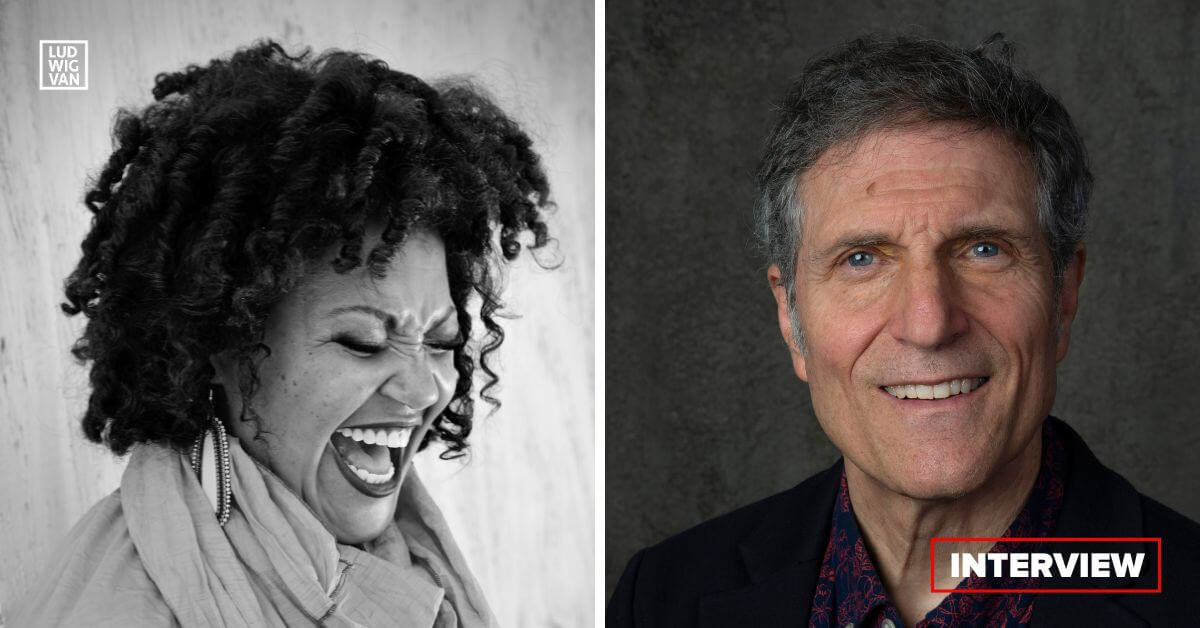
The 12th edition of the Royal Conservatory’s 21C Festival rings in the new year with new music, opening in January with a series of concerts that culminate in May. Measha Brueggergosman-Lee and Bruce Hornsby are among the headliners, with a mix of Canadian and international artists and works.
Mervon Mehta Executive Director, Performing Arts at the RCM, spoke to LvT about this year’s lineup.
21C Music Festival
The festival consists of eight concerts, with 14 premieres (including two world, one North American, and 11 Canadian), and 21 Canadian composers and artists.
“I always work with the artists on programming,” Mehta explains. “But we’re attracted to programming that is a little more adventurous.”
Booking international acts well in advance adds to the complexity. “With new music, sometimes, you’re booking something a year in advance, and the music is still to be written,” he explains. “We’re always looking for interesting things that are off the beaten track.”
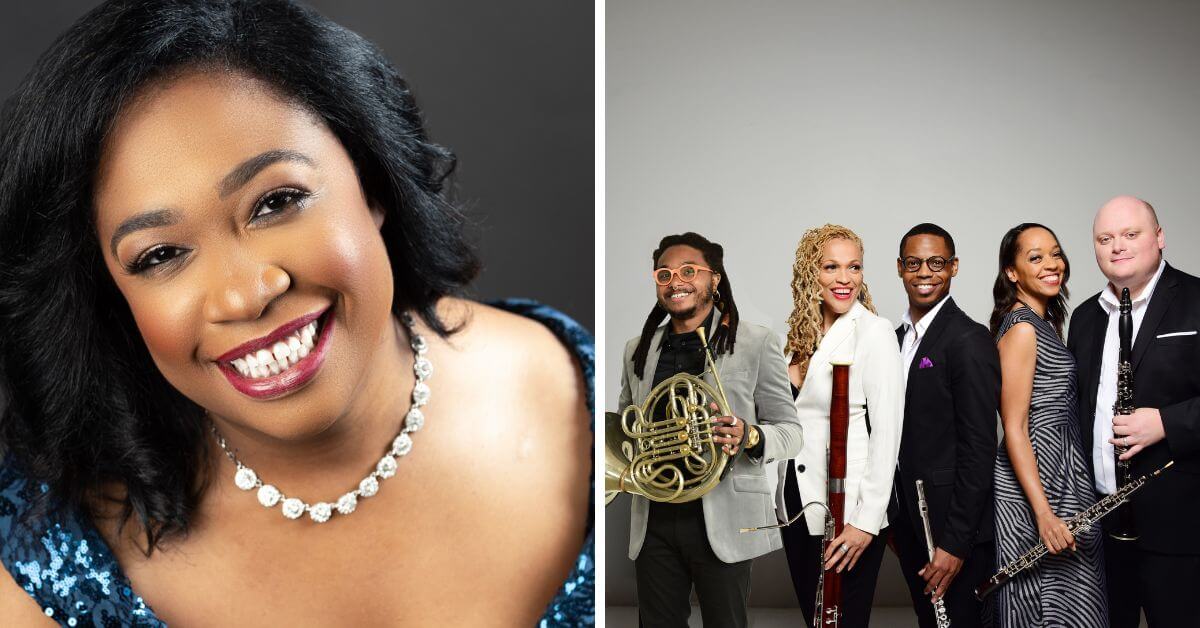
Michelle Cann and the Imani Winds (January 18)
The 2024 Grammy Award-winning Imani Winds perform with pianist Michelle Cann in a mixed program:
- Paquito D’Rivera: A Little Cuban Waltz
- Lalo Schifrin: La Nouvelle Orleans
- Francis Poulenc: Trio for Oboe, Bassoon, and Piano, FP 43
- Valerie Coleman: Portraits of Langston (Canadian premiere)Francis Poulenc: Sextet, FP 100
Composer Valerie Coleman describes Portraits of Langston, inspired by the poetry of Langston Hughes.
“Portraits of Langston is a suite in six short movements, and is my take on Hughes’ poetic memories of Harlem and Europe (mainly Paris).” She continues, “I chose Langston not because of who he is in literature, but because he was in fact, an eye-witness to legends born. His poems are so descriptive of the era, with references to particular settings and individuals that influenced him: Josephine Baker, Helen Keller, the nightlife/music of Harlem jazz clubs and Parisian cabarets. The imagery that Hughes provides gives me quite a historical palette that inspires me to illustrate a work truly unique to duo repertoire. Stylistically, this work incorporates many different elements that are translated into woodwind technique: the stride piano technique, big band swing, cabaret music, Mambo, African drumming, and even traditional spirituals.”
21C Afterhours: GGS New Music Ensemble (January 18)
Composer/concudtor Brian Current curates an eclectic evening of music. Brian is head of GGS’ New Music Ensemble, as Mehta points out. “Those students are really interested in expanding the envelope,” he says. Current is also artistic director of Toronto’s New Music Concerts.
The repertoire is a reflection of the talents of the ensemble. “He tends to pick things once he knows where the current superstars are in the school,” Mehta adds. “It’s a way of bringing our students into the concerts, which we’ve done since day 1.” The festival itself was moved to its current winter/spring time slot, in part, to open the opportunities for student involvement.
Soprano McKenzie Warriner, a 2024-25 Rebanks Fellow, will sing Luca Francesconi’s Etymo, which sets the poems of Beaudelaire to music. Beaudelaire’s poetry is noted for its mastery of both rhythm and rhyme, and romantic sensibility. Students from the GGS will accompany.
Also on the bill is Alice Ho’s Dark Waters and C’est Pas Beau?, and a world premiere by Canadian composer Kalaisan Kalaichelvan. Kalaichelvan was recently named as a recipient of the $10,000 Kathleen McMorrow Music Award, which recognizes contemporary classical music by Ontario composers.
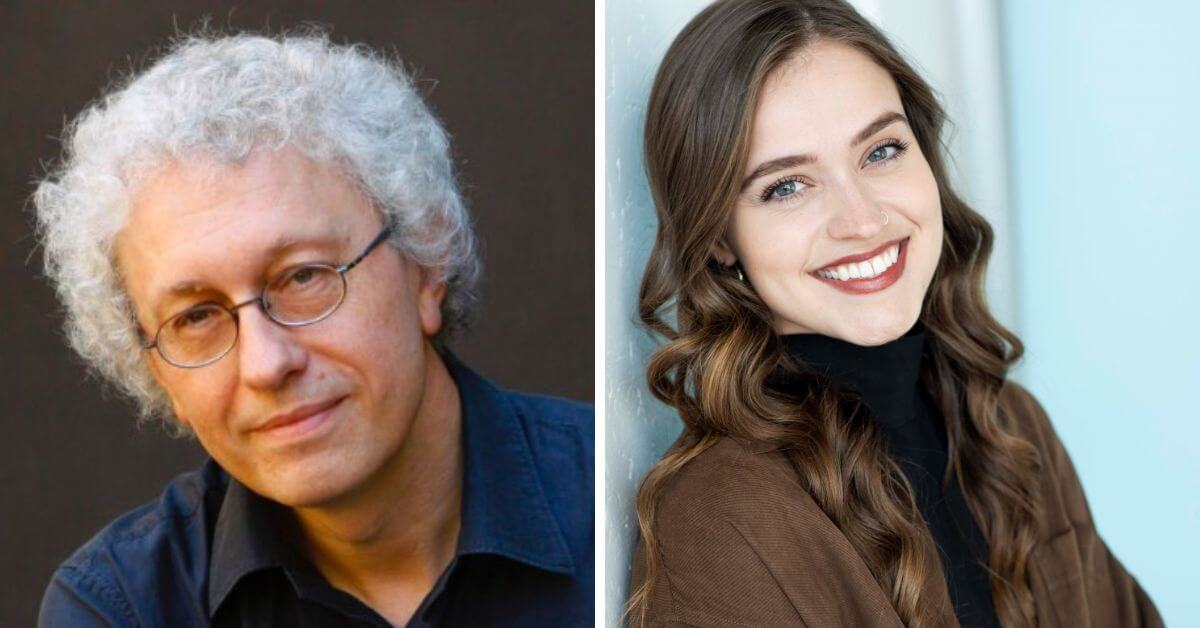
The Journal of Hélène Berr with Elena Howard-Scott (January 21, 22, 23)
Only previously performed in France, the concerts represent the North American premiere of Bernard Foccroulle’s work. Foccroulle set the words of Parisian Jewish diarist and musician Hélène Berr, who was eventually deported to Auschwitz, to music. Her diaries, which she kept from April 7, 1942, until February 15, 1944, just before she and her family were taken in a raid and deported, were rediscovered by a niece in 1994.
“That was brought to us by the Koffler Centre,” Mehta says. Without the performing space the piece requires, the organization thought it would be ideal for 21C. “I read the book, I listened to the music.”
Soprano and actress Elena Scott-Howard was a 2023/24 Rebanks Fellow, and will also be performing in the RCM’s production of Into The Woods in early January. “Her career is really kind of taking off. She’s an excellent, excellent actress,” Mehta says.
He likens the story of Hélène Berr to that of Anne Frank, although Hélène is in her early 20s as opposed to Anne’s early teens. “It’s a very banal journal on some levels,” he says. It begins with the day to day details of her life as a librarian, from the mundane minutiae of work to the first sightings of tanks in the streets, and then the growing horror around her.
As fate would have it, she was one of the last Jews in Paris to be sent to a concentration camp, and one of the last to die in Bergen-Belsen camp in 1944, not long before it was liberated by Allied soldiers. She had given the diary to her boyfriend, who would keep it, overwhelmed for decades by his grief. It finally saw the light of day when her niece tracked it down.
Belgian composer Foccroulle was inspired to write a lyrical drama for voice, piano and string quartet, using text directly from the journal. Elena will be reading from the book in an English translation, but singing in the original French, accompanied by pianist Jialiang Zhu, and The Rebanks Family Fellowship Quartet.

Measha Brueggergosman-Lee: Zombie Blizzard (January 24)
This year’s programming began with talking to Measha Brueggergosman-Lee and Aaron Davis. “We knew we were going to do the Zombie Blizzard work,” he says. “But what else do we put on the program?”
The new song cycle is a collaboration between band leader/composer Aaron Davis, Margaret Atwood, Canadian soprano Measha Brueggergosman-Lee, the Hannaford Street Silver Band, and the Aaron Davis Trio. The art song cycle blends classical and jazz idioms, using text based on Margaret Atwood’s 2020 book of poetry, Dearly. You can check out LvT’s interview with Measha and Aaron here.
The first half of the concert will consist of works by all of the artists.
Continuum Contemporary Music: Spanning (January 25)
A concert by Continuum Contemporary Music will spotlight flutist and core ensemble member, Leslie Newman. She’ll be performing Terrestre by composer Kaija Saariaho as the soloist. The ensemble will also perform works by Carolyn Chen, Anna Höstman, Jocelyn Morlock, and Ana Sokolović, along with the world premiere of a piece by Canadian composer Kotoka Suzuki.
“It’s a little bit of a different artistic choice,” Mervon explains. Continuum has appeared at 21C before, as he points out. “We always save one night for another organization.” In the past that has included Soundstreams, for example. He says Continuum approached them with the project.
“It’s their night.” Proceeds from the concert will also go to Continuum. “We do that every year with at least once organization outside the RCM,” he explains. “In the end, these are difficult concerts to sell, and we want to spread the wealth with other new music warriors.”
An increased reluctance to take risks on unknown artists and works has emerged as a lingering effect of the COVID pandemic. “Money is tight.” New music concerts feel the pinch more than most, with an increased focus on big acts that are considered a sure draw. “It’s hard to get through the clutter.”

Bruce Hornsby & yMusic present: BrhyM (May 3)
Three-time Grammy Award winner Bruce Hornsby is probably still best known for his work with the pop band The Range and their 1986 megahit The Way It Is. These days, he’s also a musical adventurer with the yMusic ensemble, a New York based sextet made up of trumpet, flute, clarinet, violin, viola, and cello.
Together, they present BrhyM, and will perform pieces from Hornsby’s catalogue as well as new collaborative work. BrhyM has already released one album, Deep Sea Vents, inspired by Hornsby’s love of the underwater world.
“Bruce Hornsby has been with us a couple of times,” Mehta says. On the last occasion, they were socializing back stage, and in the conversation, Bruce happened to mention yMusic. “That’s how that evolved,” Mehta says. “It started with those kind of conversations. It never starts with how many hits do they have on Spotify,” he adds.
The work he likes to program in the festival has a deeper and more personal connection with its audience. “Things that need a conversation with the artist,” he says. “We’ve been doing that since the beginning with this festival,” he adds, with a fluid vision of what “classical” may imply when it comes to music.
“It’s always about music that’s newly written, newly minted.” He acknowledges that their mandate goes beyond the typical four chord pop music. “It’s pieces that are written in a classical format, but not necessarily classical music.”
Final Thoughts
Mehta is also concerned about what happens to all those world premieres after their initial outing. “We do tend to bring things back,” he says. It’s just as important for new works to see their second, and third presentation as it is for their premiere.
He’s holding on to one more wish for the festival. “My one big dream is that Margaret Atwood will come for Zombie Blizzard and read her poetry,” he says. It’s a dream that has yet to solidify.
- Find more information and tickets to all the performances [HERE].
Are you looking to promote an event? Have a news tip? Need to know the best events happening this weekend? Send us a note.
#LUDWIGVAN
Get the daily arts news straight to your inbox.