
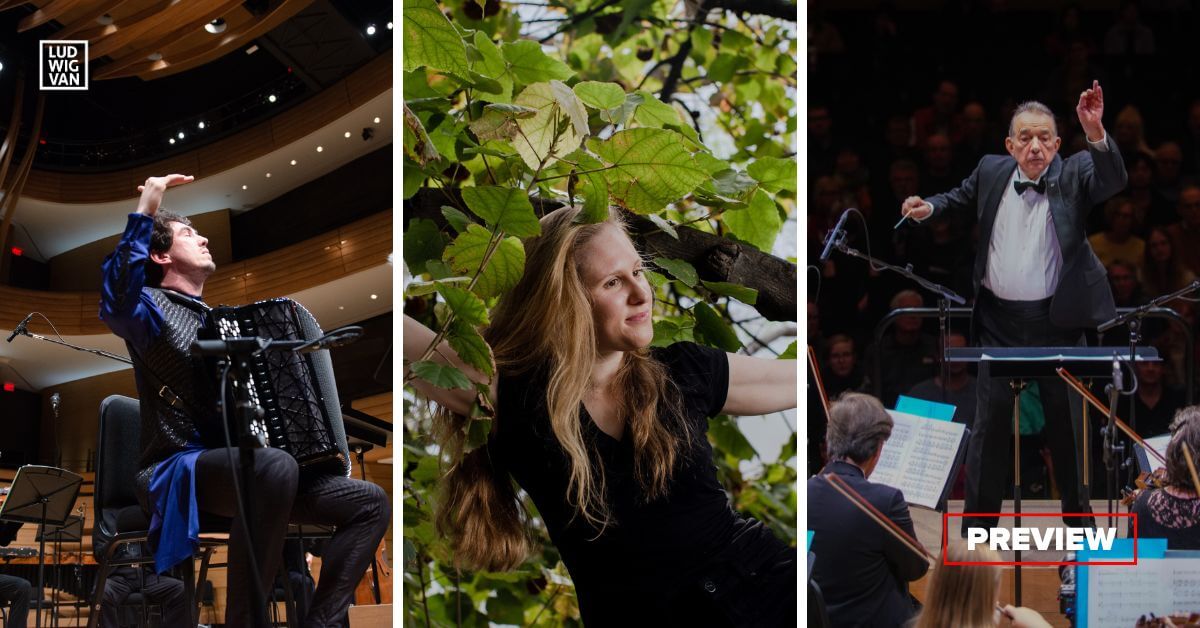
Toronto’s Esprit Orchestra will open their season on November 27 with a concert titled F(X)=. It features the work of composers Gabriella Smith, Bent Sørensen (performed with guest artist Michael Bridge), and Maki Ishii, including both a Canadian and North American premiere.
It’s one of two concerts (on November 17 and February 23) Esprit is calling The Preludes to its Edge of Your Seat International Festival, which offers audiences five concerts between March 4 and April 17, 2025.
We spoke to Artistic Director Alex Pauk about the season and more, and to Michael Bridge about performing Bent Sørensen’s challenging piece for the season opener.
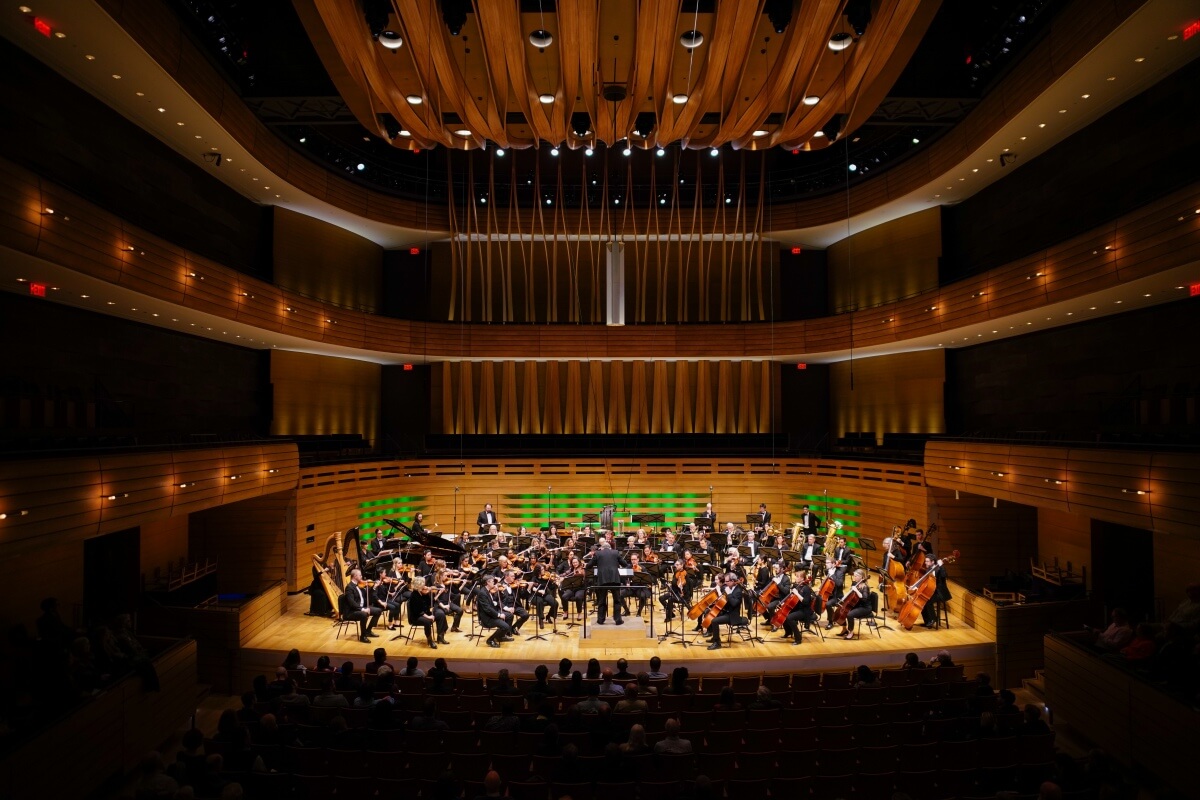

Alex Pauk: Artistic Director
2024/25 Season Overview
While the first two concerts of the season, the Prelude Concerts, aren’t part of the festival, they’re no less significant, Pauk underscores.
“They […] connect us to the way we programmed in the past,” he says.
Pauk has always been imaginative in his programming choices from season to season. But, the Edge of Your Seat International Festival takes that approach and applies it with a global perspective.
“The thrust is to make us much more involved in the international scene,” he says. While Esprit has always brought international artists to Toronto to perform as guests, the Festival broadens that aspect, while encouraging networking with local artists as well.
Esprit is also deepening its commitment to co-commissioning works with large international orchestras, which allows for the creation of monumental works.
Commissions for the Festival include Canadian composers James O’Callaghan, Quinn Jacobs, Roydon Tse and Nicholas Ma (all world premieres).
Guest composers at the Festival include Vito Žuraj (Slovenia), whose piece Anemoi is a co-commission with the Berlin Philharmonic, and will receive its North American premiere in Toronto. Other guest composers include Lisa Streich (Sweden) and Andrew Norman (United States). Akiko Suwanai (Japan), violin, and Sophia Burgos (United States), soprano, will perform as guest artists.
“What we are also doing is introducing these artists from abroad to our own composers and performers,” he says. It’s a two-way exchange where those international artists and composers will be introduced to Toronto’s music scene as well.
Along with new pieces, this season Esprit will be revisiting works they’ve performed in the past, including Claude Vivier’s Lonely Child. “We’re giving the second performance of a number works this seasons […] that we know resonate well with our audiences,” Pauk says.
Andrew Norman’s Sustain will be performed during the Festival. “This will be our third performance of that piece, and it’s not going to get tired, because it’s such a good piece. You can’t grasp everything in one hearing.”
From a presenter’s perspective., the festival is an effective way of gaining attention for those contemporary works and composers, and a focused audience
“It makes a nice package,” he says, pointing out that Festival goers will be able to explore the work of many artists.
Season Opener: F(X)=
Maki Ishii’s Fu-Shi (Shape of the Wind, 1989) is one of the pieces that Esprit has performed in past seasons. “We’re one of two orchestras in the world that play this piece. It’s very complex to put together,” Pauk says. It takes much more than the usual one or two rehearsals that would be typical for a well worn work of the classical repertoire. “The interesting thing about doing them for the second time is the deeper understanding that comes with it,” he says.
The three pieces that make up the season opening concert are very different, but share a certain quality. “They’re all spectacular in different ways,” Pauk says.
Ishii’s piece uses orchestral sounds crossed with a Japanese aesthetic, including a percussion instrument called a Cidelo Ihos. “When we first did this piece, we had to import them,” Pauk says. Since then, percussionist Ryan Scott has had the instrument copied and built here. As Pauk describes it, the player uses tongs to create indeterminate pitches. “It brings you into anther sound world all together.”
The title of the concert refers to the piece by US composer Gabriella Smith f(x)=sin²x-1/x (2019)
“It’s very coincidental, but the end of the piece has these beautiful brass cascades. I was wondering, what kind of fanfare-ish piece could I open the concert with? Pauk recalls. When he heard Smith’s work, he knew he’d found what he was looking for.
“Each [piece] occupies a unique and characteristic sound world of their own.”
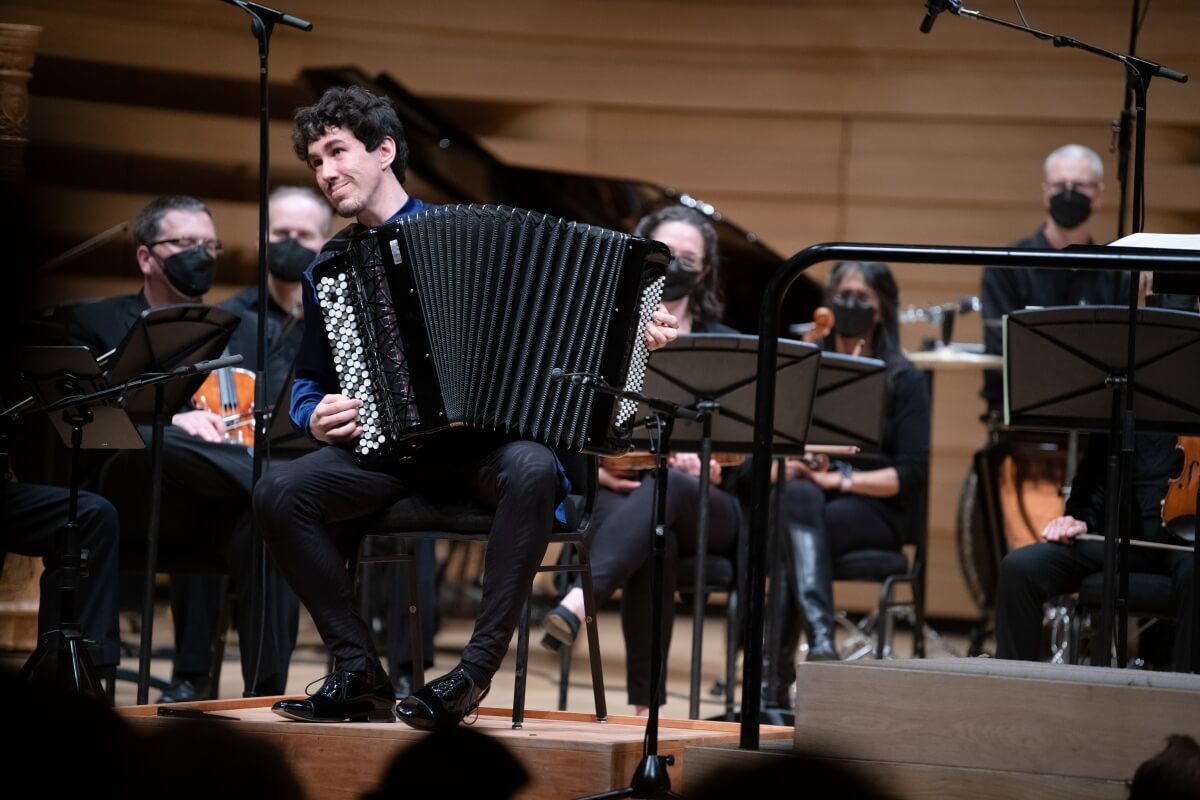
Michael Bridge, Accordion
“Michael Bridge is a consummate accordionist. He gives it everything,” Pauk states.
Michael Bridge, today renowned for his expertise and adventurous style on the accordion in classical music, actually came to choose the instrument by accident.
“Accordion came to me from a garage sale as a kid, when I was five,” he says. When it comes to classical music, he points out, “I am not quite the first generation to be a classical accordionist. In Canada, the woods were cleared by my longtime prof and mentor Joseph Macerollo.”
Macerollo founded the accordion program at the University of Toronto’s Faculty of Music in the 1970s.
“Even the possibility of doing those studies, as a teenager, inspired me to follow a career outside the folk music realm,” Bridge says. He knew the instrument was capable of so much more than the often shrill sounding folk idioms.
The accordion, played in a classical setting, has a much warmer sound, and the blend with a string section is seamless.
“I’m happy to say that I think perceptions are changing,” he says. Conductors and leaders of arts organizations, the presenters, are becoming more and more aware of the role that the accordion can play in the world of classical music. And, as Bridge reports, there is opportunity even at a local level.
“We could use two more full-time accordion players in Toronto.”
Bent Sørensen (DNK): It is pain flowing down slowly on a white wall (2010) for accordion & string orchestra
“It creates a mood,” Pauk says of the piece. “It has a stream of consciousness through it.” He notes that it changes moods, incorporating bits of familiar American pop tunes and tango rhythms. “It’s just full of beautiful melodies and chord progressions. It absorbs you.”
He appreciates the combination of strings and accordion. “It’s a very interesting sonic colour combination.”
“There are just tremendously difficult and complex passages for the accordion, but what’s really interesting about it, as the piece flows, the complexity fits into it, but without disturbing the nature of it,” Pauk says. “It’s ferociously difficult,” he adds.
“The interesting thing about it, is it doesn’t sound […] what I’ll call impressively virtuosic,” Bridge says, “except in a few moments. Most of it is about blend and control. The orchestra parts are no slouch either.”
The piece, as Bridge describes it, alternates between passages of serene beauty, and painful moments, as the title suggests.
“I find it to be a really real piece, in that it deals with many emotions of the human condition head on.” That includes pain and frustration, something many of us have felt over the last few years, Bridge notes. “It’s kind of healing to lean into that, actually,” Bridge says, “to realize that none of us are alone in feeling the pain and frustration, and then finding the beauty in it.”
He points out there are moments of simple beauty in the piece, among them, a passage that recalls a Bach-like sarabande. “People go on a big journey,” he says of the audience experience.
The composition, while using only strings and accordion, incorporates a number of special effects. At one point, the whole orchestra becomes a choir, and they sing under Bridge’s accordion melody. All of the string players are also outfitted with melodicas, a handheld instrument that uses the same kind of reeds as the accordion.
“It actually makes a lot of sense to do that with the accordion,” Bridge says.
“And then there’s a theatrical element at the end, where the string players leave the stage,” Pauk notes. A solo violinist plays off stage.
“This piece has been played in Europe over the last 10 years,” Michael adds. Pauk wanted to present it in a new way, with a visually evocative element.
“We are engaging someone to do a special lighting for this piece,” Pauk says. “The form of the work is going to be accompanied by a form of lighting design.”
“Alex is just brilliant at finding amazing music and curating concerts,” Bridge adds. It was Pauk’s idea for him to perform Sørensen’s piece. “He said, hey, do you want to practice from now until November?” he recalls with a laugh.
It’s not the first time he’s performed with Esprit Orchestra, and Michael says he’s also a frequent audience member at their concerts, and has been since his student days.
“I know the power and effect of their concerts,” Michael says. “I’m really happy to play with them in such a brilliant venue,” he adds.
Prelude & Festival
The second Prelude Concert, on February 23, 2025, uses Steve Reich’s Runner as its focus. Mark Fewer, (violin), Kevin Ahfat, (piano), Erica Goodman, (harp), and Wesley Shen, (harpsichord) will also perform works by Hans Abrahamsen (Double Concerto), Henryk Gorecki (Concerto for Harpsichord), and Pauk’s own Concerto for Harp & Orchestra.
- Find more details about the Prelude Concerts, and the Edge of Your Seat International Festival [HERE].
Are you looking to promote an event? Have a news tip? Need to know the best events happening this weekend? Send us a note.
#LUDWIGVAN
Get the daily arts news straight to your inbox.