
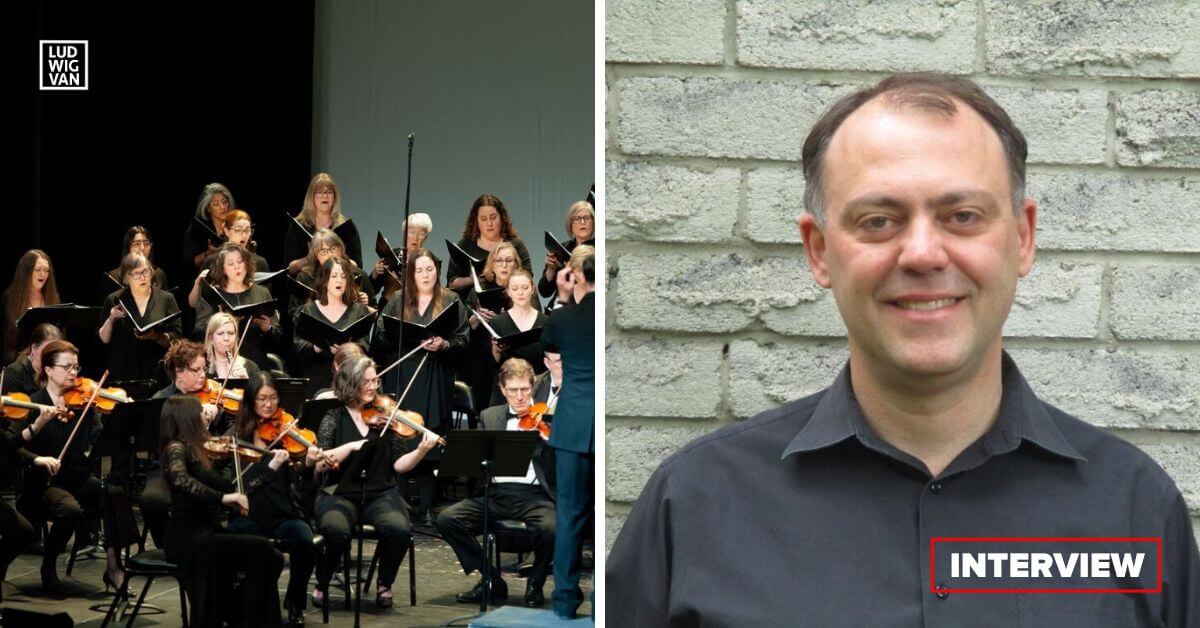
Alexander Cann will see his 15th season leading Hamilton’s Bach Elgar Choir as their Artistic Director during 2024/25 — the 119th season for the choir itself. They’ll be opening with a presentation of Handel’s Alexander’s Feast, a rarely performed work, on November 23.
It’s in line with Cann’s imaginative approach to season programming, which has included Canadian folksongs, music from WWI, and other intriguing themes, along with the choir’s traditional focus.
LvT spoke to Cann about Alexander’s Feast, and leading a Hamilton institution.
Artistic Director Alexander Cann
Alexander Cann began studying music formally at the Royal Conservatory of Music in Toronto, followed by an undergraduate degree from McMaster University (B.A.).
He was still 19, and in his second year at McMaster, when his piano playing started to attract attention. Alexander was asked to serve as musical director for a campus production of A Little Night Music by Sondheim, and it worked out so well, it led to two more shows while he was still at university. He gained conducting experience with the McMaster University Choir.
After McMaster, he completed an M.Mus. degree at McGill University, where he continued to study conducting. After completing his studies in Montreal, he went on to hold positions at the Shaw Festival, and with Tapestry Opera, among others, before landing at Bach Elgar.
Today, along with leading the Bach Elgar Choir, he also serves as Director of Music with Melrose United Church in Hamilton.
The Bach Elgar Choir: A Brief History
The ensemble was founded under the name The Elgar Choir in 1905 by Bruce Carey, who led the organization until 1922. Carey, a baritone and teacher as well as a conductor, studied in London, Munich and Florence, and became a choirmaster at a series of Hamilton churches before founding the choir.
The choir saw early success, and had a reputation for performing excellence. After the Second World War, in 1946, the choir merged wth the Bach Choir to become the organization as it is known today.
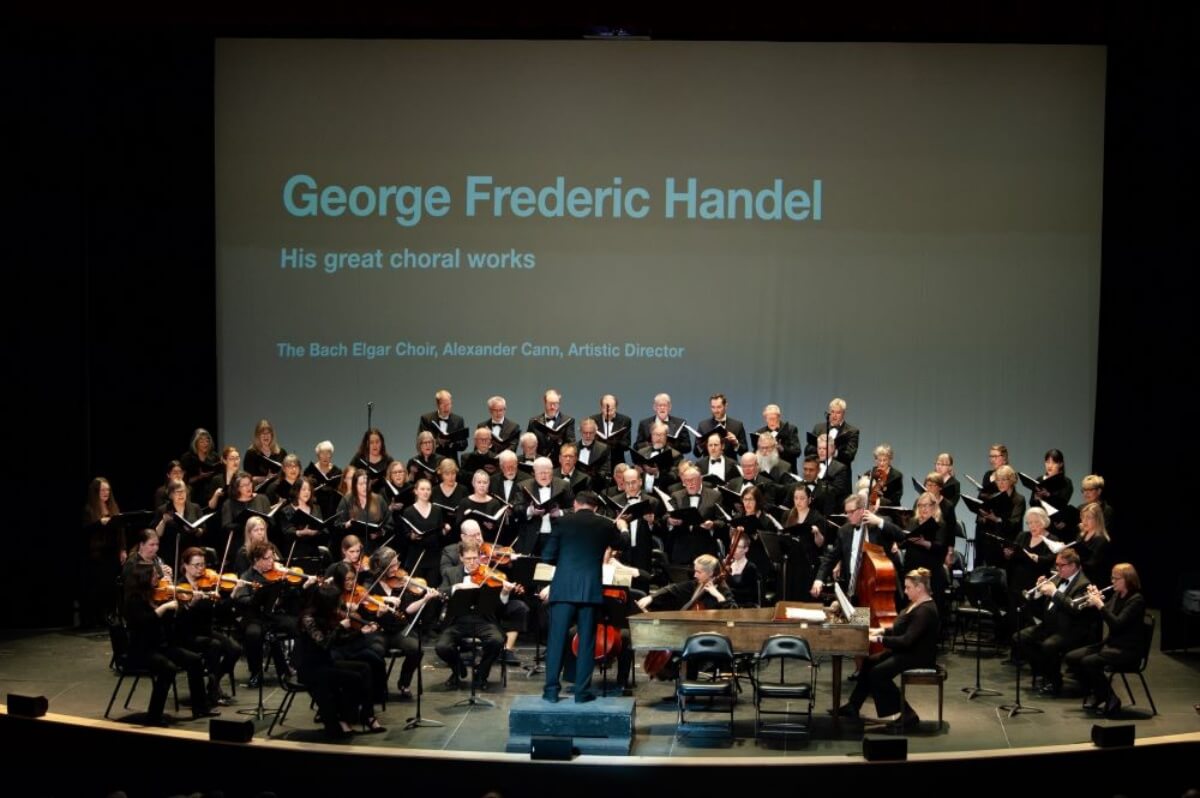
Along with Bach and Elgar, under Cann, the organization has included a focus on the major works of Mozart to its regular programming. The venerable organization often teams up with the Hamilton Philharmonic in its concert presentations.

Alexander Cann: The Interview
What’s it like leading an institution that’s anchored the choral community in the city for so long? “I would say, it certainly enters into our self image, because Hamiltonians remind us about it,” says Cann. The choir is certainly well known in the city and region. “We’re a concert choir and we have that history in town.”
He mentions the organization’s continuity in the community, with a tech who is a grand niece of one of the choir’s original members, and choir members whose grandparents also sang in Bach Elgar.
“It’s got a unique through-line presence.”
As he points out, when it was formed, it was one of only two concert choirs in the entire region, the Toronto Mendelssohn Choir having been formed in 1894.
“Historically, it’s quite unlike other choirs at the time,” he says. The choir found ready audiences throughout the area and beyond, and toured regularly in its early decades throughout the region, including the United States. “Their first concerts were in the winter — February only,” Alexander says, “hoop skirts and all. The pictures are fantastic. We care about our history and we read our history.”
Occasionally that respect for their history informs his programming, as in a recent concert where the choir performed the first piece they’d ever sung in public, and an early commission by composer Nathaniel Dett from 1917 that they’ve performed several times in recent years.
“We’re connected to our history.”
Handel: Alexander’s Feast
The November concert may be the first time Alexander’s Feast has been presented in the area. “I don’t think it’s ever been presented around here,” Cann says.
A musical ode set to a libretto by Newburgh Hamilton, Alexander’s Feast (HWV 75), was written to celebrate Saint Cecilia’s Day (traditionally November 22). Saint Cecilia was a virgin martyr of the early church, and she is the patron saint of music.
Handel composed the work in 1736, and it premiered at London’s Covent Garden in February of that year. Alexander’s Feast sets a scene between Alexander the Great and his mistress Thaïs, who have a feast in the city of Persepolis, a city he’d captured. Timotheus, a musician, sings and plays the lyre, and evokes various emotions in Alexander until they rise to a boiling point, and he resolves to burn the city down in revenge for his Greek comrades fallen in the battle.
The piece was so successful that it encouraged Handel to make the switch from Italian operas to English choral works — a decision that would cement his place in Western music history.
As the first such work of Handel’s, however, it is often overlooked by presenters and programmers in favour of the oratorios and other later works he would become famous for.
“The thing about Alexander’s Feast is that it’s right in that first […] series of works — St. Matthew’s Passion by Bach 1727, Handel’s in 1736,” Cann points out. “It’s kind of the first truly grand scale orchestral works.”
Alexander’s Feast is the outlier as a secular work, one that was intended as a concert piece. “There wasn’t anything before that that could really be called a concert piece for orchestra and choir,” he comments.
The original story of Alexander’s feast contains a political subplot about issues of its time, some four decades before Handel set music to it. “There is implicit in Alexander’s Feast a political subplot,” Cann notes. “Handel takes the story and gets rid of the political overtones. The political insinuations are to a certain extent washed away.”
Handel’s work became more associated with a renewed sense of British nationalism. It was also, despite the notion of Saint Cecilia, a public and secular celebration. “It’s the beginning of secular arts.”
Today’s audience members can appreciate a piece with a variety of mood that range form love to rage to pity.
The Bach Elgar Choir 2024/25 Season
The rest of their season includes Handel’s Messiah in December with conductor James S. Kahane and the Hamilton Philharmonic.
“It’s interesting doing the Messiah after Alexander’s Feast,” Cann notes. “You see where stuff is coming from,” he notes. The composer’s development in the way he uses the voices of the choir, and other elements, contrast from the earlier to the later work.
Their first concert of 2025 is titled The Trial of Gilbert & Sullivan, including a staged version of the iconic duo’s comic masterpiece, Trial By Jury, on its 150th anniversary. It builds on a Gilbert & Sullivan show the choir performed back in 2018. “It was such great fun, I thought, we can take this to the next step.”
It’s also ideal repertoire for a non-professional choir, which may have difficulty achieving the composer’s intentions when it comes to challenging opera choruses. “They wrote it for bel canto singers,” he points out. Operetta offers a combination of more and less challenging parts.
Martin and Brahms, over two nights, closes the season on May 31 and June 1, featuring Frank Martin’s a cappella Mass for Double Choir, and Brahms’ Ziegeunerlieder.
“Frank Martin’s piece is difficult and challenging,” he says. “The choristers need to know their onions. It requires a confident musical chorus. I programmed it because I thought the choir was ready.”
The piece is a continuation of French works the choir has been building into its repertoire over the last few years. It’s an initiative that was first sparked by the burning of the cathedral of Notre Dame in 2019, but has taken on a life of its own. “It connects over the seasons.”
He points out that the HPO’s new conductor, James S. Kahane, is also French by birth, and has an interest in French repertoire. Working on pieces in a multi-year mode helps develop the choir’s skills and familiarity with individual styles. “I like to do that,” he says.
Alexander’s Feast: Concert Details
The Hamilton Philharmonic Orchestra will accompany the Bach Elgar Choir.
“They’re crackerjack,” Cann says. “It’s another level of professionalism.”
Soloists include Bethany Hörst (soprano), Owen McCausland (tenor), and Chris Palmer (baritone).
He notes that soprano Bethany Hörst is on the faculty at the University of Western Ontario. “She’s grown into a confident artist,” he says. He also points out that tenor Owen McCauslin is in demand all over the world.
“It’s pretty cool working with artists of that calibre.”
Baritone Chris Palmer is also a jazz guitarist, and an alumnus of Bach Elgar. “He has become a truly excellent classical baritone,” Alexander says.
“I’m really proud of that cast.”
- Find more details and tickets for the performance, and check out the rest of the 2024/25 season, [HERE].
Are you looking to promote an event? Have a news tip? Need to know the best events happening this weekend? Send us a note.
#LUDWIGVAN
Get the daily arts news straight to your inbox.