
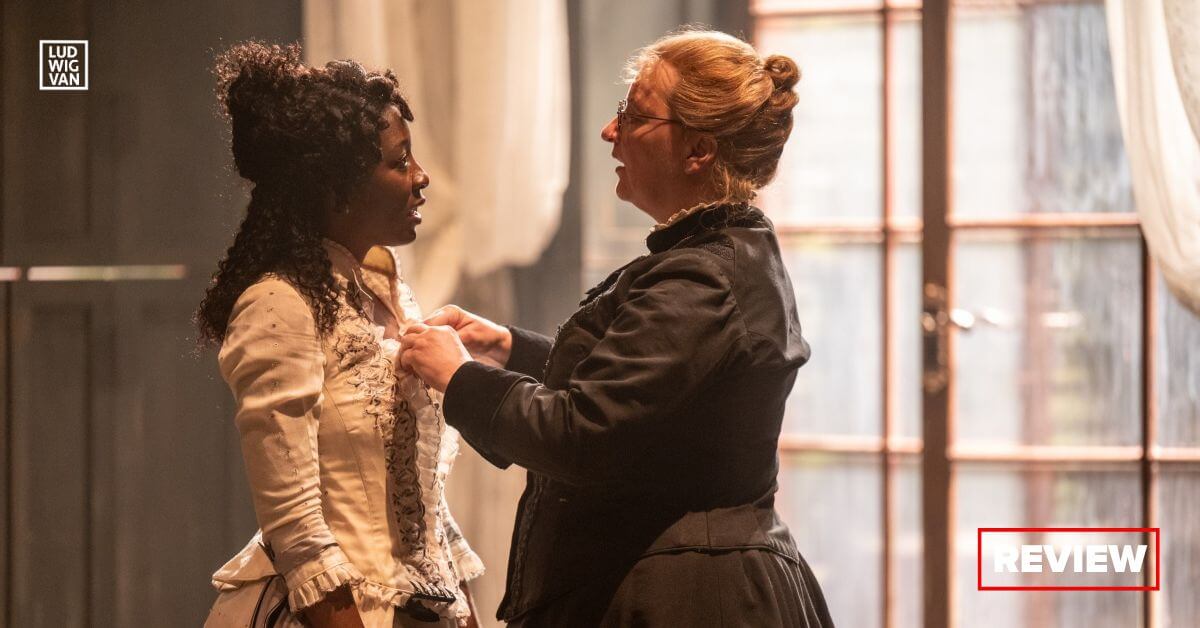
Crow’s Theatre/Rosmersholm, written by Henrik Ibsen, adapted by Duncan Macmillan, directed by Chris Abraham, Guloien Theatre, Streetcar Crowsnest, closes Oct. 11. Tickets here.
Amongst its many other attributes, Crow’s Theatre seems to becoming a home for classic theatre in Toronto. As evidence is the company’s splendid production of Henrik Ibsen’s 1886 masterpiece, Rosmersholm.
The Norwegian master dramatist deliberately set out to make the smug middle classes uncomfortable, and Rosmersholm contains enough provocative themes to sink a battle ship.
The title refers to the manor house of the Rosmer family who are the town’s aristocrats by virtue of owning the mill. As the most influential family, they are the leaders of society. At the upcoming election for town council, the current scion of the house, John Rosmer (Jonathon Young), can influence the vote. His power is doubled by the fact that he is also the town’s pastor.
The problem, as his arch-reactionary brother-in-law, Governor Andreas Kroll (Ben Carlson), discovers, is that John has fallen into the camp of new ideas espoused by the leftist newspaper published by Peter Mortensgaard (Beau Dixon), who is agitating against the old guard for control.
Not only has John lost his faith after the suicide of his wife Beth a year ago, he wants to use his privileged position to break the hold of the conservative elite and the regressive power of the church. Equality for all, justice for all — add in any idea here from the 19th century movements to reform society — and that is what John is currently espousing. In short, new thought against tradition.

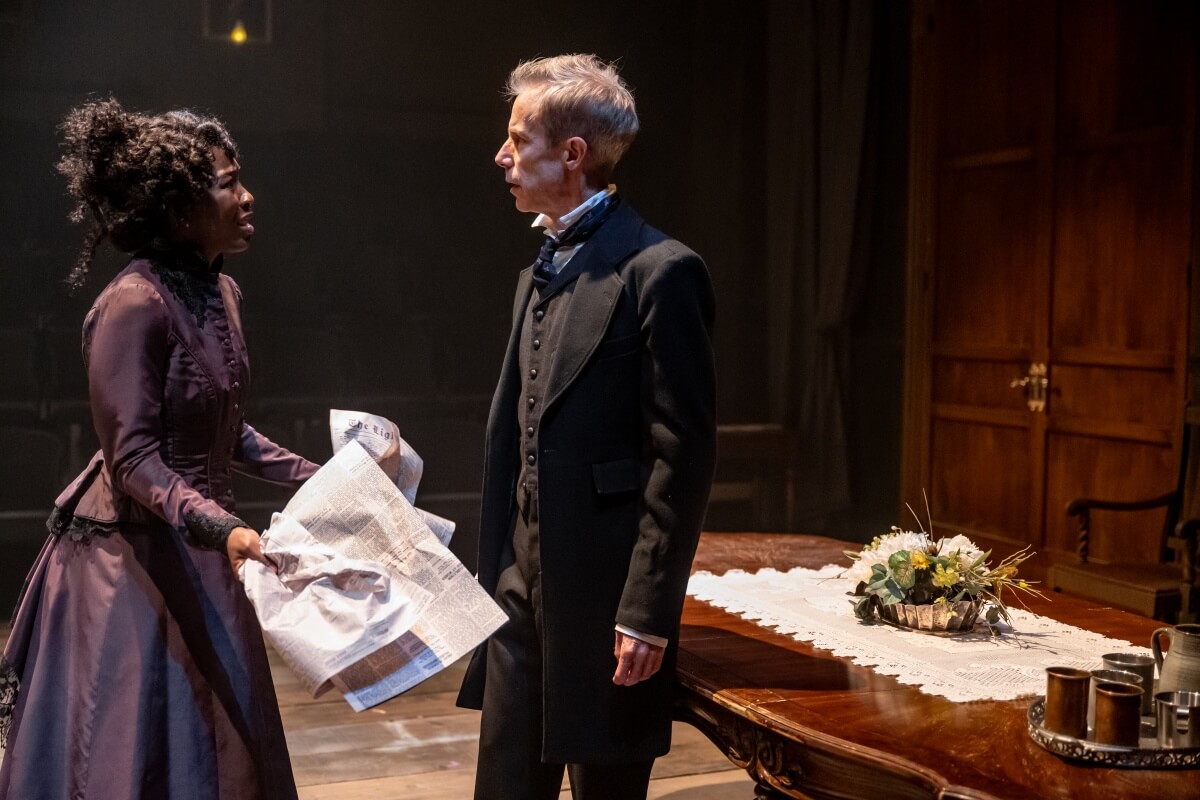
Enter Rebecca West (Virgilia Griffith), one of the most intriguing heroines to emerge from 19th century literature, so intriguing and complex, in fact, that Freud apparently wrote an essay about her.
Rebecca is radical in her beliefs, particularly about feminism and the ideas embraced by the new left. She came to Rosmersholm to be companion to the late Beth who suffered from depression, because, it was thought, she couldn’t have children, and has stayed on to help run the house, although there is a very capable housekeeper in Mrs. Helseth (Kate Hennig).
Because Rebecca is a woman, and thus politically powerless, her route to power is to influence a man, and it is she who has led the vulnerable John into new waters. Needless to say, she and Kroll become bitter enemies, and he sets out to destroy her and win back John. Matters are not helped when Kroll suspects that the two are lovers, or else, why has Rebecca stayed on at Rosmersholm after Beth’s death?
There is one other character in the play — Ulrik Brendel (Diego Matamoros) — John’s former tutor, who travels the country lecturing on political reform, but who has become an alcoholic and has fallen on hard times. With his own idealism in tatters, Brendel advises John to copy the tactics of the wily Mortensgaard who knows how to play the political game.
This plot summary is just the tip of the iceberg as to what is going on in the play, but it certainly echoes today’s world with populism against the woke — the extreme right against the extreme left. Nonetheless, Ibsen has ensured that hypocrisy inhabits both sides, and that there are no saints here. How prescient was the playwright 138 years ago to envision this crisis of conflicting beliefs?
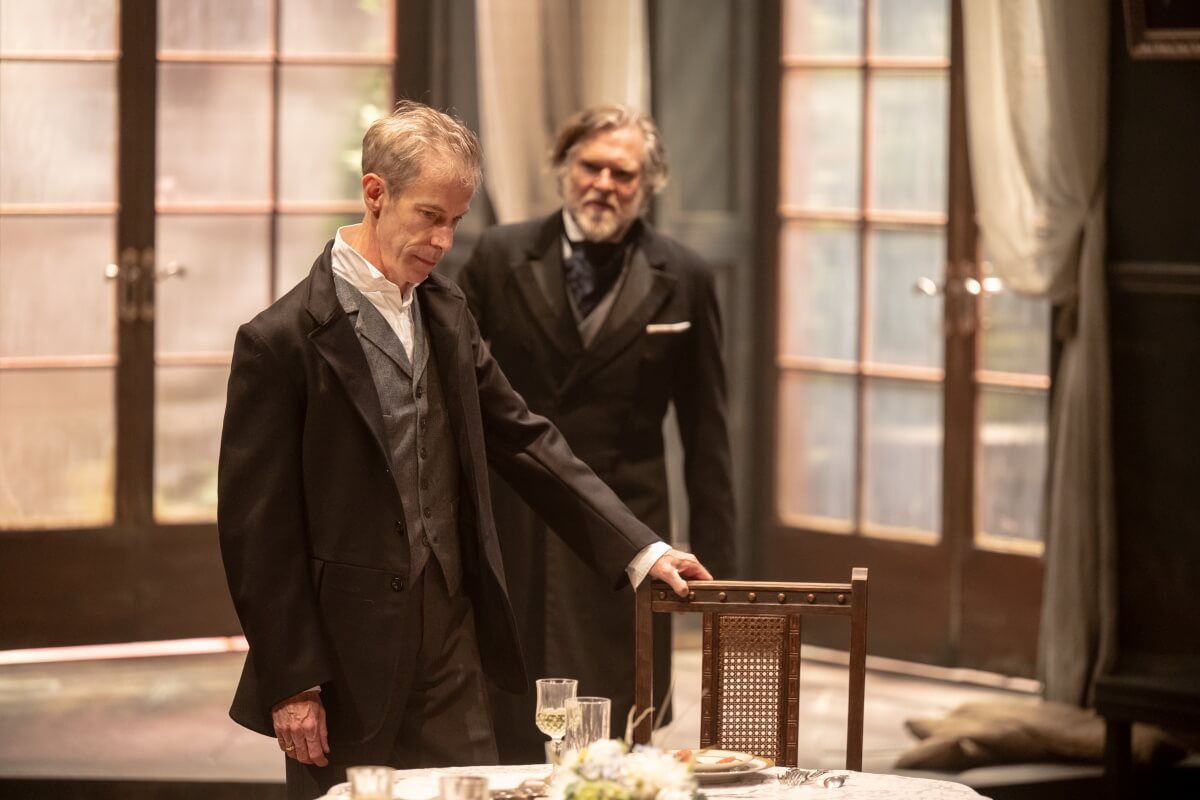
Overlying the political themes are the personal demons at play within each character, particularly Rebecca and John, and Ibsen has imbued each with enough angst to create raging emotional turmoil. By linking the personal with the political, Ibsen has created a morass of instability at the heart of Rosmers’ house. It is a quagmire that is sucking them all into chaos.
The cast is absolute perfection, breathtaking, in fact. Every character is brilliantly portrayed, both overtly and interiorly, and director Chris Abraham has once again proven that he can make actors reach down to their very souls.
There is one scene in particular, late in the play, where Griffith will make you, as an audience member, practically stop breathing because of its agonizing intensity. If she doesn’t get a Dora nomination, there is no justice. In fact, all the actors give award-winning performances.
Also an important part of the play are the silent servants (Sturla Alvsvag, Alicia Richardson and Norman Yeung) who change the scenes, and follow commands when given, and represent the very people that John wants to liberate, but who have never really had agency over themselves.
The performance is in the round, and Joshua Quinlan’s gloomy set pieces, domineering corner windows, and over-bearing portraits of ancestors, convey the dark recesses of an ancient house. Once again, Ming Wong has produced attractive period costumes, while Kimberly Purtell’s moody lighting adds its own layer of claustrophobia. Thomas Ryder Payne’s sound design is particularly potent in this production in terms of sound effects.
An added bonus is the 2019 brilliant adaptation by acclaimed British playwright Duncan Macmillan. Ibsen can be wordy, but Macmillan has cut through all that 19th century cant to provide a script that cuts to the quick, with terse dialogue that is very contemporary in feel.
Ibsen’s characters may be rooted in the past, but they sound very much of today, making this production a very relevant must-see.
Are you looking to promote an event? Have a news tip? Need to know the best events happening this weekend? Send us a note.
#LUDWIGVAN
Get the daily arts news straight to your inbox.