
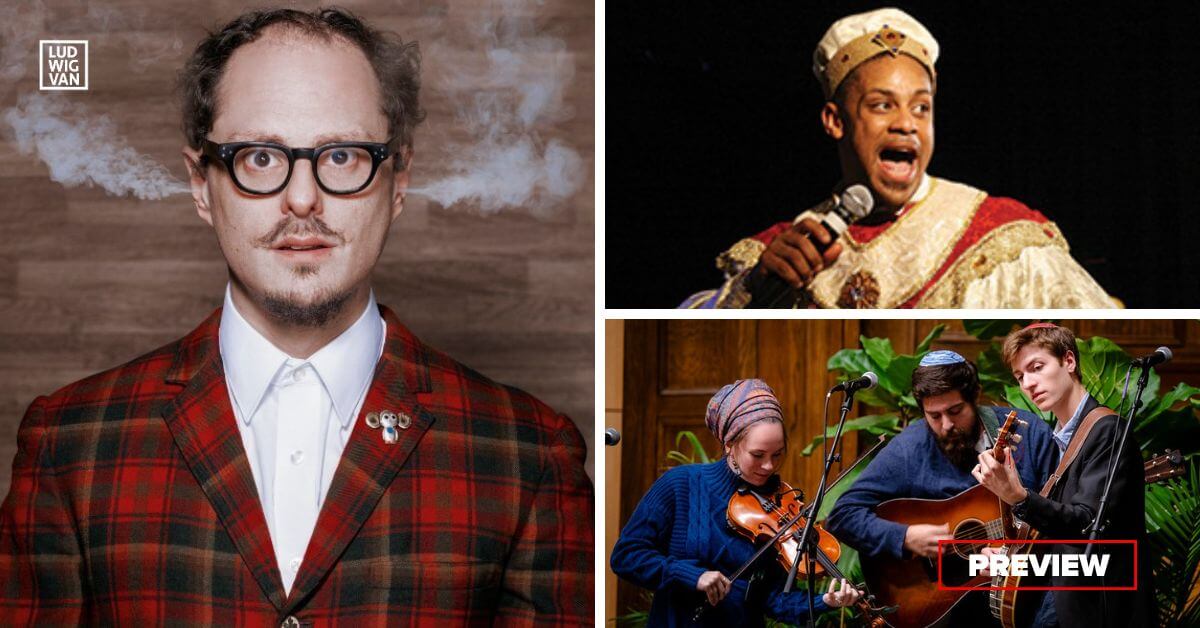
The Ashkenaz Festival returns to Toronto’s Harbourfront from August 27 to September 2. The majority (90%) of the Festival’s offerings are free to the public, and attract audiences numbering about 60,000 people each year.
Many of the musical acts incorporate Jewish elements with many others in a global fusion blend, like Jacob’s Ladder and their Jewish-infused bluegrass, or Joshua Nelson, the kosher gospel artist.
We spoke to Ashkenaz Festival artistic producer and curator Eric Stein about this year’s offerings.
Excerpt from the final moments of the North American premiere performance of the Yiddish opera Bas Sheve on August 31, 2022 at Glenn Gould Studio in Toronto as part of the 2022 Ashkenaz Festival:

Eric Stein: Ashkenaz Festival 2024
The Ashkenaz Festival was originally founded as a kind of showcase for Klezmer music and Yiddish culture. A look at the lineup for the 2024 festival, however, shows an eclectic roster of artists and culture that represents not only the traditions of Eastern European Jews, but also Sephardic, Mizrachi and Israeli culture, and well beyond.
“I think it’s something that people don’t understand that level of diversity,” says Ashkenaz Festival artistic producer and curator Eric Stein. It’s part of the fun of putting it together — finding aspects of the Jewish experience that people don’t realize exist.“To represent the festival on a cultural level, especially with music, we really go to town with that aspect.”
Diversity has historical roots. “When you think about it from a historical aspect, it makes sense,” he says. Certainly, the Jewish diaspora stretches across the globe along with the Jewish people looking to make their homes. “In so doing, as musicians and artists, they have borrowed from their host culture, and influenced their host culture,” he explains.
The Festival has expanded each year without moving from its core values. “That founding mission of the festival is still very much at the core.”
The name itself — Ashkenaz refers specifically to Jewish culture from Eastern Europe — may be a little misleading at this point, but there really isn’t a useful alternative. As Stein explains, when the Festival was founded in the 90s, it was during what was about the third wave of the klezmer revival. The music was no longer a vehicle for nostalgia, but becoming a wellspring for creating contemporary works.
The artists, as he points out, do pay attention to the traditions and history behind their work — traditions that may be in a state of fragility due to historical oppression.
“They require care and curation,” Stein says.
Music plays a large role in Jewish culture, and in the Festival “It’s played a key role in the Jewish peoples’ experience because it channels emotions.” It’s also a universal language, as he points out.
The multi-generational roster of artists, and the multicultural nature of the audiences each year, tell him that it’s an effort that is valued. “Diversity is hip these days,” he laughs. “It’s really nice that we don’t have to stretch that hard to find that,” he adds.
“I feel that the festival serves a really important role in giving the public a way to experience Jewish culture,” he says. “We’re making it accessible to the largest possible audience.” He underscores the cultural, and non-political, emphasis of the program.
Festival Highlights
The Golden Septet (August 17)
Golden Thread Septet presents Yiddish Songs of Social Change through the 20th century. New arrangements by Craig Judelman provide the music for songs about women’s rights, the secular vs. the religious movements, and more, in a blend of styles from contemporary art ensemble to fiddle kapelye. Performers include Yiddish vocalists Lorin Sklamberg and Sasha Lurje, and string players Craig Judelman Cookie Segelstein, Abigale Reisman, Kirsten Lamb, and Raffi Boden.
In the Footsteps of Zimro (August 29)
Just after WWI, musical ensembles toured Europe, often with nationalistic themes to their program.
“Jewish musicians began waking up to that,” Eric says.
Clarinetist David Krakauer recreates one such historic Jewish group, the Zimro Ensemble, a sextet of Russian-Jewish musicians who toured the world. They championed classical music with Jewish themes, and performed the work of composers like Alexander Krein, Solomon Rosowsky, and Sergei Prokofiev.
Schmaltz and Pepper (September 1)
New group Schmaltz and Pepper bring together jazz, Roma, and European folk music, and perform it classical sensibilities and virtuosity. Their lineup features Toronto Symphony principal clarinetist Eric Abramovitz, Grammy-nominated Drew Jurecka on violin/accordion/mandolin, Juno-winning pianist Jeremy Ledbetter, award-winning bassist Michael Herring, and Payadora violinist/vocalist Rebekah Wolkstein.
Read the LvT review of their recent performance at Toronto Summer Music here.
- Find out more about the Ashkenaz Festival [HERE].
Are you looking to promote an event? Have a news tip? Need to know the best events happening this weekend? Send us a note.
#LUDWIGVAN
Get the daily arts news straight to your inbox.