
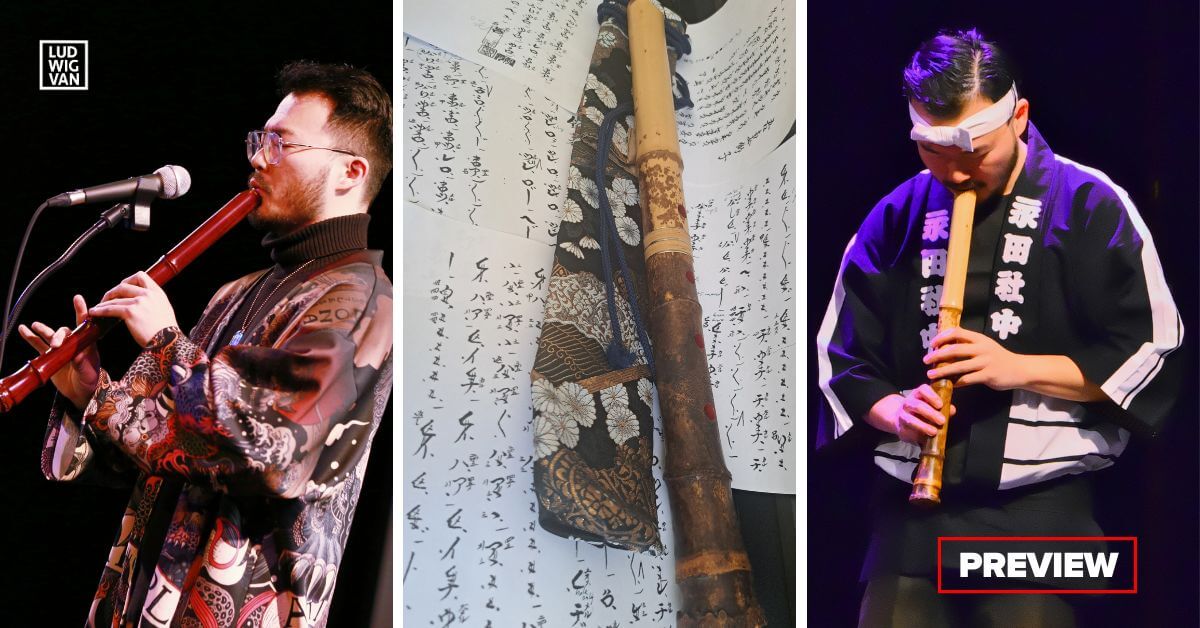
Multi-instrumentalist and composer Kevin Zi-Xiao He offers Toronto music lovers a unique opportunity at a free concert on June 1. He’ll be performing on the shakuhachi, a traditional Japanese bamboo flute.
Okuden (奥伝) is a Japanese word that refers to an advanced level of training in the arts. Kevin will be joined by pianist David Debono.
Composer & Performer Kevin Zi-Xiao He
Chinese-Canadian composer Kevin Zi-Xiao He immigrated to Canada in his mid-teens. His music combines elements of his Chinese background along with his current interests in a variety of genres. That includes both popular and traditional music of East Asia.
Having earned an Honours Bachelor of Arts degree with a double major in architecture and music, and a Master’s degree in composition, he is a current PhD candidate in composition, studying with Dr. Christos Hatzis at the University of Toronto. Previously, he studied with Gary Kulesha, Ken Ueno, and Andrew List, among others.
His works have been commissioned by a variety of ensembles, including the Scarborough Philharmonic Orchestra and the Orchestra of the Chinese Artists Society of Toronto (CAST), and he has performed his own work at new music festivals in Europe and Asia.
He received the Composition Award at the Zodiac Music Academy and Festival in France in 2015.
The Shakuhachi
Traditionally made of bamboo, the shakuhachi is a longitudinal flute that is blown at one end. The shakuhachi is tuned to the minor pentatonic scale.
As Kevin writes, “Originated in China and developed in Japan by Japanese Buddhist monks of the Fuke Sect for meditation practice, the shakuhachi started out as a religious device, while the music that resulted from lengthy, free flow blowing meditation sessions was notated and collected and constitute the classical honkyoku repertoire that is at the heart of every shakuhachi player’s training. The flute is now the gateway to a vast spiritual world and a staple of Japanese aesthetics, attracting enthusiasts from around the globe.”
The Chinese version, known as the xiao, and which inspired the shakuhachi, dates back to antiquity. Earlier versions of the Japanese instrument were developed during the Nara period (710–784), but were largely abandoned. Its current form was developed in Japan during the Edo period (1600–1868), in the 16th century by the Fuke monks.
The Concert
The program features a mix of Japanese and Western repertoire, including:
- Japanese Minyo
- Classical Honkyoku
- Bach
- Caccini
- Gershwin
- Michael Conway Baker
The concert takes place June 1 at 8 p.m. at St. Thomas Anglican Church (383 Huron Street). Admission is free, with donations appreciated.
Are you looking to promote an event? Have a news tip? Need to know the best events happening this weekend? Send us a note.
#LUDWIGVAN
Get the daily arts news straight to your inbox.