
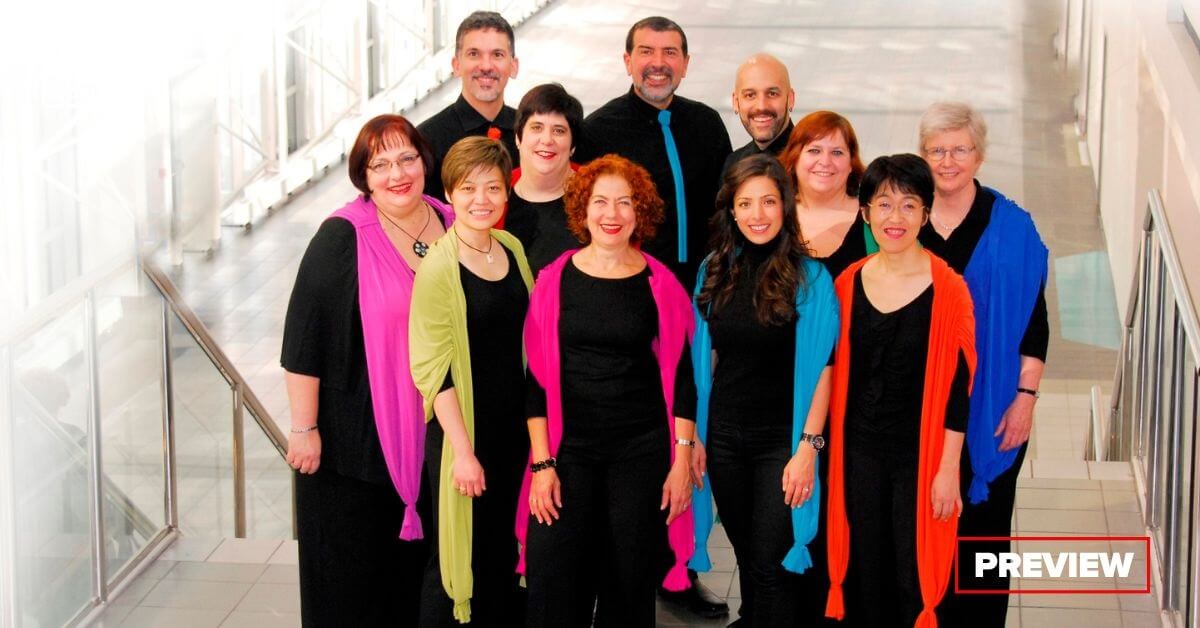
Cantemos has been warming up Toronto’s musical landscape with a focus on music in Spanish, Portuguese, Latin and native languages of the Americas for the last 15 years. Their anniversary concert on May 12 will be a multimedia event featuring a premiere, along with beloved repertoire, dance and visual arts.
Laurie Evan Fraser will conduct Cantemos, along with the Upper Canada Choristers, with pianist Hye Won (Cecilia) Lee in a program titled Our Voices Together: Corazones al Unisono.
We caught up with Fraser and Cantemos coordinator Jacinto Salcedo to talk about the choir and the upcoming performance.
LvT: What led to the formation of Cantemos?
Laurie Evan Fraser: ln May of 2005, the Upper Canada Choristers presented a concert — Toronto Soundscapes: Sharing Our Voices. It was a celebration of the Toronto cultural mosaic with music from many world traditions. It was prefaced with the following:
“The people of Toronto come from all over the world, and so do the members of this choir. The more we learn from each other about our musical traditions, the smaller the world gets. But at the same time our world gets richer — denser somehow, sweeter, concentrated, more and more delicious.”
The concert opened with music from the First Nations by MorningStar River and continued with music from the Maritimes, French Canada, and the Prairies. We moved to the West Indies, then South America, Africa, Asia, and Europe, wending our way back to end in Canada.
This concert contained the seeds of what would three years later develop into our Latin ensemble, Cantemos. Formed with a nucleus of choir members from Colombia and Venezuela, the singers in Cantemos continued the multicultural model of membership in the larger choir, with a commitment as ambassadors of Latin American music.
Cantemos is an auditioned, chamber ensemble singing mostly a cappella repertoire in Spanish, Portuguese, Latin, and indigenous languages of the Americas.
LvT: What does having a focus on Spanish, Portuguese, Latin and native languages of the Americas add to the usual repertoire heard in this region (i.e. Toronto)?
Laurie Evan Fraser: Singing repertoire in the original languages adds a richness and texture to the performance that is not possible in translation. The listening required to pronounce the texts properly also enhances skills in other areas, enabling singers to perceive more nuances in intonation and musical shaping.
Language is culture, and when a language is no longer spoken or sung, the culture dies. As ambassadors of Latin American choral music, it is our responsibility to remain faithful to the original languages.
Jacinto Salcedo: As a Venezuelan immigrant, I feel seen in Cantemos. I get a lot of respect and admiration for my motherland and for Latin American culture. In Venezuela everyone sings in a choir. It is a tradition that not only schools and churches have choirs; banks, social clubs and government offices also have choirs. There is a tradition at large of family gatherings dedicated to singing. So, that Upper Canada Choristers had the vision to have a Latin American ensemble is dear to my heart. I feel at home.
Without jumping into stereotypes, I’m sure that there is a different sensibility in the language and music from Latin America, one can say, that there is a different lens how we see love, and family, communal living, it’s more flirty, passionate, sometimes rough and raw, sometimes sophisticated.
Cantemos performs César Alejandro Carrillo’s La rosa de los vientos in 2018:

LvT: What can you tell us about El Pájaro Que Espero (The Bird I Await), commissioned from Venezuelan composer, César Alejandro Carrillo — the world premiere piece? How would you describe it?
Laurie Evan Fraser: I am going to let Jacinto Salcedo answer this principally, but I have a couple of things to say:
Jacinto was in touch with the poet, Laura Morales Balza, shortly after we received the score, asking for insight into the lyrics. Jacinto arrived at a rehearsal just after having received Laura’s answer. As Jacinto translated Laura’s message, those of us in the rehearsal were profoundly moved, many of us were brought to tears.
The poem and setting are exquisite. We are so grateful to have the chance to premiere this wonderful new work.
Jacinto Salcedo: When we commissioned the piece from César Alejandro Carrillo, we knew what to expect musically from him, so we gave him carte blanche with regards to the text. However, when he asked for some keywords, we talked about cultural representation, love, language, communication, compassion, nature appreciation, family, memory and passion.
So César engaged his wife Laura (she is a multi-talented artist, graphic designer, photographer, singer and poet). Inevitably the suggested subjects landed on a shared lived experience for them, the memory of their son who passed away at a young age.
El Pájaro Que Espero (The Bird I Await) It’s a poem of awaiting, of observation, of appreciation of nature and specifically of a bird. It’s filled with metaphors of softness, warmth, eternity, and a sense of anticipation and wonder. This song feels like a sweet caressing, a landing place for calm and relief. From a place of light, acceptance and hope.
Morales said, “Modernity has made us subjects less aware of the natural. It has made us less observant. It has limited us to the immediate and we have lost count of the sky, of space, of the world, of the other.
“I write from my experience, trying to make the message universal from the images that I feel or try to build.
“I saw the opportunity of writing this poem for Cantemos as a gift to me. This poem is a prayer of hope, of daydreaming, of infinite certainty and strength. It is a contemplation of nature, to the universal song of a bird.
“I think that singing has saved me. Singing has made it possible for me to be alive after seeing my son leave. Singing has made it possible for me to find relief even when my body and soul felt incomplete. So I tried to draw a series of images to bring hope to those who listen to it.”
LvT: The choir has presented works of Carrillo’s previously — what is it about his compositions that has made him a Cantemos favourite?
Laurie Evan Fraser: Long before the formation of Cantemos, I programmed some of César’s music. I love his harmonic vocabulary, the richness of the added 7ths and 9ths and close multi-voiced harmony. Once Cantemos started singing together, I learned that some of our singers had sung in one of Carrillo’s choirs in Venezuela. I got to know him through his music and then became personally connected to him through our commissions.
Cantemos repertoire is largely a cappella, and César writes principally a cappella songs that can have percussion and cuatro added if desired. (The cuatro is a small, 4-stringed Venezuelan guitar used in ensemble playing.) His music is challenging to sing and distinctive. A few years ago one of our singers during a rehearsal of Carrillo’s Missa Sine Nomine, suddenly said, “I want to marry him!”
LvT: How was the program put together overall — is there a specific quality or message you wanted to send for the 15th anniversary?
Laurie Evan Fraser: I typically plan programs 3-5 years in advance. I had some basic ideas about music choices for this concert early on — certainly the fact that I wanted to revisit earlier commissions, and also that I wanted to showcase some of the wide variety of music Cantemos has sung through the years. Then last summer, Cantemos got together in the backyard of two of our members, and we started talking about Cantando Flores. I was looking for a suitable title for the concert and thought the inspiration for that might come from looking at the lyrics of that song. We brainstormed, and everyone emailed me suggestions. In looking them over I was drawn to the phrase: “Who we are and what we stand for.” Then one singer suggested: “Corazones al Unisono”.
We know from a wealth of research that has been done on the effects of singing that respiration rates and heartbeats become synchronous as we sing together. And we know that music also brings us together in a very spiritual sense. As we celebrate diversity and multiculturalism, we also celebrate the things we have in common.
We also have a commitment to the perpetuation of choral music, and commissioning is one way of ensuring the future while we support composers in the here and now.

LvT: The concert will involve a multimedia presentation, including films, projection and dance. How did that aspect of the project come to fruition?
Laurie Evan Fraser: I have been drawn to using multimedia elements in concerts for some time, and we have been pleased with the results in the past. We have an awesome creative team that has grown in scope through the pandemic, necessarily as we have tried to find new and creative ways of connecting with audiences and also our own members. Jacinto Salcedo is not only our Cantemos Coordinator, but he is also the Producer of our live streamed concerts and has spearheaded many innovations. Otto Pierre, another Cantemos member, is a graphic designer who designs our posters and also helps with some of the animation and other graphic design. Both Jacinto Salcedo and Otto have the connections that have enabled us to expand our horizons this time. Jacinto Salcedo’s child, Camila, is an award-winning artist who will be adding art work to one of the Cantemos songs through a Timelapse app. Jacinto Salcedo’s brother and sister in-law in Spain create shadow puppet theatre in their company: CIA. OLVEIRA SALCEDO. Otto’s niece is the dancer who will appear with us.
Combining these elements virtually continues the work that has been ongoing these past 3 years. The pandemic has actually helped move our choir to a new level, and we hope to continue that momentum moving forward.
Jacinto Salcedo: We were forced by the pandemic to learn how to rehearse on Zoom, how to put together virtual choirs, how to stream concerts. It is like the pandemic forced us to elevate the level of production. That expanded not only the way we learned and performed music, but with video being a visual medium, it had an impact on the way we presented ourselves. Laurie’s vision of collaborating with other art forms was streamlined too by the possibilities to collaborate with performance artists abroad via video. So we will be singing to a choreography of shadows, of lines and of bodies.
LvT: Blessing — Bendicion [by Laurie Evan Fraser] is inspired by connections between traditions. How do those connections translate into the music?
Laurie Evan Fraser: Many traditions have a common greeting or phrase to wish one another well. By combining the Irish blessing that is a familiar and well-loved British Isles tradition with a Spanish children’s prayer known throughout Latin America, we are pointing out the commonalities. Musically it translates this way:
Blessing — Bendicion begins quite simply with 4 unison phrases, each sung by a different soloist, before the full choir finishes the verse in unison. The sopranos and altos sing the next verse in harmony, with the melody moving between the two sections. At this point the text changes from English to Spanish, and Cantemos sings in full 4 part harmony. At the conclusion of the Spanish prayer, all basses and tenors sing an ‘amen’ section in 2 parts, and the song concludes in English with everyone singing in harmony together.
Tickets and details for the May 12 performance at Grace Church-on-the-Hill are on sale now here.
#LUDWIGVAN
Get the daily arts news straight to your inbox.