
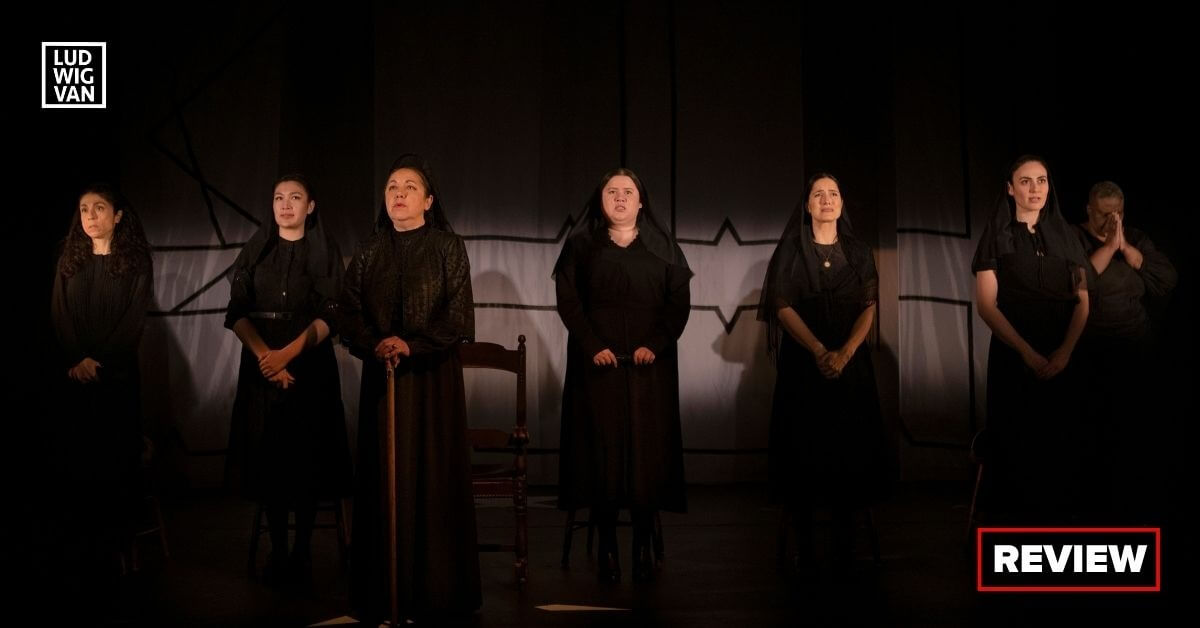
Aluna Theatre & Modern Times Stage Company/The House of Bernarda Alba, written by Federico García Lorca, translated by David Johnston, directed by Soheil Parsa, Buddies in Bad Times Theatre, Apr. 6 to Apr. 24. Tickets available here.
Breathtaking in its dramatic sweep! Harrowing in its impact!
Soheil Parsa’s magnificent production of Federico García Lorca’s 1936 The House of Bernarda Alba is simply among the finest interpretations of this classic play ever mounted in this city. If there ever was a run/don’t walk, this is it.
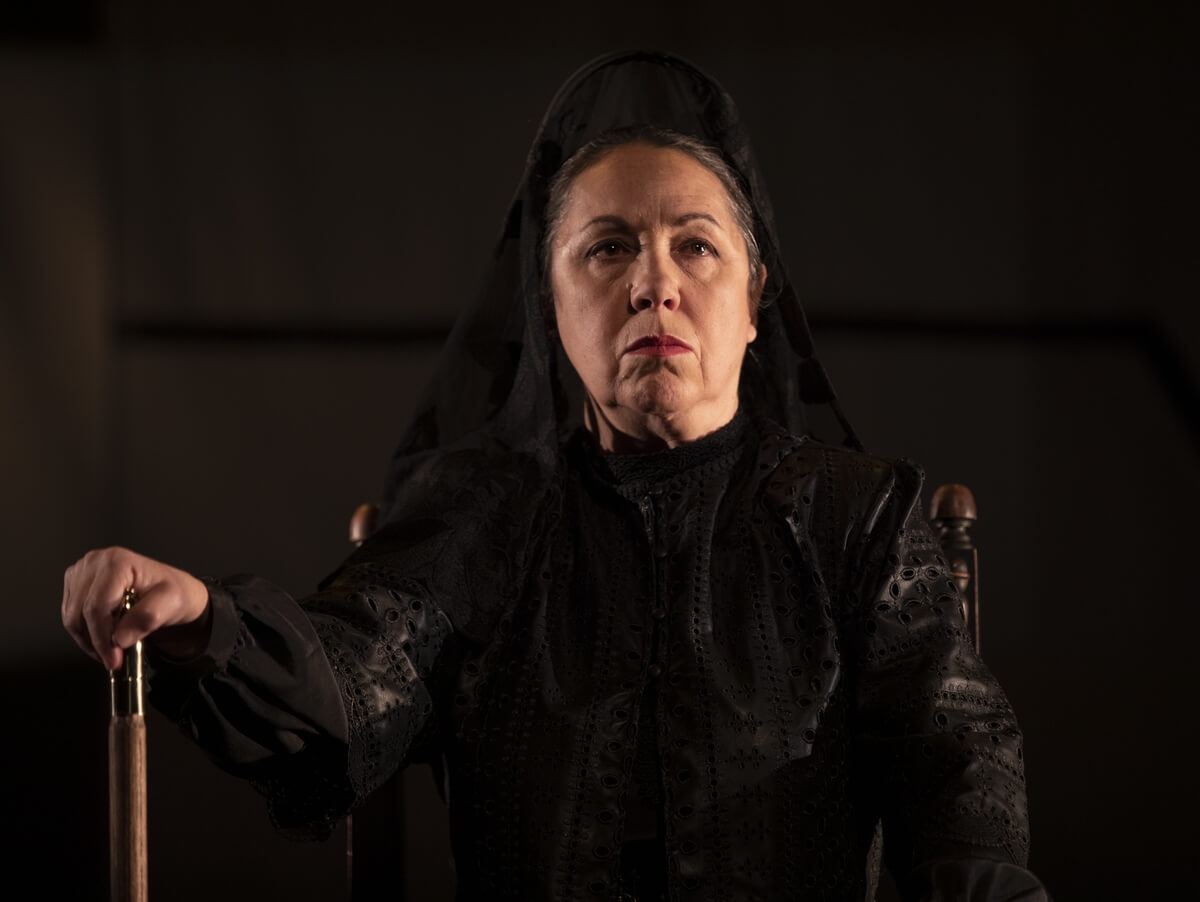
Anyone who follows my reviews knows that Parsa is one of my favourite directors. He is the former co-founder/artistic director of Modern Times, one of the great Toronto independent theatre companies. For this production, Modern Times has linked up with Aluna Theatre, arguably the most important Latin theatre group in Canada. Aluna’s artistic director, Beatriz Pizano, also happens to be an outstanding actor, and she is performing the pivotal role of the formidable harridan Bernarda Alba. Casting and directing doesn’t get much better than this.
The early death of García Lorca at age 38 is one of literature’s most tragic and senseless losses. The talented Spanish poet, dramatist and theatre director was a leader of Spain’s avant-garde, numbering artist Salvador Dali and filmmaker Luis Buñuel among his friends. He was instrumental in encouraging a revolt against naturalism and realism in the Spanish arts, championing theories such as symbolism, futurism and surrealism. He was also an avowed socialist and homosexual.
In the early days of the Spanish Civil War, the combination of his left-leaning politics, his progressive views on the arts, and his homosexuality, brought him to the attention of Franco’s fascist militia, and shortly after finishing The House of Bernarda Alba, his last play, he was arrested in Granada and executed. His grave has never been found. When one thinks of the poems and plays he still had in him, the heart breaks. At least we can be grateful for the works he left behind.
The title, The House of Bernarda Alba, is perfectly apt because Bernarda is the martinet who controls her five daughters with an iron fist. It is, above all else, her house, because it was inherited from her family. When the play opens, Bernarda’s second husband has just died, and she declares eight years of mourning, essentially creating a cloistered convent.
The daughters, one from Bernarda’s first marriage, Angustias, 39 (Lara Arabian), and four from her second — Magdalena, 30 (Monica Rodriguez Knox), Amelia, 27 (Theresa Cutknife), Martirio, 24 (Liz Der) and Adela (Nyiri Karakas), 20, seethe with repressed sexuality, and chafe under Bernarda’s yoke. Their blighted lives are fraught with tension.
In this hothouse of raging hormones, of course there is a man in the picture. Pepe “el Romano”, whom we never meet, is Angustias’ much younger fiancé who is secretly wooing Adela, but is also desired by the jealous Martirio. Magdalena is the shit-disturber who sews the seeds of poison. Only placid Amelia seems outside the forces of discord and discontent.
In this house of women, also lives the old housekeeper La Poncia (Rhoma Spencer), who is not afraid to talk back to Bernarda, warning her of the impending disaster that this collision of sisters will create. Actor Soo Garay performs three roles — Bernarda’s elderly mad and cruelly treated mother, Maria Josefa, the household maid, and the visiting neighbour Prudencia.

The House of Bernarda Alba, like all García Lorca’s canon, cannot be taken at face value. One must look deep, and within the subtext are themes of the deadening impact of oppression, the dangers of unrequited passion, the effect of men on the lives of women, the power of gossip, and the demands of conformity. For Bernarda, the house must remain respectable against all else. One can also read into the script, Spain at large, and the rising tide of fascism. García Lorca gave the play the ironic subtitle, “A drama of women in the villages of Spain”, which speaks volumes in and of itself.
Which brings us back to Soheil Parsa.
When the director approaches the classics, I feel that his main preoccupation has always been to honour the intent of the playwright. García Lorca wrote in a high theatrical style, and Parsa has interpreted this as deliberate dramatic cadence. The actors speak with clearly defined diction, enunciating every vowel and consonant. The speeches are declamations that ring off the stage like an assault. It is theatre at its most overwhelming, and we are caught in its depths.
This also means that Parsa ensures that we are very aware of the theatrical values that are meant to envelop us.
Thomas Ryder Payne’s sound design (yes, him again) is filled with an avalanche of noise, including the incessant peeling of church bells, the chatter of mourners, the gossip of neighbours, the seductive and tantalizing singing of the male harvesters as they come and go from the fields. Even the sound of nighttime cicadas is loud. Everywhere in the script that there is a hint of a sound effect, Payne has put one in. The designer has been clever, because the more we are aware of the village outside, the more we realize just how closed in are the daughters.
Trevor Schwellnus’ set and lighting tend to the abstract, except for Bernarda’s formal chair and the daughters’ backless stools. The backdrop is a see-through curtain with patterns of lines and stars. A bank of light bulbs are behind the curtain that can glow warmly pink, or blaze with white light. Somehow, the set and lighting do evoke rural Spain, as well as the claustrophobic atmosphere of the house.
Angela Thomas’ costumes are perfection. For the first part of the play, Bernarda and the daughters are wearing period black dresses, stockings and shoes, each different from the other. Except for Bernarda, they seem suffocated by the mourning. In the play’s finale, the daughters are clothed in white nightgowns, again, all different. Only La Poncia and the maid are not in black. Overall, the basic simplicity of the black and white costume palette seems to absolutely match the directness of García Lorca’s forceful words.
Parsa was among the first directors in the city to engage in multiracial and gender-bending casting. While there is no need in the script for the latter, the unbelievably strong cast does reflect the Toronto mosaic. The production boasts such compelling performances that the audience can’t help but be swept up in the drama.
Pizano, as the poker stiff Bernarda, is unrelenting in her sense of rightness. She dominates the stage, as her character demands. Spencer’s sly Poncia is as wise as she is forthright. Garay is quite marvellous in capturing the differentials of her various roles.
As for the daughters, the casting is exceptional. The tentative Angustias, the lovelorn Adela, and the placid Amelia, are contrasted against the rebellious Magdalena, and the bitter Martirio. If I have to isolate one of the daughters as a first among equals, I’d have to point to the riveting, yet subtle, performance of Liz Der as Martirio, but I can’t stress enough the sheer brilliance of the cast as a whole.
There is something absolutely thrilling when a production reaches beyond the stage and pulls the audience into its dramatic grip. Such a theatrical experience is Soheil Parsa’s The House of Bernarda Alba.
#LUDWIGVAN
Get the daily arts news straight to your inbox.