
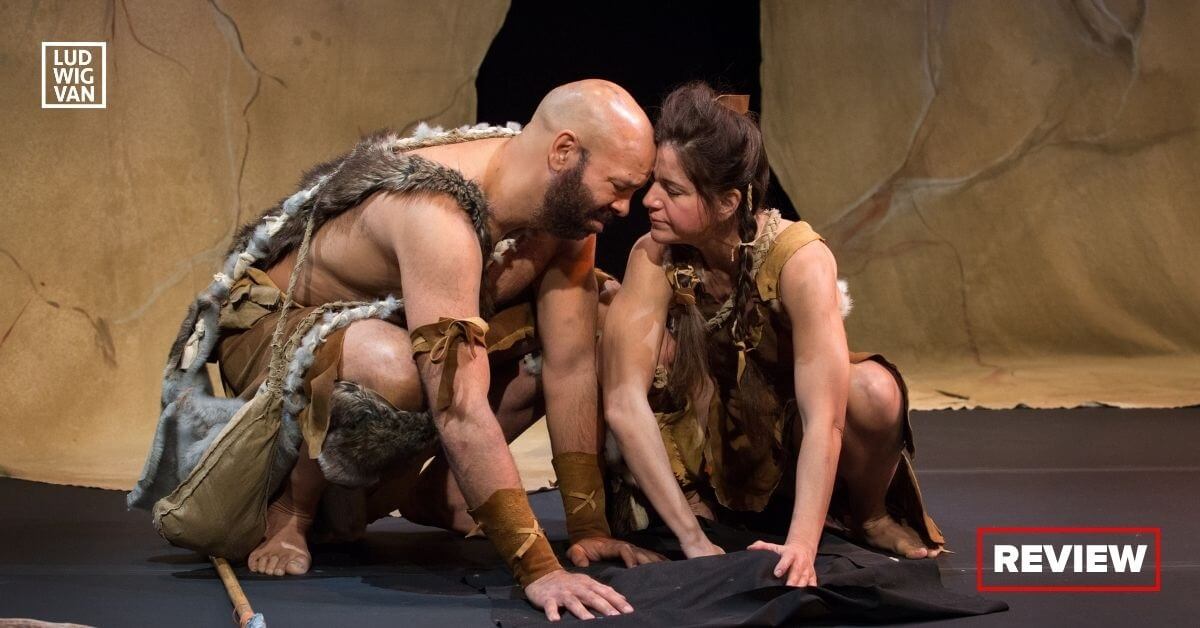
Tarragon Theatre/Orphan Song, written by Sean Dixon, directed by Richard Rose, Tarragon Mainspace, Mar. 27 to Apr. 24. Tickets available here.
I simply don’t know how to describe Sean Dixon’s new play, Orphan Song. Initially, my instinct was a dismissive laugh. So here are some words to address my dilemma, and anchor this world premiere in some context — radical, risky, visionary, gutsy, imaginative, clever, brave, admirable, difficult, dumb?
In short, Dixon attempts to create the world of our ancestors in 40,027 BCE when the Early Modern Humans (EMH) were sharing the world with the last of the Neanderthals who were dying out. In case you are thinking that this is the Flintstones, where modern life is imposed on primitive humankind, think again. Dixon’s burden is to set his action on what life was like 40,000 years ago.
At the beginning of the play, a human couple, Gorse (Beau Dixon) and Mo (Sophie Goulet), who have just lost a child, adopt a little Neanderthal child (played by Kaitlin Morrow), the lone survivor of the clan. Their nomad group also includes Gran (Terry Tweed), who is Gorse’s mother.
The play follows these hunter/gatherers through a series of adventures, aided by seven actors who function as a chorus of both flora and fauna. For example, the Neanderthals, and various animals, are rendered through body puppets devised by Morrow, who is listed as puppet master. In other words, the actors wear the puppets, who then move as their own bodies move.
To recreate how Gorse, Mo and Gran talk to each other, Dixon fashioned his dialogue from the “Swadesh List” which contains the 200 words considered basic to every language, and which, when you think about it, is quite an achievement. Thus, the primitive speech sounds a bit like “Me Tarzan, You Jane”. As well, apparently, 40,000 years ago, EMH could count to five. Who knew?
There is one very big problem, however. The humans have no common language with Chicky, as they call their adopted child, who doesn’t use words. Composer/sound designer Juliet Palmer, in collaboration with the cast, has devised a series of sounds to be Chicky’s Neanderthal language, and Morrow gives a remarkable performance that seems to mimic birds through a series of pipes, purrs, whistles, chimes and chirps that is divinely musical. In fact, the Neanderthals are referred to as Pipers for this reason. Palmer has also included some quite lovely choral singing, as well as primitive musical instruments used in the score.

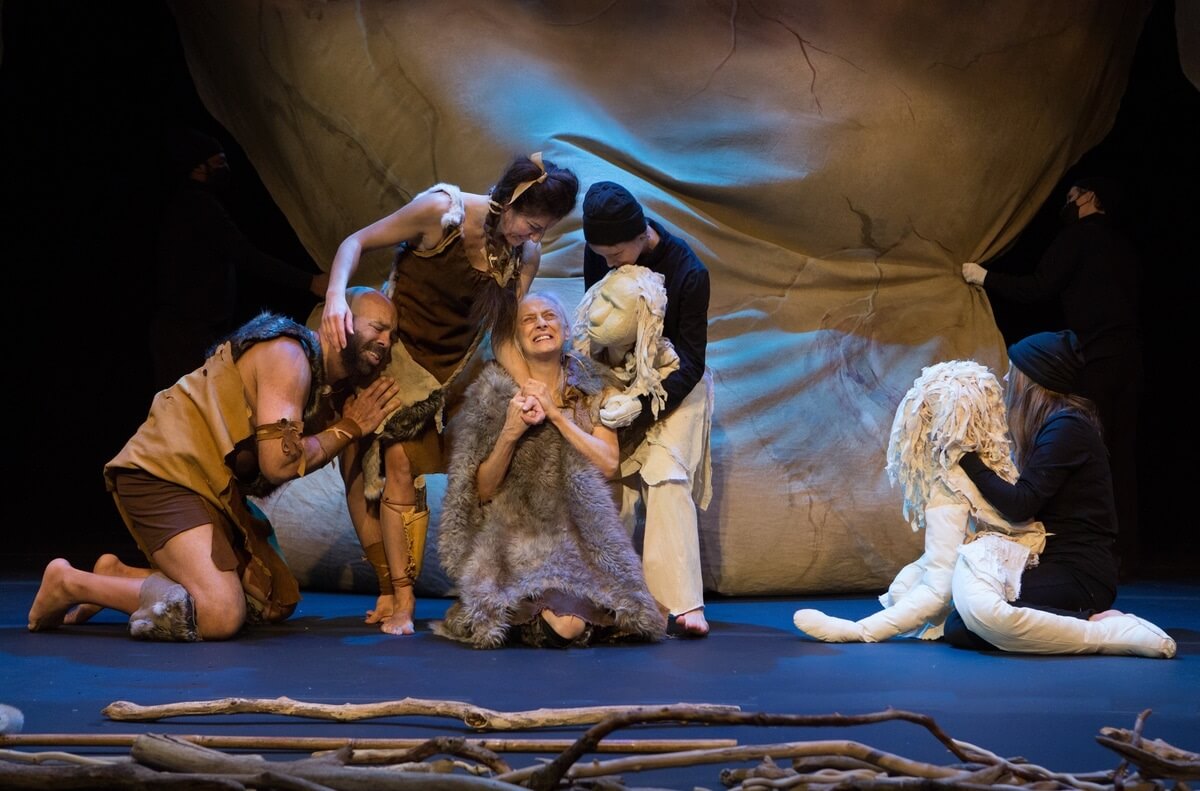
Dixon was inspired to write the play as a result of his wife and him adopting a 13-month-old little girl in 2014, and the difficulties of earning her trust. The needs of the child had to be prioritized, and they, as the parents, had to work hard to create the family dynamic. Gorse, Mo and Gran have a similar job to do in protecting Chicky in a dangerous world while building their new family.
The program notes state the main question that the play addresses is: “How do we love when we can’t communicate?” A corollary question is: “How are the bonds of family formed within clashing cultures?” While Chicky gravitates readily to Gran, and eventually Gorse, their relationship with Mo is very rocky, much to that grieving woman’s despair.
Charlotte Dean’s costumes for the three humans are suitably made out of skins and fur, while Graeme S. Thomson’s set design comprises three curtain drops that resemble both animal hides or a geological landscape. There is also a front rampart made out of wooden sticks. The chorus is dressed in black, but add props and costumes as needed.
Director Richard Rose took on quite a challenge with this play, which committed him to render life 40,000 years ago in some realistic fashion, and overall, he succeeded. He was also aided by a cast who played it for real. The Neanderthals might be puppets, but we feel their pain. We do sense the Gorse family’s treacherous lifestyle, them against nature, as it were. In particular, Mo’s anguish at Chicky’s rejection is a moving factor throughout.
There is also great imagination in how some of the scenes are manifest. For example, the chorus creates eye-catching visual images such as woolly mammoths and giant birds by the use of props and manipulating the curtain drops. They also cleverly create the moon through its phases by a series of signs carried at a slow walk.
Nonetheless, even though I was drawn into Chicky’s story, at the very back of my mind was the urge to laugh at the primitivisms in the language, which I admit, is my bad. (Apparently, “fuck” is on the Swadesh List.)
On the other hand, when someone mentions this play years from now, I bet that I’ll remember it in vivid terms. Orphan Song, after all, is one of the most unusual plays that I have ever seen. I’m just not sure it’s for all markets. You do have to suspend a lot of disbelief.
[Last Updated: April 13, 2022 — 2:00 pm EST. This article has been corrected to amend the misgendering of artist Kaitlin Morrow. We regret the error.]
#LUDWIGVAN
Get the daily arts news straight to your inbox.