
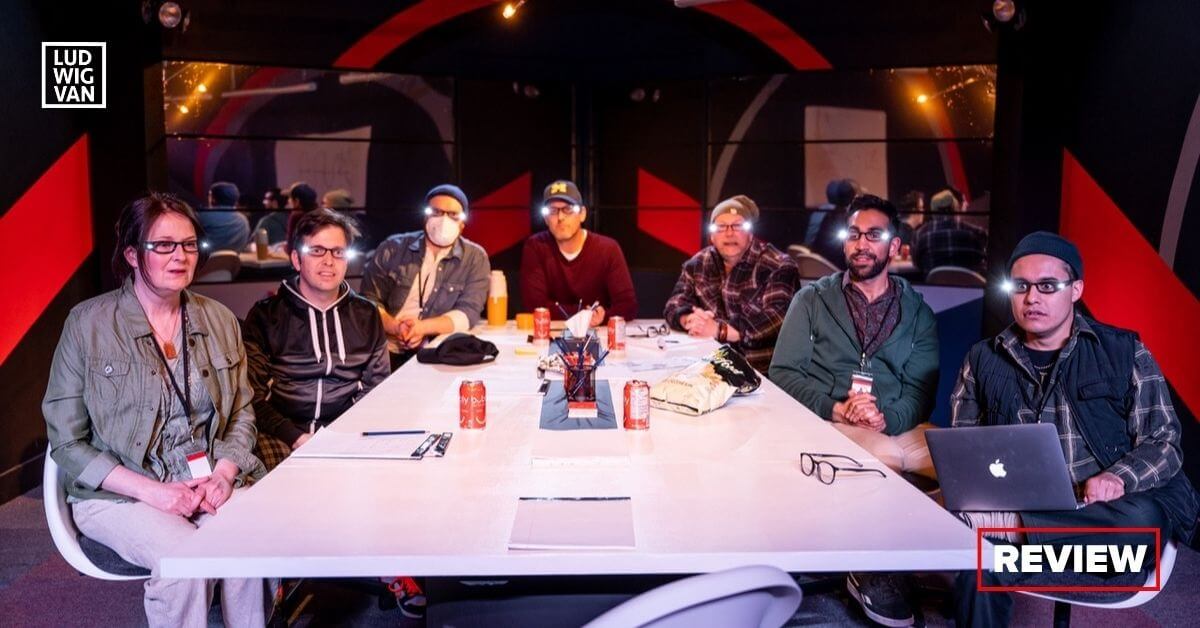
Coal Mine Theatre/The Antipodes, written by Annie Baker, directed by Ted Dykstra, Coal Mine Theatre, Apr. 3 to May 15. Tickets available here.
First, let me stress the fact that I’m a minority opinion. Others are going gaga over Coal Mine Theatre’s latest production of American playwright Annie Baker’s The Antipodes. Alas, I had trouble with the play itself, but not the production. I had so loved Baker’s The Flick (2014 Pulitzer Prize), that perhaps my expectations were too high.
Let’s talk about Coal Mine Theatre, however. In just six seasons, the company has risen to the top tier by presenting world-class plays that are substantive and challenging. Going to Coal Mine means getting a real dose of “theatre” which is what its devoted followers (including me) crave.
Now Baker’s The Antipodes is quintessential Coal Mine — namely, substantive and challenging. For me, though, the play is, overall, too vague and unresolved, despite the strong acting and directing. Yes, there is a compelling, even fascinating aspect to Baker’s theme of exploring the nature and importance of storytelling, but the play falters when it slips into magic realism. That flight of fancy, among other things, includes an apocalyptic weather event that threatens the building, and seems to have crippling consequences on the group. The mix of concrete theories about storytelling, coupled with pie in the sky speculations, do lead to a complicated and dense plot.
The Antipodes is set in a boardroom. There are eight men and one woman, Eleanor (Sarah Dodd). They seem to be brainstorming ideas about monsters under the leadership of Sandy (Ari Cohen). Apparently, Sandy led the team that created the successful Heathens, and so has been given carte blanche on this new project. Two of the writers/storytellers are Sandy veterans, David (Joshua Browne) and Danny M1 (Murray Furrow), as is Brian (Joseph Zita), who has been promoted from personal assistant to notetaker. They worship Sandy and the great storytellers who came before him.
Eleanor and the other three men are new. Eleanor seems misplaced, although she does have valid ideas that the men seem to ignore. Josh (Colin A. Doyle) is having trouble getting his identity pass and, as a result, is not getting paid. Adam (Nadeem Philip) is the quietest, but it falls to him to display the most vivid imagination. In perhaps the most moving scene of the play, Danny M2 (Simon Bracken) who tells an absolutely heartfelt truth about storytelling, is punished for it. What does that say about the glibness of some of the others?

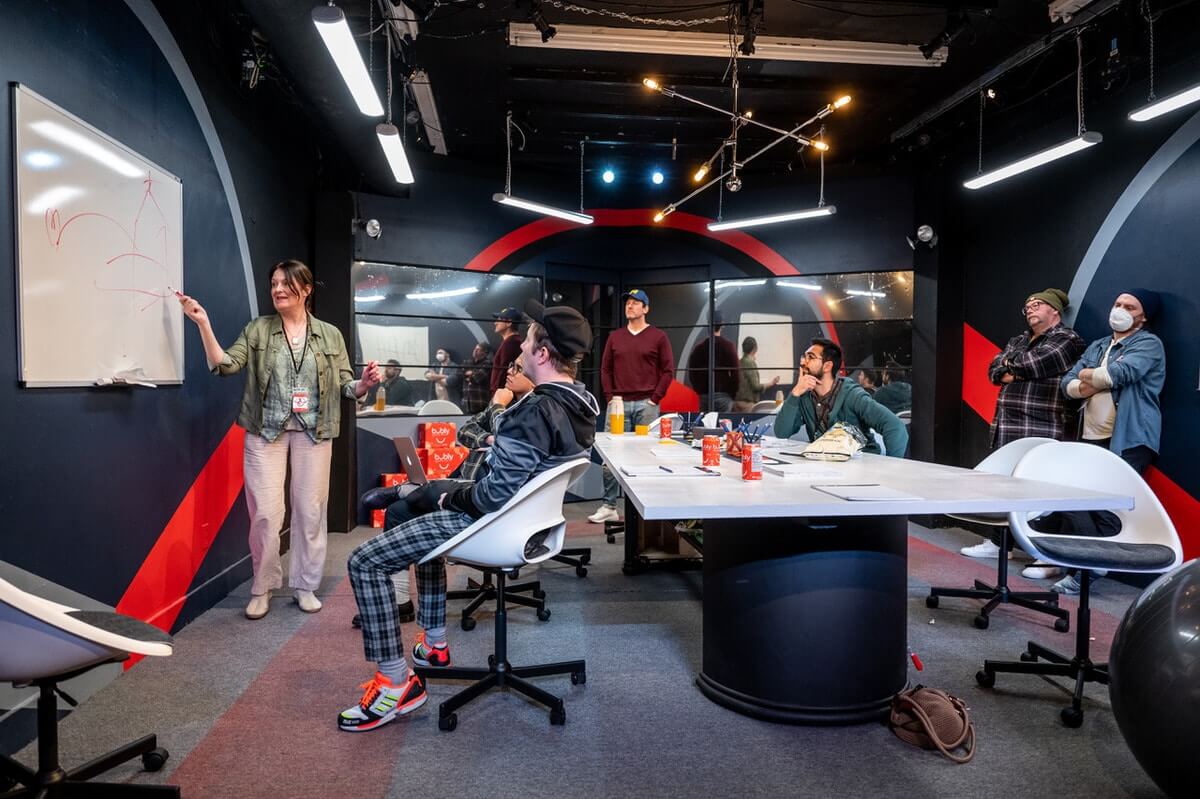
Then there’s Sarah (Kelsey Verzotti). She is Sandy’s cheerful little bundle of a PA who brings in their meals and does her boss’s bidding, even covering for Sandy when he falters. It seems Sandy’s wife has medical problems, which he either dismisses, or uses as an excuse to miss meetings when things aren’t going well. Sarah is an interesting role because the character clearly knows more than she is saying, particularly about the senior producers, who appear only by telephone or video link.
Baker is deliberately circumspect about just what this project is. A movie? A TV series? A board game? For the playwright, clearly, the storytelling process is the most important thing, not the what and why that are driving it. Sandy believes that the best ideas come from personal revelations (divulged under a cone of silence), so the group begins with how they lost their virginity, to somehow hearing an unbelievable retelling of Hansel and Gretel, to ending up with the most fanciful creation story ever told. What is true and what is not fly out the window.
Director Ted Dykstra changes days by having the actors change positions on stage, and most are present throughout. Nick Blais’ very realistic set contains all the accoutrements of a modern-day boardroom, including a large medicine ball for those who don’t want to sit on a chair. Blais also did the lighting, which has an interesting effect in creating the bigwig’s Zoom call. Alexandra Lord’s main costume design is for Sarah, who has a different outfit every time we see her. Andy Trithardt’s sound design covers the scene changes nicely.
In the end, I was never able to discover exactly what Baker wanted to say about storytelling, which is the point of the play. The Antipodes moves from mundane truths to fantastical fiction and back again, which leads to interesting, even compelling moments, but without an anchor.
And then there’s the title, and I always have to grapple with titles. The geographical antipodes are diametric opposites that draw a line through the centre of the earth. For example, Spain, Portugal and Morocco are antipodal to New Zealand. In other words, one’s antipode is the furthest possible distance away. So what are the antipodes in Baker’s play? I’m still working on it.
In short, the parts of Baker’s The Antipodes, for me, are greater than the whole.
#LUDWIGVAN
Get the daily arts news straight to your inbox.