
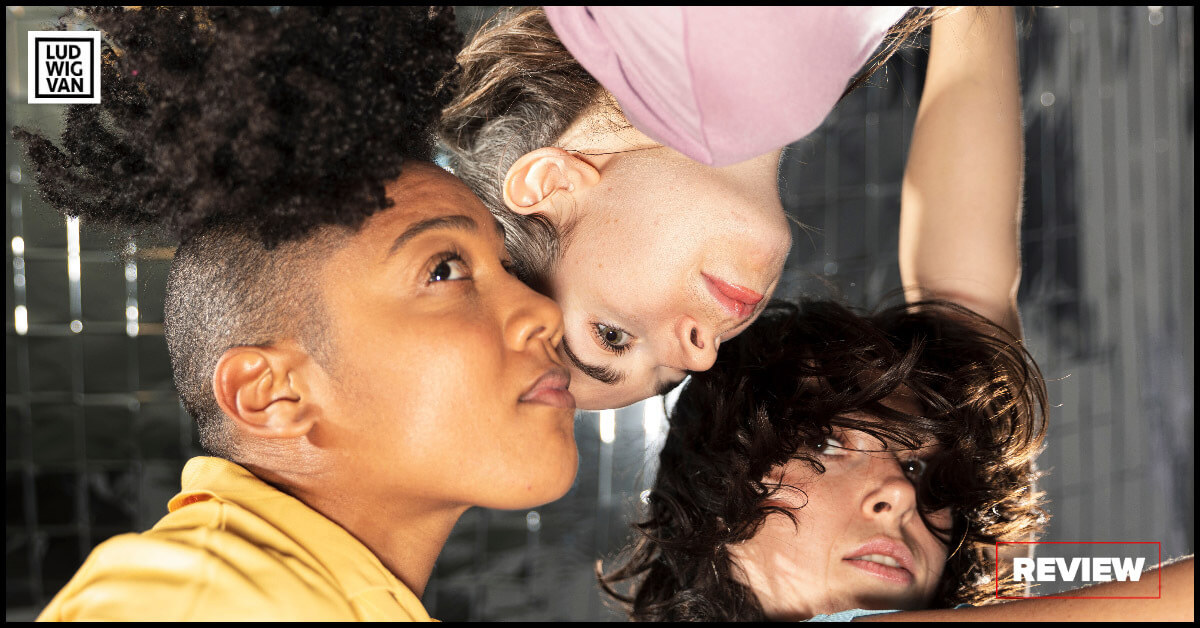
Citadel + Cie/On Air, choreographed by Heidi Strauss with the performers, The Citadel: Ross Centre for Dance, Feb. 18 to 19; 23 to 26. (Livestream Feb. 25.) Tickets available here.
The honour of welcoming back live performance to the Citadel has fallen to veteran choreographer Heidi Strauss and her new work On Air. The highly physical piece is challenging for both the dancers and the audience.
Strauss is among the most cerebral of Toronto dancesmiths. Using the basic premise of exploring human behaviour, usually through the medium of relationships, her goal is to anchor the audience in the shifting reality of the ever-changing world. Differing perspectives is everything in a Strauss work. What you see is not always what is obvious. She also never spoon-feeds the audience, which means the viewer must connect the dots.
The hour and 20-minute On Air merges live dance, livecam and pre-recorded projections and text. Strauss says in her program notes that she was influenced by the pandemic and the necessity of having to create some of the work in a virtual reality, resulting in the experience of being in the state of in-between. This led her to the broader question of the influences that have shaped us overall, and the way we connect to each other in the new normal. “The past and future are always in conversation in all of us,” she states.
These opaque themes translate to the stage in a physicality that is off-centre, captured by the three excellent dancers — Syreeta Hector, Jane-Alison McKinney and Amanda Pye — as always fighting to keep their balance through body movements that are awkward, angular and anxious. This is a dance of trying to find gravity and never quite succeeding, whether in solos, duets or trios.
The audience is sitting in chairs against the wall and in the round, which puts us up close and personal with the dancers. We immediately experience the unsettled, restless, seeking, angst-filled movement that is exhibited throughout the work. The dancers must maintain immense control while performing a punishing physicality.
The spoken word deals with great-grandmothers and grandmothers, all three of whom were, apparently, very strong women. This being a Strauss piece, however, the text is written in such a way that we feel we have arrived in the middle of a conversation. It’s up to us to figure out the nature of what is being said. There is also an allusion to a new baby, the next generation, as it were, and what the three dancers want her to learn from the great-grandmothers in the past, and the dancers in the current present.
Jeremy Mimnagh’s projections are surprising because you never know when they are going to flash on the two overhead screens. The most unusual, and in fact, most disturbing shot, is from an overhead cam. Taken at this angle, the dancers don’t look human because their bodies are flattened and lengthened as to be unrecognizable. These images, of course, add to the uneasy feeling of the piece as a whole.
Another piece of the On Air puzzle which Strauss has handed to us is André du Toit’s ravishing lighting. It is a wild kaleidoscope of non-stop shifting colours and shadows. The very dizzying quality of this dance landscape is another contribution to the off-balance nature of On Air.
Which brings us to Joshua Van Tassel’s original electronica score which mirrors the dance like hand to glove, sometimes gentle, other times harsh and unrelenting.
Even the costumes have a nervous edge. Alana Elmer has costumed the women in vintage clothing from her grandmother’s farm. They are a clash of different styles and periods, so the eye finds no rest in looking at them.
As Strauss say in her program note, “Through play and relationship, the dancers and audience approach the uncertain and unanswerable together.”
On Air absolutely engages the mind and the imagination.
#LUDWIGVAN
Get the daily arts news straight to your inbox.