
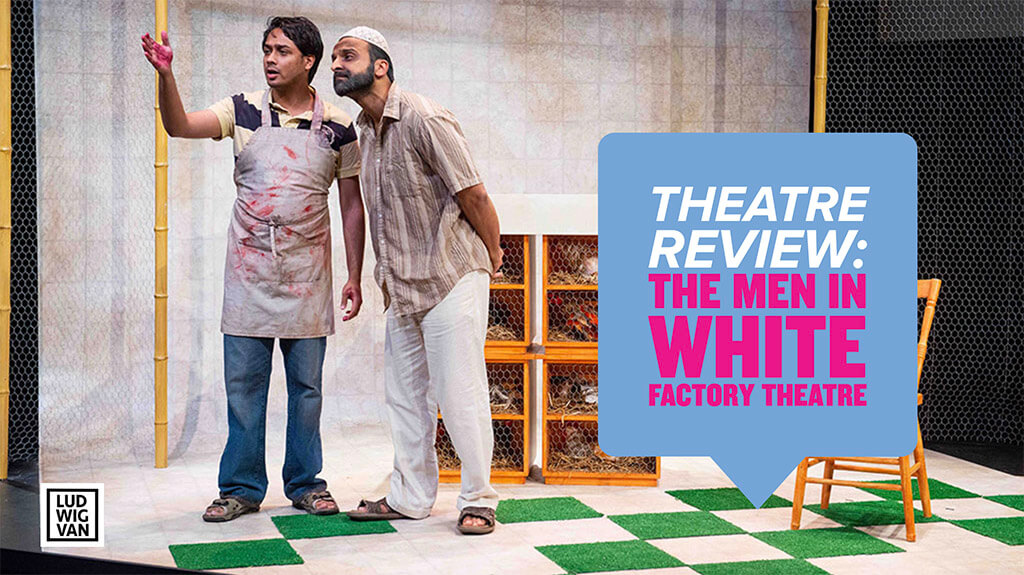
Factory Theatre/ The Men in White by Anosh Irani, directed by Philip Akin, Factory Theatre Mainspace, Oct. 13 to Nov. 4. Tickets available at 416-504-9971 or www.factorytheatre.ca.
This month there are two plays which are centred around sports teams. Sarah DeLappe’s The Wolves (at Streetcar Crowsnest until Oct. 27) is about a girl’s soccer team. The Men in White by Anosh Irani deals with a cricket team. DeLappe’s intention was to present teenage girls as complicated people. Her play is personality-driven. Irani is more interested in plot and storytelling rather than character development. (For The Wolves review, see here.)
Vancouver-based Irani is the author of four acclaimed novels and the hugely successful play Bombay Black (2006). Thus, The Men in White is a much-anticipated event. Sadly, the play, which premiered in Vancouver in 2017, is disappointing on several levels. First, the story aspects are obvious, and the ending is predictable long before it happens. I expected more depth from Irani. Second, Philip Akin’s direction is flat, and this production is not up to his usual high standard. Finally, there are a couple of actors who are miscast. Out of fairness, I should point out that The Men in White is a finalist for the prestigious 2018 Governor General’s Literary Award. Obviously, that esteemed committee sees more in Irani’s play than I do.
There are two concurrent stories happening in The Men in White. On one side of the stage is a chicken slaughterhouse located in Bombay’s mostly Muslim neighbourhood of Dongri. There we meet the owner Baba (Huse Madhavji) and his 18-year-old assistant and foster son Hasan (Chanakya Mukherjee). The latter does all the killing and the cutting, while Baba reads the newspaper and philosophizes. Hasan, who is a school dropout, has a crush on the 16-year-old, college-bound Haseena (Tahirih Vejdani). He becomes a nervous wreck whenever she comes into the shop. The other love of Hasan’s life is cricket, and he is apparently a very good player.

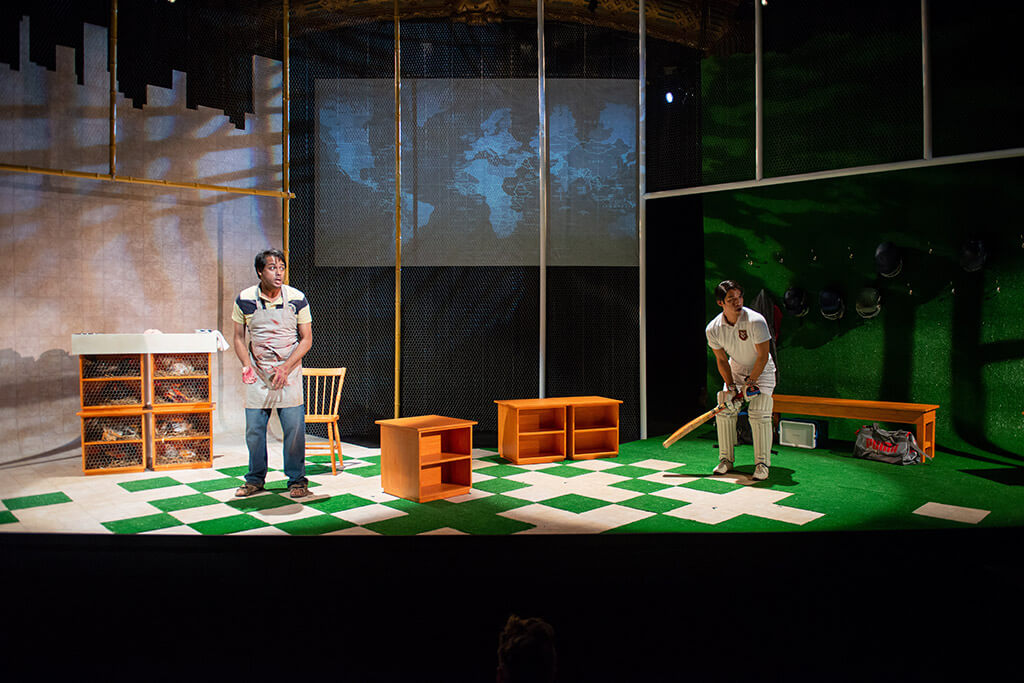
On the other side of the stage is a locker room in Vancouver. where we meet five members of a local cricket team. In the diaspora, South Asians of all varieties are going to come together to play their beloved sport, and Irani has cast a wide net. Randy (Sugith Varughese), the team’s captain, is a Hindu and a successful restaurant owner. He gives one of the strongest performances in the play. Doc (Cyrus Faird) is a Zoroastrian and a medical doctor. Abdul (Gugun Deep Singh) is a Moslem and an illegal immigrant who works as a cook. For comic relief, there is Ram (Farid Yazdani), who is a real good-time Charlie, and his friend Sam (John Chou) who is Chinese. The only reason Sam is on a South Asian cricket team is that he follows in Ram’s footsteps. Because of their dismal record, Randy want to bring Abdul’s talented brother Hasan (he of the chicken shop) over from India on a tourist visa to help them win some games.
During the course of the play, we follow Hasan’s tentatively growing mismatched romance with Haseena, which really does become repetitive over time. While Mukherjee does a lovely job at creating Hasan’s naïve innocence, Vejdani is just too old to play a schoolgirl. Back at the locker room, along with the discussions about how to get Hasan to Canada, we get religious conflict between Doc and Abdul, as well as stories about each man’s immigration experience, none of which is pleasant. The limp production is not helped by Doc’s weird accent that sounds more Scots than South Asian, or that Abdul mumbles his lines. Also, the men are forever tripping over their sports bags. There are some funny moments, particularly from Baba and Sam, but the halting pacing takes any zip out of the performance.
Perhaps the production will gel as the run progresses, but Irani’s superficial script is the play’s biggest failing.