The Truth About Love. Claire de Sévigné, soprano; Huw Montague Rendall, baritone/narrator; Rachel Andrist, piano. 12 p.m. Richard Bradshaw Amphitheatre, Feb. 14, 2018.
Given that yesterday was Valentine’s Day, what’s more appropriate than a recital of love songs? I attended a delightful one at noon, given by Canadian soprano Claire de Sévigné. She was joined by pianist Rachel Andrist, and a narrator, Huw Montague Rendall, someone unknown to the audience. His task was to read some of the poetry associated with the songs. More about that later.
This recital isn’t your ordinary, run-of-the-mill recital. It’s a perfect example of an intelligent and thoughtful thematic programming that we get all too infrequently in Toronto. When I travel to New York, London (particularly Wigmore Hall), and Munich, these recitals are the norm. This concert demonstrates that while art of the song will never be a hot seller, there will always be an audience for the best of the genre. When it is as thoughtful and well executed as this, it’s an unalloyed pleasure.
Titled The Truth About Love, it’s a 50-minute exploration into the journey of love, neatly arranged into five sections, all expressed in song. The pieces are well known, by Fauré, Debussy, Wolf, Liszt, Schumann, Strauss, Schubert, the usual suspects when it comes to love song composers from the Romantic/Late Romantic Period! It runs the gamut, from the initial passion of two people falling in love, to the utter bliss of a happy union, to the (hopefully not inevitable) pain of a break-up, and then to the distant memory of a love lost. The last segment is a cluster of pieces by contemporary composers, underscoring the universality of this most elemental of human experience.
From the first note on, de Sévigné sang with her trademark pure, fresh, sweet, crystalline tone, perfect for this repertoire. In the first group, Passion, the soprano captured beautifully the wide-eyed excitement of two people falling for each other. She did it through her voice, but also through facial expressions and hand gestures, always just enough and never overwrought. Her delivery of Debussy’s “Apparition” and “Es muss ein Wunderbares sein” by Liszt were particularly lovely.

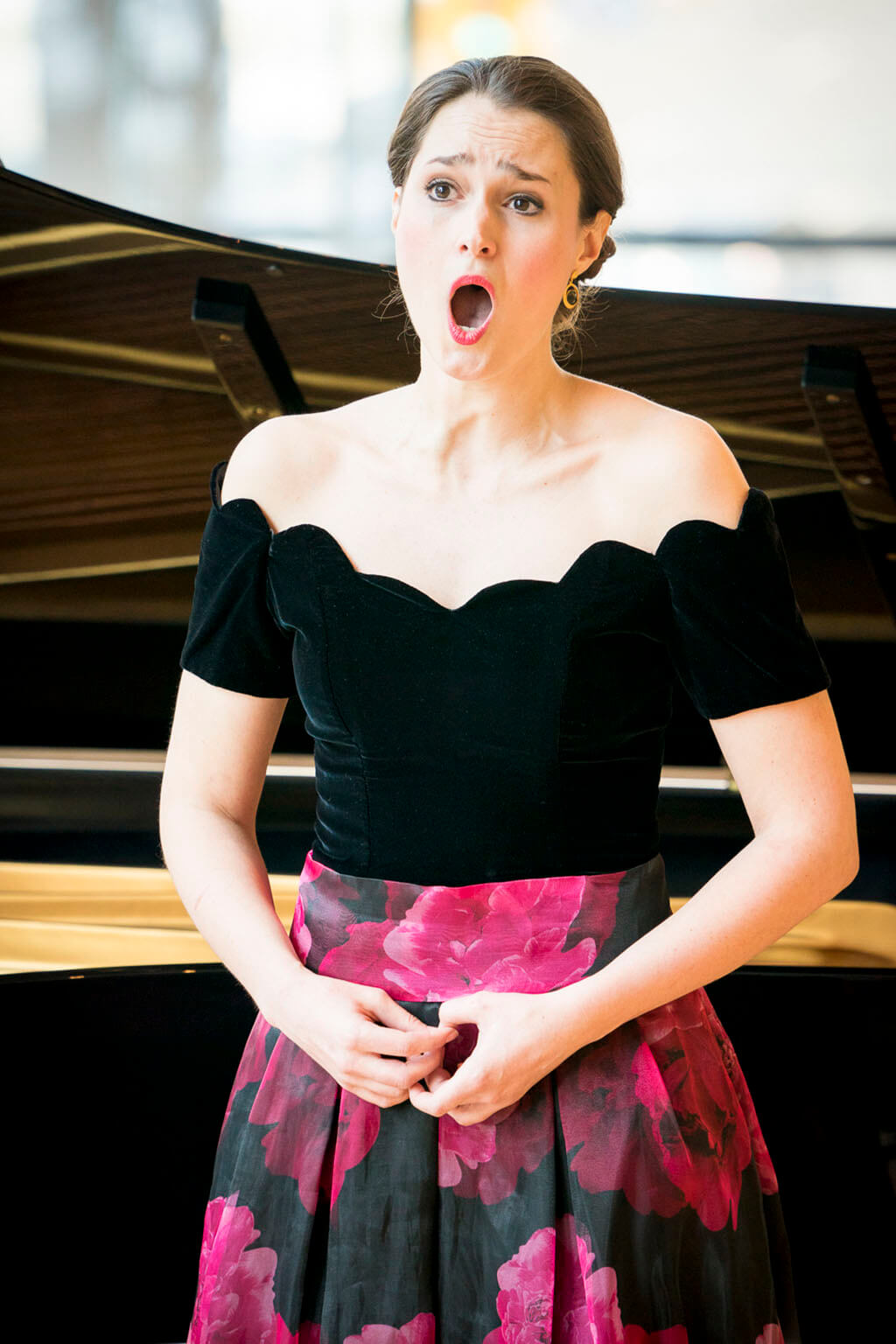
One could argue that her sweet and pearly timbre is too inherently happy a sound to be entirely convincing in depicting the trauma of a breakup, in the third segment, The Pain. But her vivid facial expression and body language helped a great deal here. The wistfulness and regret in her voice, in the fourth segment, The Memory was beautifully done. A very lovely “Apres un reve,” a truly inspired Fauré masterpiece. If I were to nitpick, her “Je ne t’aime pas” by that master of irony, Kurt Weill, lacked the edgy bite, the world-weary gruffness one has come to expect in this song. But you know what? I’ll take it.
The formal part of the concert ended with “contemporary” pieces by Hughes, Previn, Copland and Bridge. I put it in quotation marks as some of these were composed nearly a century ago, like Copland’s haunting “Pastorale” in 1921! Vocal recital devotees will recognize the Copland piece, and also Frank Bridge’s “Love went a-riding,” very popular in recital programs these days. The Bridge was sung by de Sévigné with such infectious joy that it brought the audience, restrained from applause earlier, to its collective feet. I would be remiss if I don’t mention the good work of collaborative pianist Rachel Andrist, a rock throughout. Sorry if it sounds like an afterthought — I don’t mean it to be.
A few songs I was hoping would be on the program but weren’t, such as Schumann’s “Widmung,” or Strauss’s “Morgen” and “Heimliche Aufforderung.” Well, maybe not the last one since it seems to be the domain of big male voices. In any case, the twenty or so she did sing, she sang quite marvellously. A most ambitious program, in three languages, a wide-ranging repertoire (although strangely nothing Baroque), covering all facets of love, requiring different styles and moods. And she did it beautifully.
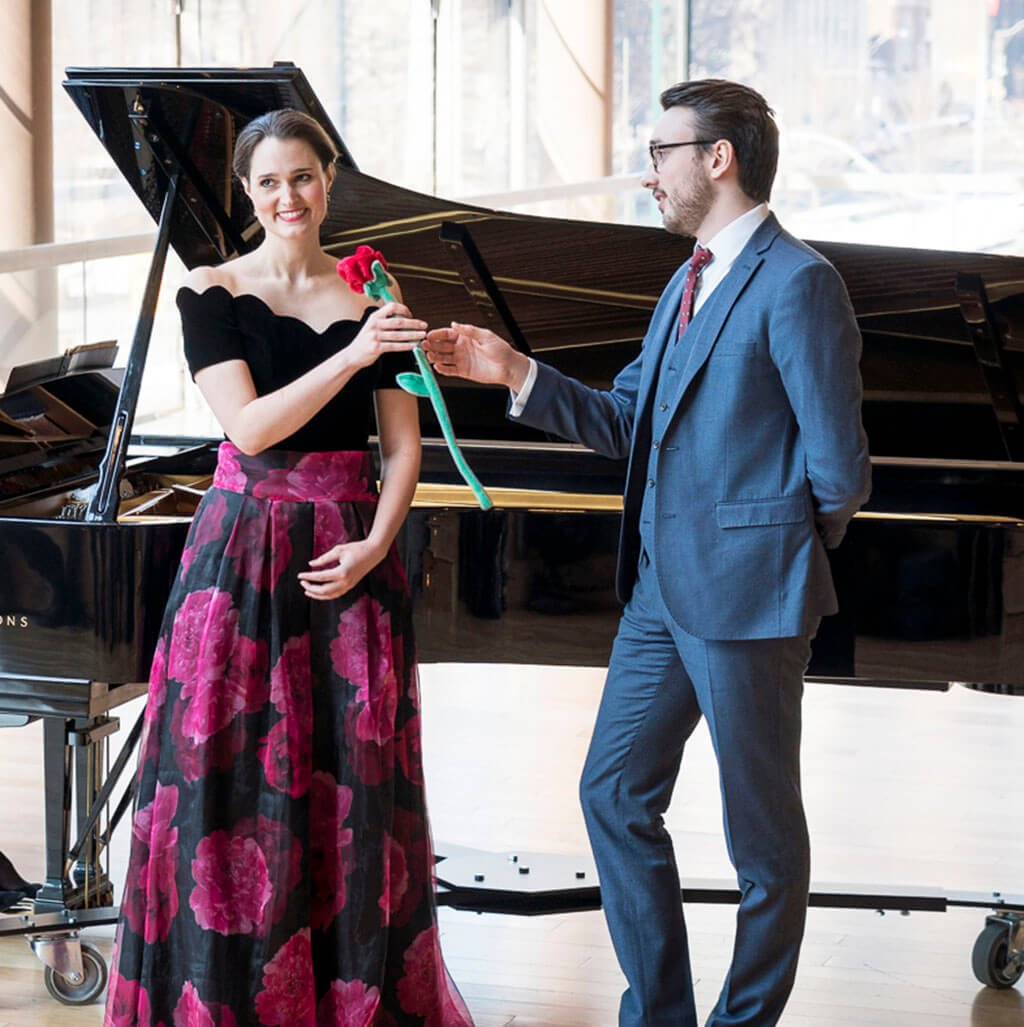
With the formal part of the program over, the audience rewarded the soprano and pianist with warm ovations. Then came the surprise from the soprano: “We have one more prepared. It didn’t make the cut in the formal program, but it served to inspire us. It’s a song by Britten.” Huw Montague Rendall, whom we had only heard his speaking voice up to this point, joined the soprano in a spirited and funny rendition of the cabaret song “Tell Me The Truth About Love,” set to text by WH Auden.
Not only does Mr. Rendall have a nice speaking voice, his baritone is equally stellar — mellifluous, warm, and focused. Knowing nothing about him, a bit of research for this article tells me that his father is British tenor David Rendall and his mother the British mezzo Diana Montague! I recall hearing David Rendall as Lensky in Onegin in Ottawa in the early 1980’s. Also, his magnificent “Fuor del mar” in the Met Idomeneo was unforgettable. Obviously, Huw Montague Rendall learned from the greats. At the end of the encore, he fished a red rose out of the Steinway and offered it to the soprano. Well, we should have known! Happy Valentine’s Day, Claire and Huw!
LUDWIG VAN TORONTO
Want more updates on Toronto-centric classical music news and reviews before anyone else finds out? Follow us on Facebook or Twitter for all the latest.