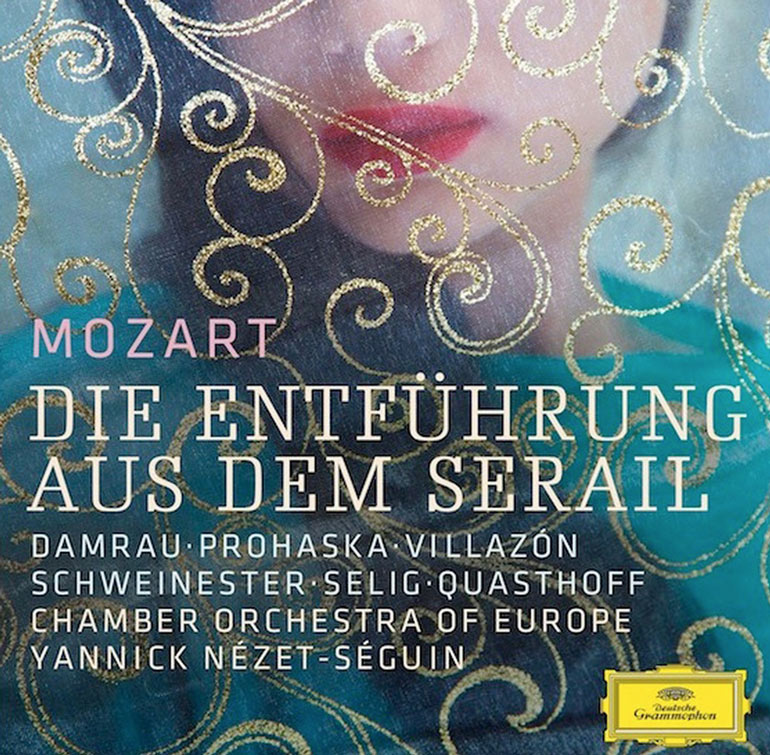

MOZART: DIE ENTFÜHRUNG AUS DEM SERAIL: Rolando Villazon (Belmonte), Diana Damrau (Konstanze), Anna Prohaska (Blonde), Paul Schweinester (Pedrillo), Franz-Josef Selig (Osmin), Thomas Quasthoff (Pasha Selim), Vocalensemble Rastatt. Chamber Orchestra of Europe/Yannick Nézet-Séguin. DG 479 4064 (2 CDs) Total Time: 139:02
This is the third installment in a Mozart Opera project headed by tenor Rolando Villazon and conductor Yannick Nézet-Séguin. On the strength of major successes with Don Giovanni and Così fan tutte, this latest release was eagerly anticipated. Briefly stated, it is at least as good as the performances which preceded it.
The performers participating in the Mozart Opera project gather together in July at the Festspielhaus in Baden-Baden for several concert performances which DG uses as the basis for its recordings. Villazon (one of the executive producers) appears in each opera, and Diana Damrau is featured both in Don Giovanni and Die Entführung, but otherwise the singers are different in each recording. Artistic continuity is assured in having Nézet-Séguin as the conductor for the entire project, and it is his thoughtful preparation and energy that distinguish the series thus far.
Although Nézet-Séguin’s orchestra plays on modern instruments, the style is very much historically informed. He takes great care to discourage excessive vibrato, and the use of open strings is encouraged throughout. A good example of this approach is the introduction to the Act 3 duet for Belmonte and Konstanze, where, as the lovers face almost certain death, Mozart conveys their anguish with music of the utmost poignancy. The way that he brings out the chromaticism in these opening bars and obtains maximum expressiveness in phrasing is quite remarkable.
Elsewhere, Nézet-Séguin shows a masterly sense of when to press forward and when to ease up. Another aspect of his conducting is the insistence on sharp, almost Beethovenian dynamic contrasts. This may be a small orchestra, but it has plenty of power when the drama requires it.
Rolando Villazon is an opera singer who puts his heart and soul into every performance. For many listeners, this makes him uniquely exciting, even charismatic. For others, he can seem over the top. In his first aria, “Hier sol lich dich den sehen”, which follows the Overture, Villazon sings beautifully. Later in the opera, he has several more demanding arias and tosses off the technical difficulties in these with aplomb. Occasionally, his voice seems strained, but on the whole Villazon offers a far more multi-faceted Belmonte than we are used to hearing.
Diana Damrau as Konstanze sails through some of the most difficult music Mozart ever wrote for a soprano with absolute security. Anna Prohaska as Blonde has plenty of demanding top notes of her own to contend with, and she too is wonderful. In fact, the entire cast of six could hardly be better. Talk about luxury casting. Although Thomas Quasthoff is no longer singing, he is excellent here in the speaking role of Pasha Selim. The Muslim leader becomes a real person in this performance, ardently wooing Konstanze, venting his anger over what Belmonte’s father had done to him, and in the end, giving the young lovers their freedom:
Sail back to your home and tell your father that you were in my power and that
I let you go, so that you might tell him that there is more pleasure in repaying
injustice with good deeds than matching evil with evil.
How timely in this age of Muslim extremism to be reminded of the beneficent actions of a Muslim potentate, albeit a fictional one.
Available for purchase via iTunes and Amazon.com.
#LUDWIGVAN
Want more updates on Toronto-centric classical music news and review before anyone else finds out? Get our exclusive newsletter here and follow us on Facebook for all the latest.


- SCRUTINY | TSO Lets Berlioz Do The Talking In Season Opener - September 21, 2018
- RECORD KEEPING | Even Yannick Nézet-Séguin Can’t Make Us Love Mozart’s La Clemenza di Tito - September 6, 2018
- RECORD KEEPING | Giovanna d’Arco With Anna Netrebko Explains Why The Best Operas Survive - August 30, 2018