
In three performances starting Friday at the Al Green Theatre, Toronto Masque Theatre pairs a baroque-era favourite, John Blow’s Venus and Adonis, with The Lesson of Da Ji, a newly commissioned work from composer Alice Ping Yee Ho and librettist Marjorie Chan.
This pairing, entitled The Lessons of Love, is not just about juxtapositions of old and new or East and West. It is all about the happy coexistence of all sorts of aesthetic differences — exactly the way they do every day in the city of Toronto itself.
The Toronto Masque Theatre orchestra is led by artistic director Larry Beckwith on period instruments — which are joined by traditional Chinese erhu, pipa and guzheng.
Longtime Toronto Masque Theatre dancer and choreographer Marie-Nathalie Lacoursière is working alongside Peking Opera expert William Lau, of the Little Pear Garden Collective. Lacoursière directs Venus and Adonis. Derek Boyes directs The Lesson of Da Ji.
The singers are Vania Chan, Charotte Corwin, Benjamin Covey, Alex Dobson, Derek Kwan, Marion Newman, Xin Wang, and Timothy Wong.
I ask Ho and Marjorie Chan if it was intimidating to be commissioned to complement an iconic Western piece.
They both burst out laughing. “I didn’t even have time to consider it,” says Chan.
They both wanted a personal story, something that anyone would be able relate to. Ho’s inspiration was Daji, a classic femme fatale with a sadistic streak from the time of the Shang Dynasty, nearly 3,000 yeas ago. She is a figure still prominent in Chinese culture.
In reality, the episode Chan chose for the opera The Lesson of Da Ji should come with one of those spoken warnings from the evening news on TV: “Some viewers may find the images disturbing.”
One character’s demise is pretty much the most gruesome fate anyone could imagine. But it’s all part of a larger story that has a lovely little stringed instrument at its core.
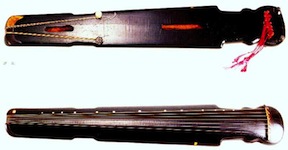
The new opera’s score owes a lot of Peking Opera in its patterns and sounds. Ho says that’s because she wanted to respect that tradition, one that she has been immersed in through previous collaborations with Lau.
Except that here, the guqin and gamba get to play together, which is something totally new.
“The philosophy of playing instruments is entirely different” in Western vs Chinese traditions, says Ho. “Chinese instruments need time to vibrate,” she explains.
So the first draft of her opera score came in at 90 minutes, well over the time limit of one hour. Chan had revised her libretto down by September, but Ho didn’t finish writing the music until about a month ago.
The two collaborators finish each other’s sentences and share easy laughter. Given that it’s their first collaboration, it looks like everything turned out well.
“We’d love to try and work on something else together,” smiles Chan.
“We got to understand each other’s rhythms,” adds Ho.
In the course of our conversation, I discover one more thing that binds this piece to the centuries of opera tradition: popular music.
Verdi’s operas are full of quotations of songs heard on the street, for example. Ho reveals that the whole second half of the score for The Lesson of Da Ji is based on a Chinese drinking song from around 200 A.D., with all sorts of variations to hide it.
“But the pipa player recognized the tune,” Ho laughs.
For all the details on this double bill, click here.
John Terauds