
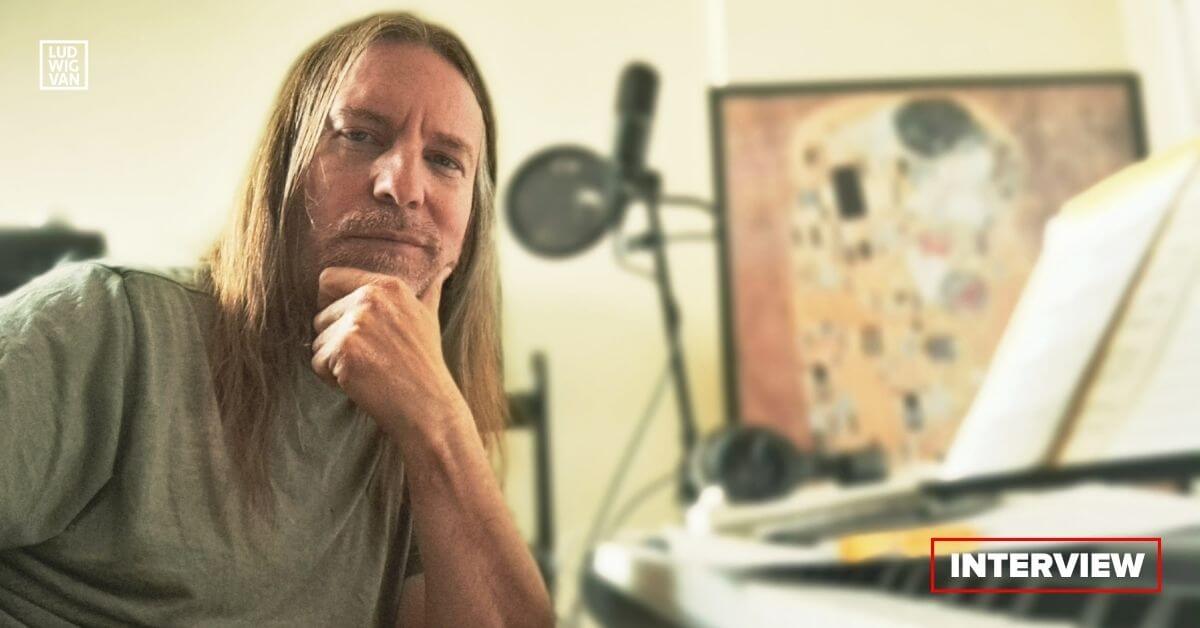
Toronto composer Matthew Reid recently released a new piano album called Moods of Limited Transposition (Book II). It’s the second release in a planned four-part project that will eventually consist of 36 short piano pieces.
Reid’s inspiration comes from the historic examples of Bach and Chopin. Interestingly, he is the only person who has led both a Second City Mainstage show and a Toronto Symphony Orchestra performance.
LV caught up with Reid to ask about the new album.
The Soundtrack of Life, an excerpt from The Second City Guide to the Symphony:

Matthew Reid, Composer & Pianist
Toronto native Matthew Reid has composed music for films, television, games, and theatre. Among other things, he’s got a distinct specialty in the field of comedy. All together, Reid spent more than a dozen years at Toronto’s acclaimed Second City in a variety of roles, including Music Director of the Training Centre, and then the Mainstage. He served as Primary Composer and Musical Director from 2006 until 2015.
His comedic musical, titled The Second City Guide to the Symphony, has been performed by orchestras across North America since its composition in 2014. His classical music revue Mass Hysterical: A Comedic Cantata featured Colin Mochrie, Russel Braun, and members of the Toronto Symphony Orchestra.
In 2016, he worked with Derek Frey (known for his collaborations with Tim Burton) to compose the music for the award winning horror short Green Lake. He also wrote the score for Jon Stewart’s 9/11 feature documentary No Responders Left Behind (2021).
Matthew has also written music for dance, including Ashe by Newton Moraes Dance Company, performed by Pulga Muchochoma and filmed by Red Violin producer, Barbara Willis Sweete.

Matthew Reid: The Interview
“When (if?) completed, it will comprise 36 short works, the longest, most difficult project I’ve ever worked on, and I will probably drop dead from mental exhaustion. Although eccentric (how could that be?) they’re also approachable, and I think some of you (many) will find them interesting, mysterious, or striking,” Matthew says in a statement.
In composing the works, Reid began with a rule: once he plays a specific chord combination, he never repeats it in that piece. It’s a nod to Olivier Messiaen’s musical modes of limited transposition.
In his Moods of Limited Transposition, Reid has used the principle to create a sound world that is both minimalist and atmospheric.
“It’s a play on his theoretical work, substituting moods for modes,” Reid explains. “I convinced myself to use one of the things I’ve been playing with over the years. I call it curated permutations,” he continues.
“I use three-note chords, they can be spelled six different ways. Four note chords can be spelled 24 different ways. It was kind of a Pandora’s box. I opened it once, and once I started it I thought, I have to continue.”
The whole project began with the first few pieces, before he had a bigger project in mind.
“When I wrote the first one, they were just preludes or little pieces,” Matthew recalls. “Maybe I should start writing a piece a day. This is a year after I’d made a resolution to write a piece a month just to get back into the swing of it.”
He recalls a professor at the University of Toronto who’d accomplished the same goal. It sounds like a simple principle, perhaps deceptively so. “It became nowhere as easy as a piece a day,” he says.
“It ended up being much harder than that. A lot of scrunched up paper.”
His “rule” came from the desire to avoid repetition. “Not repeating yourself — mowing the same lawn again and again,” he says. Listeners will quickly catch on to your repeated patterns. “They already know how this ends.”
Reid says it resulted in a productive work process. “It got into a groove, and I don’t mind this sort of idea of these small tertiary form pieces,” he says. “Look for a surprise in the B section,” he adds, “a contrast. But, hopefully not too obvious in how you’re developing [them].”
He’s thinking about people who might listen to a lot of music that is written in this kind of form. “I didn’t want anyone to see who the killer was on page three, including myself.”
Mass Hysterical: A Comedic Cantata

Composition
“Inspiration,” he says, “I think most of them — frustration. It’s part of the process.”
Each piece has a different mood or association, but he wants to avoid too literal an interpretation. While he creates them with a certain emotion or idea, he’s titled the movements only with numbers. “It’s meant to be broad; they’re not in the title.”
That initial spark of inspiration may also change as he’s writing. “Gentle, calm, et cetera… They start there, but they don’t necessarily end there.”
Though most of the pieces are quite short (the longest is 2:49), he reworks and polishes them multiple times. “That’s what makes composition interesting,” he says.
“If you’re lucky, you can add one bar at the end or beginning, that […] creates a sense of discovery 20 bars later,” he says. “There was a lot of that.”
Technology helps by taking on the drudge work of transcription. “I don’t know where I would have been without electronic notation,” he says. That said, he also writes music old school style at times. “I still use pencil and paper.” That often happens when he’s working out ideas for certain types of pieces.
But, using an electronic work station offers an easy way to edit. “It’s the ability to visually compose,” he says. “You can see it more, you can see it shaped more, and hear it immediately. I still compose at the piano for the most part.”

Style
Reid majored in music theory at university. It doesn’t make it any easier to pin down his own style.
“It’s always a hard thing,” Matthew says. “In 2026, it’s become even easier to research who has done things,” he adds. When he began, it was more difficult to contextualize without extensive research. He recalls being at university and playing the work of a Russian composer who’d used similar concept of serialism for his work. “I didn’t recognize what they were doing,” he says.
In the end, he sees himself as a composer of his time. “I’ve just thought of myself as contemporary classical music.”
That’s where he uses AI —to point him towards discussions of musical theory. “It could point me to conversation threads where they’re discussing this very thing,” he explains. It was in one of those discussions that he found references to American composer Tom Johnson, who used mathematical concepts in his work. “I suspected there was at least one [composer] who did that, albeit in a very different way.”
Reid was looking to create his own sound using the ideas he found. “I was very conscious of not trying to sound like the poor man’s version of other composers,” he says, “trying to avoid neoimpressionism or neoromanticism.”
Along the way, he came up with his own theories. “I call one of the techniques I use curated permutation. It’s not strict permutation,” Matthew explains. He carefully selects a nine-note scale that offers a set of chord progressions.
While it begins with theory, though, it develops musically. “And then, making it sound like something I’d like to listen to,” he says.
That’s the root of what he strives for as a composer — to have the same kind of impact as the music that first inspired him. “I discovered the Well Tempered Klavier, and I discovered The Messiah. It was in our piano bench. They were the most magnificent things I’d ever discovered,” he says.
“My favourite works of art are those that made me want to work.”
Every month, he shares his work in an online salon with other artists. “It’s a show and tell,” he explains. It gives him an impetus to keep working on a regular basis. “I would like to have something new.”

Moods Of Limited Transposition
Reid hopes to release the remaining two books of his planned series by the end of this year, although paying gigs have gotten in the way since he started.
“Almost six months I spent on the first two books,” he says. “I took a little break. I’ve started No. 1 in Book III. I’m on my third rewrite,” he adds. “The original idea was to have it done within a year. Probably January, February, we’ll see.”
Although the pieces are short, it doesn’t translate into easy or quick when it comes to composition. “Short pieces — condensing it is its own sort of art,” he says.
“After Book I, a few of those pieces went beyond four minutes, even five minutes. The idea too, is that the harmonic language expands as the books progress,” Reid explains. “I explore the idea of transposing the modes.”
By Book IV, he wants to have explored each mode in full.
Listen To The Music
Are you looking to promote an event? Have a news tip? Need to know the best events happening this weekend? Send us a note.
#LUDWIGVAN
Get the daily arts news straight to your inbox.