
Brott Music Festival: Gorecki Immersive: Symphony of Sorrowful Songs. Jocelyn Morlock: Disquiet (2006); Górecki: Symphony No. 3, op. 36 “Symphony Of Sorrowful Songs”. National Academy Orchestra Of Canada, Tania Miller, conductor, Ilan Mendel, assistant conductor, McKenzie Warriner, mezzo soprano. July 4, 2026, Church of the Ascension, Hamilton, ON.
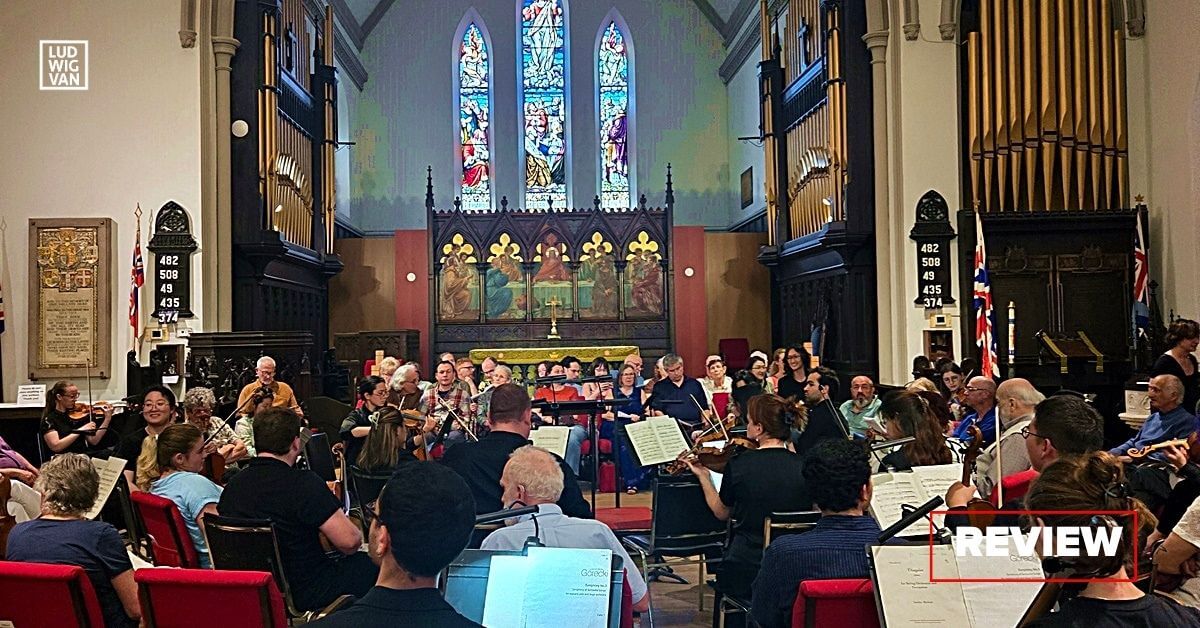
The Brott Music Festival’s Immersive concerts take place in the 139-year old Church of the Ascension, just south of Hamilton’s downtown. It’s a gorgeous, grand — and acoustically friendly — Gothic Revival structure with a spacious feel.
The “Immersive” part refers to the fact that the audience is seated among the musicians, quite literally. The black musician’s chairs are interspersed with the red audience seats in a round configuration around the conductor’s podium, offering the chance to experience the music immersed in not only the sound, but the musicians themselves as they work.
Górecki’s Symphony No. 3, with a short introduction by Jocelyn Morlock’s Disquiet, was the perfect pairing for the environment.

Jocelyn Morlock: Disquiet
Ilan Mendel, assistant conductor of the NAO this summer, led Morlock’s 2006 piece Disquiet, a well chosen prelude to Górecki. The piece is moody and emotional, and plays with the colours of the orchestra from the bright tones and shimmer of the vibraphone to the darker side of the lower strings.
Disquiet is cinematic in scope, and builds a sense of tension only to break into a lighter section. It’s a very affecting piece of music, and a reminder of what a shame it is the classical music world lost Morlock too soon.
Górecki: Symphony No. 3, op. 36 “Symphony Of Sorrowful Songs”
Górecki, a Pole, wrote his third symphony around three different texts, and in Polish history, there is certainly enough to create a wealth of sorrowful material. However, as conductor Tania Miller pointed out in her opening remarks, the composer resisted the notion that the piece referred to specific historical events. His intent was to create a work that reflected anyone’s sorrow, in particular, the depth of emotion between a mother and child.
The three texts include, in the first movement, a 15th century lament of Mary as the mother of Jesus, speaking to him as he dies on the cross. In the second movement, the soprano sings the word that were inscribed on the wall of a cell of a Nazi prison during the Second World War by an 18-year old girl. She addressed the words to her mother, telling her not to cry, and calling on the Queen of Heaven to support her. The final movement comes from a folk song that is thought to date from the time of the Silesian Uprisings of 1919 to 1921. In it, a mother searches for her son, and mourns his loss in the conflict.
Written in 1977, the piece is seen as a kind of bridge between Górecki’s earlier, more avant-garde work, and his later period when he re-embraced tonality.
Miller finished her remarks with, “I hope for you that it is a profound experience.”
It was.
Performance
The piece begins with the basses, who enter one by one in a canon that repeats the melody at staggered intervals. The lovely dark tones of the instruments set an appropriately solemn tone.
Gradually, the cellos, then violas, then violins also join in, and the piece rises in a melancholic swell of emotion. Bassoons, trombones, and a contrabassoon contribute to the dense texture of the music in the first movement, as the melody weaves together.
As the piece unfolds, it does so in similar waves of emotion and intensity. Throughout the work, the musicians maintained a wonderful sense of both tone and emotion.
The challenge for both the composer and his interpreters is to create movement where the overall mood is so dark. Górecki handles it masterfully in the score with ebbs and flows of energy, wielding the colours and dynamics of the orchestra in an unending undulation of organic movement.
For the musicians, it requires a high degree of sensitivity and commitment to carry his intentions through. That was in evidence with the NAO, whose energy and focus never wavered. Barring a few short passages for various instruments, including violins, flute, and the lower strings, it’s a true ensemble piece, where all of the parts need to be firing on the same level.
McKenzie Warriner, Soprano Soloist
Soprano McKenzie Warriner’s performance crystallized the emotions of the work, offering both the darker aspects of sorrow and despair, and if not hope, then a kind of solace at times. There was a good balance between her voice and the orchestra for the most part, with only a line or two as she sang in her lower register becoming overwhelmed by the music.
Warriner has just the right sort of voice for the work — with a tone that’s pure and warm, and can range from dark lower notes to soar high above the orchestra. She delivered the anguish of all three women represented by the texts, from holy mother to imprisoned girl to mother again in a thoughtful performance.
Final Thoughts
I sat in the middle of the cello section, with basses to my left and far right, percussion behind me, and woodwinds to the far left. I could have followed along with the cello score, but found it far easier to get swept along with the sound. Likewise, much of the audience seemed very interested in the musicians of the National Academy Orchestra as they played.
The full house, including the floor and some balcony seats, sat is rapt silence, with nary a cough or throat clearing for the entire duration.
It was truly a magical and moving experience. Performing in that kind of configuration must require an intense kind of concentration, and the young musicians of the NAO were more than equal to the task.
You can catch the second Immersive concert later this summer. Appalachian Spring Immersive takes place on August 6 at the same atmospheric venue. Find details [HERE].
Are you looking to promote an event? Have a news tip? Need to know the best events happening this weekend? Send us a note.
#LUDWIGVAN
Get the daily arts news straight to your inbox.