
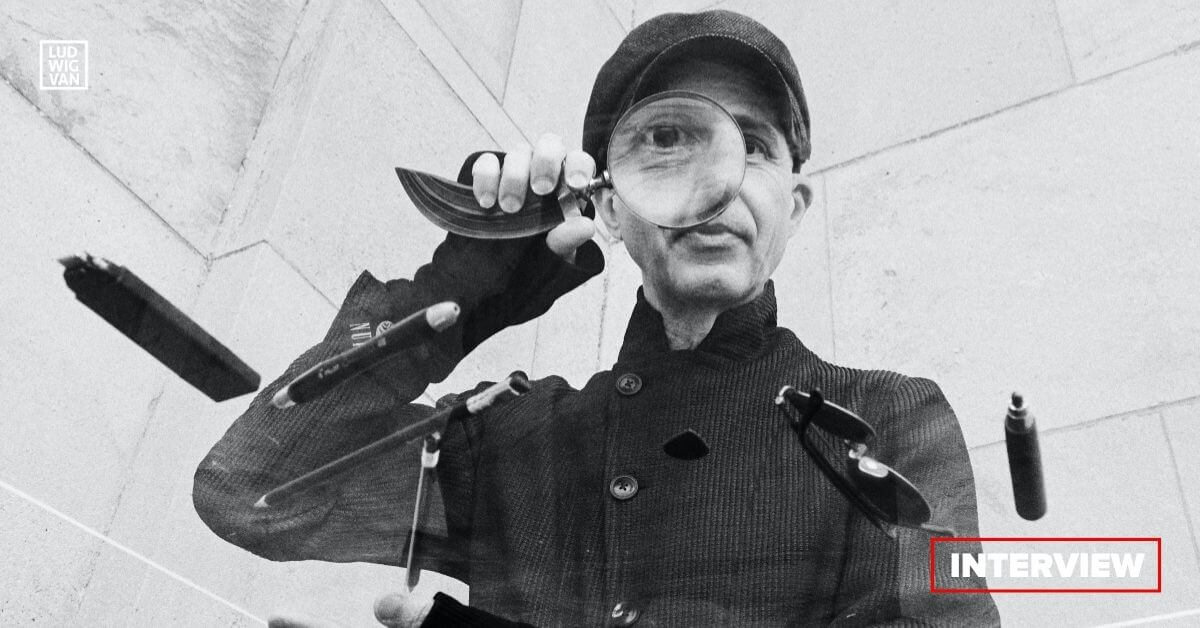
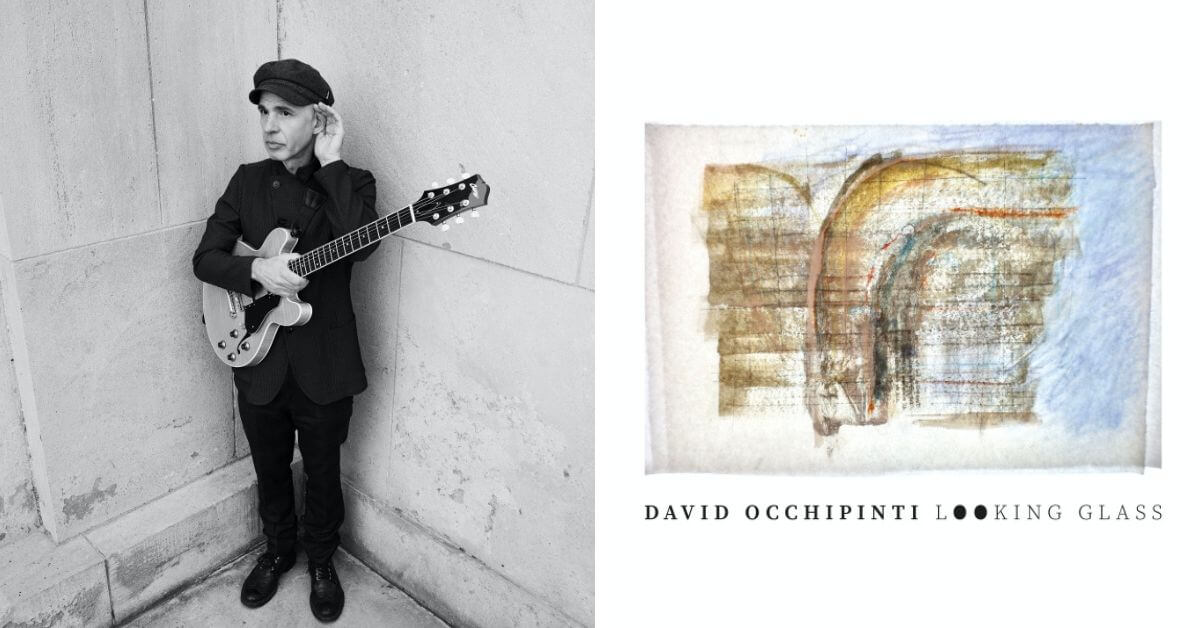
Toronto guitarist and composer David Occhipinti is releasing a new album of original music on the Elastic Recordings/ Occdav Music label. Looking Glass, written for electric guitar and string trio, along with other guest artists, will drop on June 12, 2026.
On the new album, he works with a variety of artists, including percussionist (and Officer of the Order of Canada) Beverley Johnston, mezzo soprano Alex Hetherington, and soprano Charlotte Mundy, along with his regular collaborators, Aline Homzy and Steven Dann on violin and viola respectively, and Maria Zachariadou, associate principal cellist of the BBC Philharmonic.
David Occhipinti
Canadian composer and guitarist David Occhipinti works in the field of jazz, improvisation, and contemporary classical music. He has received two Chalmers Arts Fellowships from the Ontario Arts Council. Two of his recordings, Forty Revolutions in 2007, and Duologue, his 2003 collaboration with saxophonist Mike Murley, have been recognized by JUNO nominations. David’s recordings have been broadcast on the CBC and BBC.
His 2025 release Camera Lucinda featured eight tracks of chamber music with improvisational elements.
Saturnia (2022), his first orchestral work, was part of the Toronto Symphony’s Explore the Score reading event that occurred at Roy Thomson Hall in October of 2022. Other classical works include a commissioned piece for brass and percussion written for the Ottawa Symphony Orchestra to compose a piece for brass and percussion. The work, titled En Passant, received its premiere in Ottawa on May 1, 2022 with Jean-Michel Malouf conducting.
Other commissions and recordings include the track Net of Gems for flute and harp, which appears on a recent recording by Suzanne Shulman and Erica Goodman, along with music written for percussionist Beverley Johnston, Kairos Percussion Quartet, Arraymusic Ensemble, Canadian Children’s Opera Chorus, and Random Access Large Ensemble.
David studied music in New York City with Jim Hall, and spent three years living in Italy. He has been based in Toronto since his return to Canada. As a performer, he has toured across North America, Europe, and in Japan.

David Occhipinti: The Interview
Occhipinti’s musical journey began with performance.
“I started playing guitar, learning Beatles songs,” he says. “At about the age of 16, i just started writing things on the guitar, and on the piano. I started on piano.”
His knowledge of music theory took a while to catch up.
“I think even my very first composition, there were certain chords, I didn’t know how to name them. So I just wrote them out.”
Writing music was a release. “It’s a great way to express yourself,” he says. “I was a teenager, so if you have a lot of things going on emotionally that are difficult, it was a great way of [using it as therapy],” he adds.
That’s not to say that every work is an expression of an emotion. ”Sometimes I write the opposite of [what I’m feeling],” David explains. “Creativity just makes you feel good. That’s why I’m still hooked,” he continues.
“It’s probably my favourite thing in life is to compose.”
Style
“In my case, I’m coming from jazz,” he says. When it comes to style, though, he finds it a fluid notion. “Some of my favourite artists, I can’t really say what they’re style is, but if I say the name of the artist, we all say, yes, I [know what that is]. Joni Mitchell comes to mind,” Occhipinti adds.
“That’s something I’ve always aspired to. You could say the same thing for visual artists, like Picasso. Stravinsky was like that too. They go through phases, but they’re always themselves,” he elaborates.
“I guess I’m trying to do that as well, to be true to myself, and take elements that I’ve been influenced by, and incorporate them into my music.”
Adding guitar to strings is part of his sound world.
“That in itself, just the instrumentation of having the electric guitar with the strings — and making it work. Trying to blend with them, and feeling the rhythm in the same way that the strings feel,” he says. “I try and do what the music calls for, and not let the ego get in the way.”
Virtuosity and facility with the instrument is part of the music, not an end goal.
“After a while the story kind of takes a life of its own. When I’m writing, I have to get out of the way, and let the music take over,” David explains. “I feel it’s a very spiritual thing.” The communion of the artist and their work is a “kind of uniting” he says.
Collaborators
“It’s actually the first one I’ve ever done with string trio,” he says of the new recording.
The Camera Ensemble, on his 2025 Camera Lucinda release, was larger. “Some of the people have played on other albums with a larger ensemble,” David says. “Some of the same cast is there.
[But], I feel it’s more contained,” he adds.
“They played on that recording as well, but having a string quartet — the string quartet has this history,” David says, “an overwhelming weight of history.”
As he mentions, some of his favourite composers write for string quartet. “A contemporary composer I really like is John Zorn. He writes for string quartet,” he notes. “String trio, I think I felt a little less of that angst of comparing myself [to those composers].”
He’d already written a piece on commission for Beverley Johnston. “Beverley’s fantastic,” he says.
He met soprano Charlotte Mundy at the University of Toronto. She’s based in New York these days.
“Alex Hetherington, I also met her at UofT. I heard her singing at a workshop, and I thought, wow, that’s incredible,” he recalls. “She was a first year undergrad, and she already had this mature voice.
I’ve kept working with her.” Occhipinti and Hetherington have recorded a whole album together.
“She’s a great person, and a wonderful, wonderful singer. She has a great sense of humour. She made it sound like a million bucks. She’s naturally funny.”
Sotto le Stelle, featuring mezzo-soprano Alex Hetherington, composed by David Occhipinti:

The Album
The album includes 12 tracks: Six Bagatelles, Frumious Bandersnatch, Sonyshnyky, Sotto le Stelle, Who’s Your Dada?, and You Stepped Out. Much of the music has a playful edge to it.
“Well I love Erik Satie, and he would have all of these funny instructions on his piano parts. He was a real character,” Occhipinti says. He relates taking a recent trip to Paris to look up his old haunts, and burial site.
“I love Frank Zappa as well. Just poking fun a little bit at serious art,” he explains. “Bringing out humour too. We write “serious music”, but just having that playfulness and not taking yourself too seriously is nice.”
The one track that breaks that rule is Sotto le Stelle, with its more sombre tone. It was written in memory of his late step mother. “I really appreciate her presence in my life. She listened to me play. Just the way she listened to me very attentively was very helpful,” he says. “She gave me unconditional love.”
He employs a variety of imaginative techniques on the release, including customizing his guitar with an extra pickup near the nut, allowing him to access microtonal pitches above where he places his fingers. He uses those overtones on Frumious Bandersnatch.
Frumious Bandersnatch was, of course, inspired by Lewis Carroll’s The Jabberwocky, in his book Through The Looking Glass.
“There are notes in there — I felt like I was stepping through the looking glass. I’m discovering something on the guitar that I’ve been playing so long.”
He’d been listening to those microtonal overtones for some time. After asking his guitar tech to add an extra sound bar, he could explore them purposefully.
“When I was doing that on the guitar, it reminded me of Lewis Carroll.”
Listeners
How would he describe the new album with listeners in mind?
“There is one thing I can say that is not apparent, especially on a CD. I think of this as an LP actually, the first side is he Bagatelles and the Frumious Bandersnatch, and I think that the music is more adventurous. The second half is more lyrical,” he says.
In decades past, the tracks of an album were meant to be listened to in order, from start to finish — albeit with a pause to turn it from side A to side B. That’s how he thinks of the tracks.
“Not only do I have a turntable, but a Victor Victrola,” Occhipinti says, “and it’s actually on the album, on the last track.” The scratchy sound of the Victrola is incorporated into the track You Stepped Out.
“I love LPs and I love 78s,” he adds.
David is working on possible gigs through the summer to showcase the new release. He’ll be performing a solo show at the Canadian Music Centre on the release date of June 12 as part of the CMC’s Second Friday series.
- Find out about David Occhipinti’s June 12 performance at the Canadian Music Centre [HERE].
- Find David Occhipinti’s Looking Glass, out June 12, 2026 on Elastic Recordings/ Occdav Music (ER 027/ OM 009 — CD & download) [HERE].
Are you looking to promote an event? Have a news tip? Need to know the best events happening this weekend? Send us a note.
#LUDWIGVAN
Get the daily arts news straight to your inbox.