
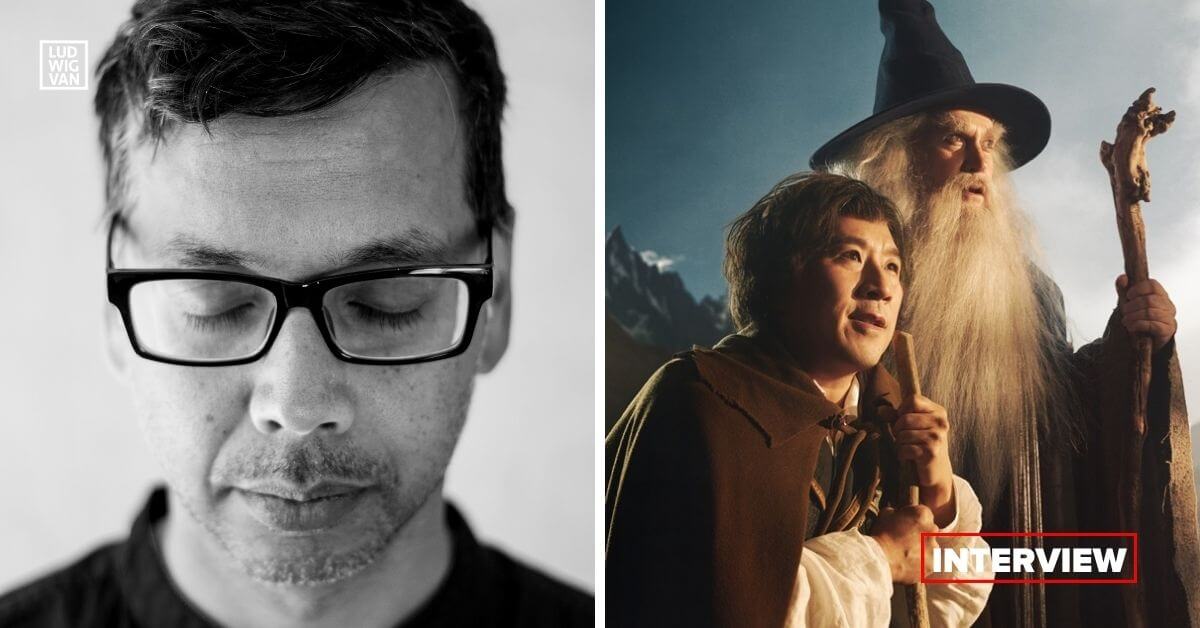
The Hobbit is, of course, a classic story of the J.R.R. Tolkien world, and it’s also a new play that’s taking the stage at this year’s Stratford Festival. Based on Tolkien’s book, the new family-friendly play was adapted by Kim Selody and directed by Pablo Felices-Luna.
The Hobbit began previews on April 21, with opening day on May 30 at the Avon Theatre.
Longtime Stratford artist Debashis Sinha is responsible for the music and sound design for the epic fantasy. In his tenth season now at the Festival, Sinha has previously worked on Serving Elizabeth as composer, along with Romeo and Juliet, Casey and Diana, Women of the Fur Trade, The Crucible, Treasure Island, The Changeling, Breath of Kings as both composer and sound designer, and Anne of Green Gables, Wedding Band, Death and the King’s Horseman, Mother’s Daughter, The Aeneid as sound designer alone.
LV caught up with Sinha to talk about his work on the project.

The Hobbit®
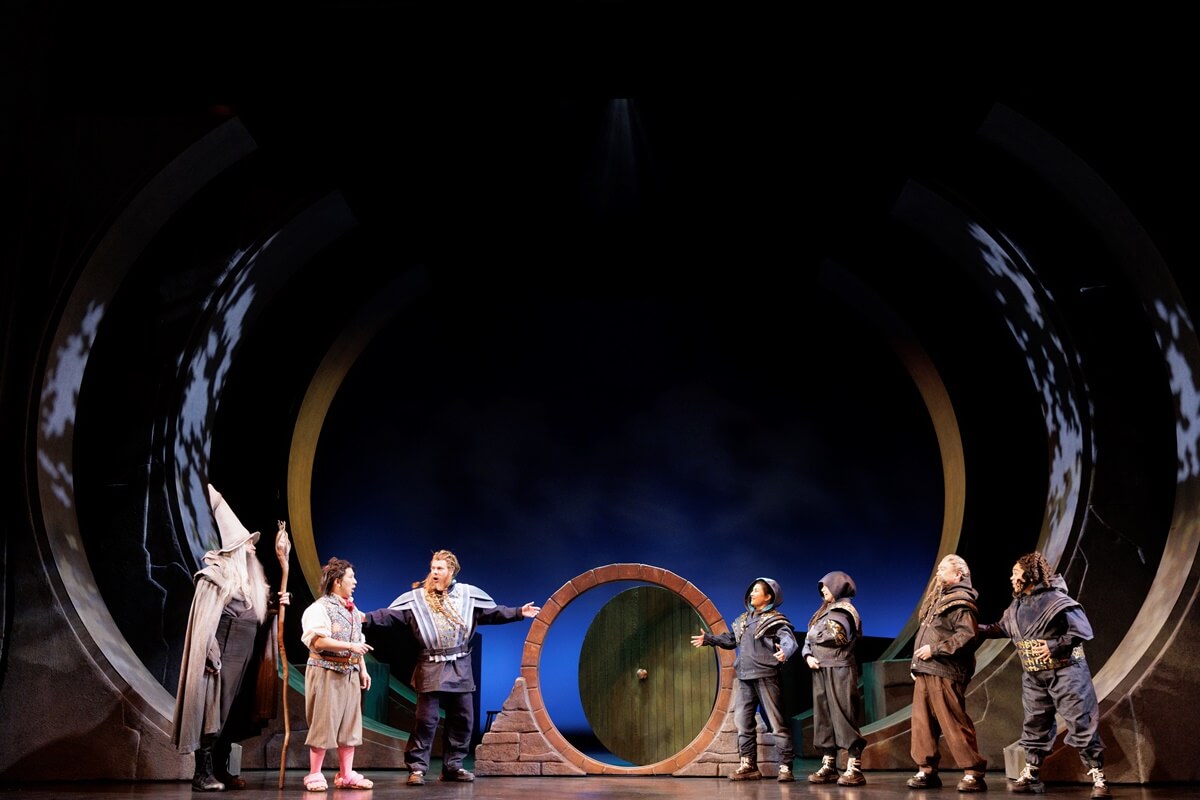
Licensed by Middle-earth Enterprises, the new play stays true to Tolkien’s original story, unlike the many liberties taken in the film adaptation. Middle-earth is still a magical place filled with not only Hobbits, but also Dwarves, Elves, Wizards, Goblins, and, of course, Dragons.
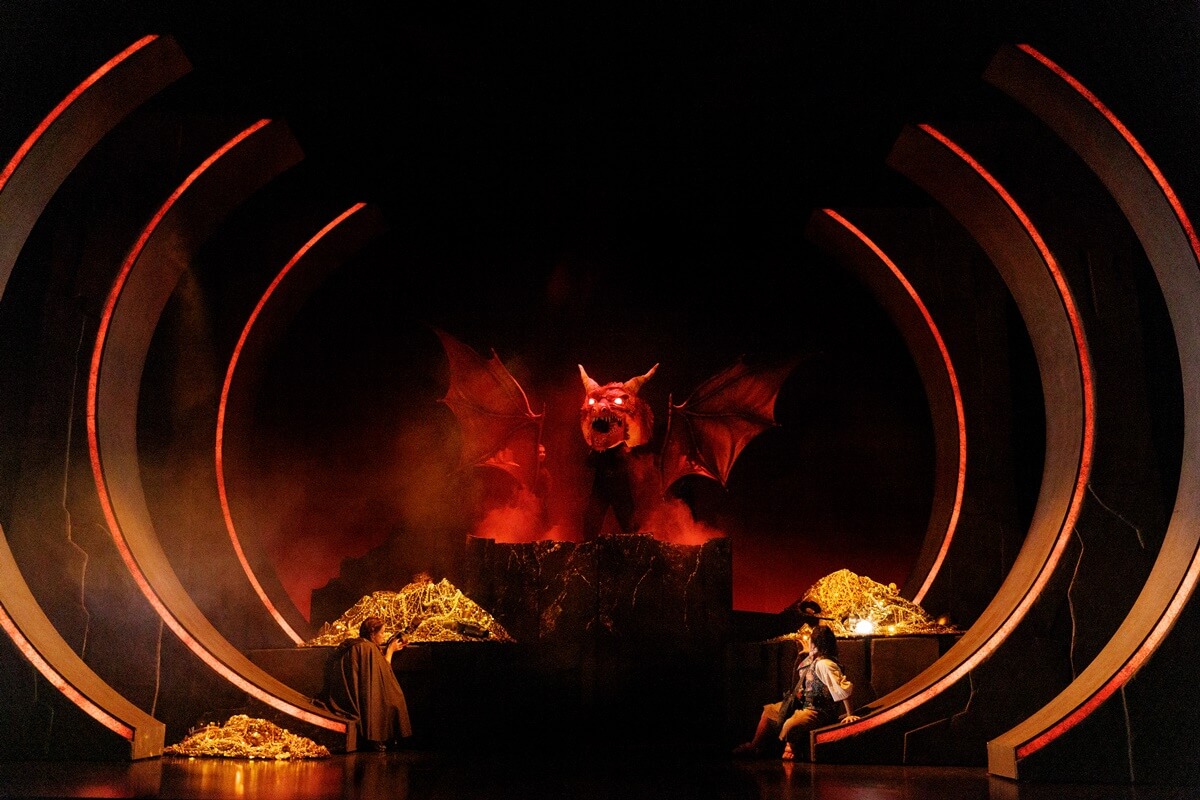
As Bilbo Baggins is talked into joining the Dwarves’ crusade to reclaim their home under the Lonely Mountain, many adventures ensue. The production features staged battles and magic effects that use water-based haze and special lighting, along with other staging to recreate the many environments in the story, from the pastoral shire to the Dragon Smaug’s inner mountain lair.
Debashis Sinha
Debashis Sinha’s work spans multiple genres and media, including solo and ensemble audiovisual performance projects on the concert stage to composition and sound design, and experiments in electronic and electroacoustic music and technology that include research into machine learning and sound.
The second generation South Asian Canadian trained with master drummers in a range of global music traditions. A fascination with technology and electronic music led him to add those fields to his creative repertoire.
As a composer and sound designer, he’s worked with a number of theatre companies outside The Stratford Festival, including Soulpepper and Why Not Theatre, among others, and has a longstanding artistic relationship with choreographer Peggy Baker. In 2024, Sinha was named as a finalist for the Siminovitch Prize. As a composer for media, he was awarded the Louis Applebaum Composers Award in 2023.
He has appeared as a solo artist at the Sound Symposium, ORF Kunstradio, Deutschlandradio Kultur, the Art Gallery of Ontario, Madrid Abierto, MUTEK, the Guelph Jazz Festival, Radio National Espana, and the International Symposium on Electronic Art, among others.
Sinha is a dedicated educator, and has led sound design intensives, asynchronous video courses and guest lectured at the undergraduate, graduate, high school and community levels across Canada and internationally. He is currently an associate professor at The Creative School at Toronto Metropolitan University.

Debashis Sinha: The Interview
Debashis Sinha’s musical career began on stage, but quickly developed into multiple other pursuits.
“I started as a performing musician, a stage musician exploring many different cultures of music when I moved to Toronto,” Sinha explains. “It became apparent to me that the end goal of playing music wasn’t really enough for me.”
While performing on stage has its own rewards, Debashis was looking for a greater kind of engagement. “That drive led me into all these different places,” he says. “I wasn’t content with practising my instruments and getting really good at them.”
Curiosity also played a role. “I ended up doing a lot of different things.”
When it came to sound design, he saw an opportunity. There weren’t so many sound designers in the city when he moved to Toronto. The tech was prohibitively expensive at the time.
“I was also kind of a nerd and really interested in technology,” he laughs. “That was kind of way for me to investigate many different kinds of interests at once.
The Hobbit
His involvement in The Hobbit likely came about as a referral. In his tenth year now at The Stratford Festival, Sinha knows that Head of Design Michael Walton is often consulted by the various directors of different projects.
“As far as I know, I think Michael suggested me to Pablo,” he says. “Sometimes, directors have you in mind right at the outset,” he adds. “In Stratford, there are a lot of designers kicking around in the stable.”
For the entire production, naturally, the spectre of the enormously successful LoTR and The Hobbit film franchises looms large in the public perception of the story.
“It’s an interesting challenge. Last year I sound designed Anne of Green Gables, and of course that’s another story that people are very attached to,” Sinha says.
“Those kinds of shows are tricky. They can be tricky, but for The Hobbit in particular, from the outset, we were aware that there was so much [iconic] material out there,” Debashis. “That was something we did talk about it to make sure that we didn’t talk about it,” he says. The production team proceeded with only the new play in mind.
“The thing that I love about theatre is that every play has a script, and the script exists outside of time and place; it’s a document that anyone can open up,” he says. “Each time you make a story, the only way for the story to be good, is for it to be the story that you’re telling now,” he continues.
“In a way, I’m aware of The Hobbit and the general outlines of the story, but it wasn’t a huge part of […] the mythology that drove me as a young person. I was a little bit insulated form that energy. You have to accept that you’re telling the story in the here and now.”
The Hobbit: Music & Sound
The play isn’t a musical per se, with a caveat.
“The characters do sing songs, because Tolkien wrote the songs and the music.” Sinha composed melodies and music for each of the songs the characters sing.
Other than the songs, there is music that occurs intermittently throughout the story. “There’s incidental and transitional music.”
Sound design for The Hobbit involves a range of sound effects and other tricks to help establish the varied environments depicted in the story.
“It is one of the more dense shows that I’ve done,” Debashis says. After an initial script reading, and then a meeting with director Pablo Felices-Luna, he already had a plan in mind. “I said, what I hear a lot is Middle-earth — the birds, the sounds, the mountain.” He looked to create a sense of being in nature, in Tolkien’s world.
“It was really important to me. In the end, it didn’t end up being a huge sound gesture for each scene. It’s really just hints — almost subliminal in a way. I like to work that way,” he explains, “Aural environments I made to point to the fact that we’re in this place.”
It can involve something as subtle as a background sound, such as birds chirping in a forest, that stops at a certain point in the scene. “Little tricks” as he calls them, such as that, serve to underscore the significance of what follows.
“It was important to me to let Middle-earth be a character.”
Musical Style
As with his own work, the music crosses a range of styles and genres.
“It’s pretty eclectic,” he says. “The work I do tends to be pretty eclectic — not genre driven. The first song, with the Dwarves clinking their glasses, it’s kind of a big chaotic samba party.”
The Dwarves also sing a song while bobbing down the river. “It’s more of a reggaeton thing,” he says. At other points, the music is lush and epic in scope.
“It’s more about capturing the energy of the scene,” Sinha explains. “I tend to work instinctively. I have a lot of interests that I like to explore.”
That’s one of the great advantages of writing music for theatre — you can end up writing in just about any genre or style.
“It’s really a lot of fun. There’s different ways of corralling all those ideas to make sure they’re a cohesive whole.”
The Dwarf songs came together pretty quickly. “I wrote all the songs in the play in one morning,” he says. It took him a little by surprise. “I’m not a trained musician. I’m not a songwriter. I was kind of concerned,” Debashis explains. Early on a sunny Sunday morning in the spring, he headed to his garden. “I took my baritone ukelele to the shed and said, let’s see what happens.”
The Joys of Theatre
“I think the thing that I like about working in theatre, and that has kept my theatre practice going for a couple of decades now, is the community that develops,” he says. “There was really a sense of a shared experience that I really value. Every day becomes more and more valuable in the world that we’re in,” Sinha adds.
“The power of making theatre is that you have to be pretty analog,” he laughs. “The frame for me to engage with all those electronics is really about all those things that I value about working in the theatre process.”
Theatre is a communal process. There are meetings where different ideas are proposed to the team — it’s all part of that shared experience.
“They’re all kind of foundational to everything that I do,” he says. “Foundational to making and witnessing and being part of theatre in general. Theatre has taught me a lot about the way I want to be in the world,” Debashis explains.
“Working on The Hobbit was all of those things.”
Show Details
The Hobbit plays at The Avon Theatre in Stratford until October 23, 2026.
- Find show details and tickets [HERE].
Are you looking to promote an event? Have a news tip? Need to know the best events happening this weekend? Send us a note.
#LUDWIGVAN
Get the daily arts news straight to your inbox.