
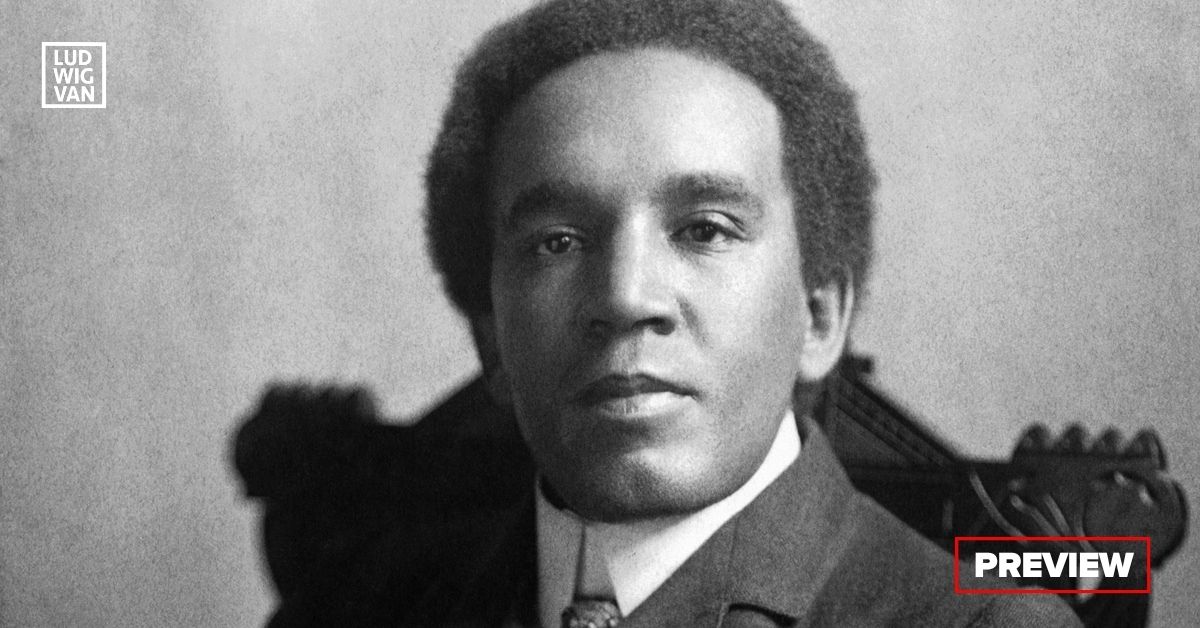
INNERchamber Concerts will close their 16th season with Imagining Samuel Coleridge-Taylor on May 24. The concert features Roy Lewis, who will present the life and work of the British composer and conductor through poetry and prose. He puts the music into the context of the historical events that shaped the composer.
Coleridge-Taylor’s music, creating during the dying days of the Austro-Hungarian empire at the turn of the 19th century, bridges old and new worlds, and fused the legacy of Viennese forms with North American Black music.
“I am particularly excited about the program, Imagining Samuel Coleridge-Taylor, because we get to share this fantastic music that may be less familiar, but is so well crafted. Roy Lewis has created a beautiful narrative to tell this story, using a blend of fiction and fact, poetry and prose as he paints a picture of Coleridge-Taylor’s life, his inspirations and the obstacles to his deserved success. This will undoubtedly be a highlight performance of the season,” says Andrew Chung, INNERchamber Artistic Director, in a statement.
A taste of the music:

Program
The program consists of:
- Samuel Coleridge-Taylor (1875-1912) Clarinet Quintet in F-sharp minor, Op. 10
- Samuel Coleridge-Taylor selections from Piano Quintet in G minor, Op. 1
- Samuel Coleridge-Taylor selections from 24 Negro Melodies, Op. 59
- Antonin Dvorak (1841-1904) Scherzo from Piano Quintet No. 2 in A major
- With additional repertoire TBA
Music will be performed by the INNERchamber Ensemble: Peter Shackleton, clarinet; Charmaine Fopoussi, piano; Andrew Chung, violin; Jung Tsai, violin; Judith Davenport, viola; Ben Bolt-Martin, cello.
Samuel Coleridge-Taylor
Samuel Coleridge-Taylor was born to an English mother and father from Sierra Leone in Holborn, London in 1875. The couple was not married.
His father, Daniel Peter Hughes Taylor, studied medicine in London, but prejudice stymied his attempts to work as a doctor in Britain. He left England to return to West Africa without knowing Alice Hare Martin was pregnant.
Samuel was named after poet Samuel Taylor Coleridge. There were many musicians in his mother’s family, and his talent began to show itself at an early age. His grandfather paid for violin lessons, which Samuel began at the age of five. Taylor also joined a church choir, where prominent organist and choirmaster H.A. Walters also guided his musical education.
Taylor was awarded a scholarship to the Royal College of Music at age 15. He switched from violin to composition, and published a few early pieces while still a student. Once he completed the degree, he worked as a professional musician and professor at the Crystal Palace School of Music.
His 1898 work Ballade in A Minor and the trilogy Hiawatha’s Wedding Feast (1898), The Death of Minnehaha (1899), and Hiawatha’s Departure (1900) began to garner notice, and are among his most performed works today.
Samuel’s later compositions integrated elements of African and Black American gospel music with the Western late Romantic tradition. He and his work became more and more overtly anticolonialist, and he joined an activist group known as the PanAfricanists. He composed the music for the first PanAfricanist conference in London in 1900.
His music was influenced by the great late Romantic composers such as Dvořák, Tchaikovsky, and Grieg, all of whom also incorporated the musical traditions of their respective heritages into their works.
Coleridge-Taylor wrote many other compositions, including choral and vocal pieces, orchestral and concert works — notably the Violin Concerto in G minor, Op. 80, and Othello Suite, Op. 79, and both piano and chamber music, including his 24 Negro Melodies, Op. 59.
Even though he died of pneumonia at the young age of 37 in 1912, Coleridge-Taylor left his mark on early 20th century society, and became a symbol for Black people and other people of colour around the world. He was so famous in his time that he became known as the “African Mahler”, and toured the US three times. He was invited to the White House by President Theodore Roosevelt in 1904.
At his death, he left a wife and two children, both of whom pursued careers in music.
Video-on-Demand
In-person tickets to Imagining Samuel Coleridge-Taylor are sold out, but are still available for Video-on-Demand. This concert will also be captured on video, available the following Wednesday (May 27) for all ticket-holders.
- Find details [HERE].
Are you looking to promote an event? Have a news tip? Need to know the best events happening this weekend? Send us a note.
#LUDWIGVAN
Get the daily arts news straight to your inbox.