
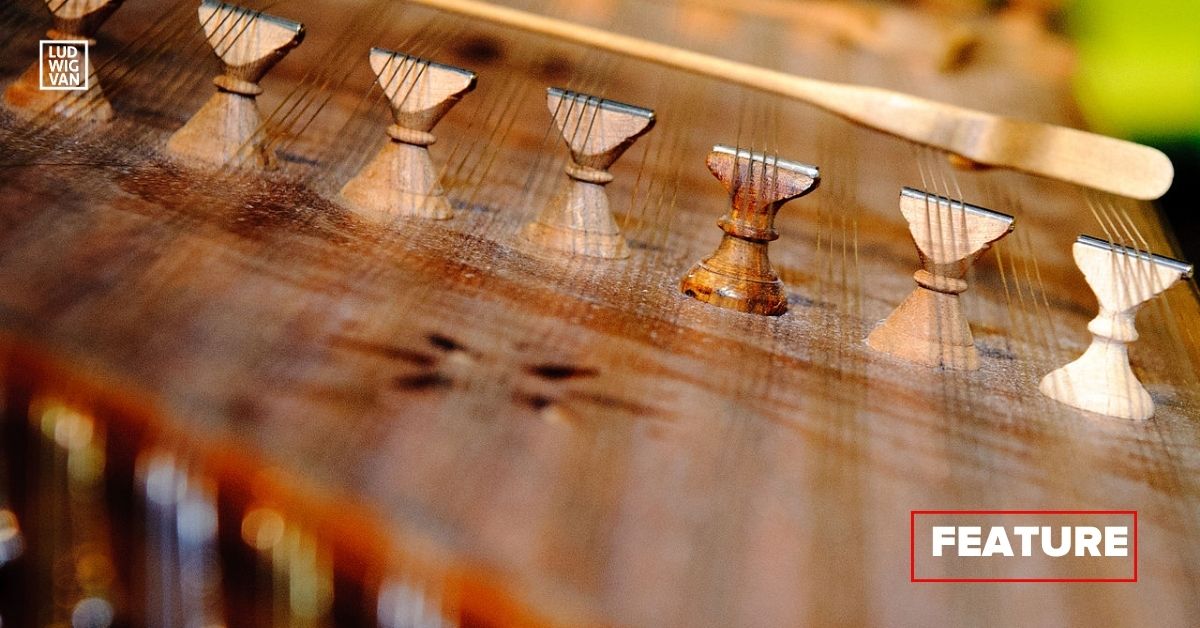
The Aga Khan Museum presented HAMMERED: International Festival of Dulcimers over the May long weekend. It celebrates an instrument that has crossed the world in various forms, and brought together the traditions of different cultures.
In North America, we might be tempted to narrowly associate the dulcimer with bluegrass and folk music, but it’s a global family of instruments that are an integral part of many classical traditions from Asia to India and Persia to Eastern Europe.
What all the forms of the dulcimer have in common is a system of producing sound by striking metal strings with wooden mallets.
LV caught up with Amir Ali Alibhai, Head of Performing Arts at the Aga Khan Museum to talk about the instrument and festival.

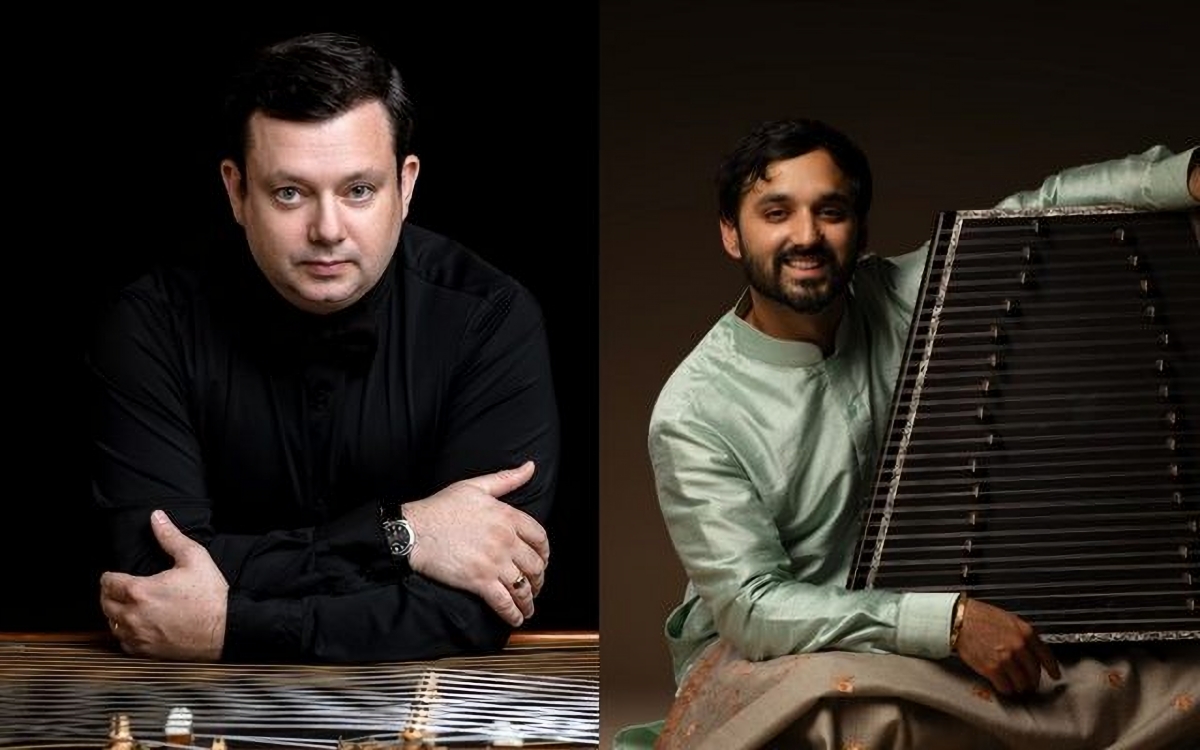
Amir Ali Alibhai: The Interview
HAMMERED brought something new to Toronto’s music scene.
“It’s the very first. It’s something I’ve been talking about with Amir Amiri, who is an Iranian santoor player.”
Amiri is the Artistic Director of HAMMERED, and he and Alibhai have collaborated on previous occasions.
“We were talking and thinking about [the fact that] so many of these instruments are actually related to one another in ways that people don’t often think about,” Alibhai says.
Through the instrument, the connections between diverse cultures are illustrated. The dulcimer is, in fact, a direct forerunner of the modern piano, where the hammers are operated via the keyboard.
He mentions the landmark 100 Years of Iranian Piano Music concert featuring Franco-Swiss pianist Layla Ramezan which took place at the Aga Khan Museum in 2017. Iranian-Canadian composer and multi-instrumentalist Sina Bathaie accompanied Ramezan on the santoor (also written as santur).
“I paired Sina with her, and between some of the piano performances we had the santoor,” he recalls. “I asked the santoor player if he wouldn’t mind playing acoustically.” Seen and heard side by side, the connection became clear. “I suppose that was the first time that we thought about the connection between the piano and a pretty archaic seeming instrument like the santoor.”
It was at Womex, the annual Worldwide Music Expo, where he first experienced the cimbalon.
“That’s the connection with the piano,” he says. “I was blown away.”
The cimbalon is classified as a type of chordophone. In it, the strings are set into a large trapezoidal shaped box on legs. The metal strings are stretch across the top, and there is a damping pedal underneath. The very first was designed by Hungarian V. Josef Schunda in 1874 in Budapest, and was based on existing dulcimer instruments that were common in Central and Eastern Europe. It is played by striking the strings with a pair of hammers wrapped in cotton.
Not long after its innovation, the cimbalon attracted the attention of politicians, and major Hungarian musicians, including Franz Liszt, who used the instrument in his Ungarischer Sturmmarsch (1876) and in the orchestral version of his Hungarian Rhapsody No. 6. Many other composers of the classical music tradition used the cimbalon, including Zoltán Kodály, Háry János, Igor Stravinsky (who owned his own cimbalon), and Béla Bartók, who used it in his Rhapsody No. 1 for violin and orchestra (1928).
In the 20th century, composers such as Pierre Boulez, Peter Maxwell Davies, Peter Eötvös, György Kurtág, Miklós Kocsár, Richard Grimes, Louis Andriessen, and Peter Machajdík also became enchanted with its unique sound.
The cimbalon is also associated with gypsy and Jewish folk music.
Asia
The dulcimer, however, travelled even farther east to China and other Asian countries. It became one of many cultural elements that found their way along the Silk Road between Eastern Europe and Asia.
“It always fascinated me that with the pipa, it’s such a quintessentially Chinese court instrument, it comes from the oud,” Amir says. “Eventually it evolved into the pipa.”
In China, the instrument developed into the yangqin, which is used in varying ways across China. It’s shimmering tones are used in refined and lyrical music in the Guangdong province. In the northwestern province of Xinjiang, the music of the yangqin is transformed into a more rhythmic and expressive mode.
Like the cimbalon, the strings are stretched across a trapezoidal wooden frame, sometimes with legs. Bridges are used, which create a louder sound. Traditional instruments typically use three bridges, with modern instruments often using five. Musicians from southern China introduced it to Thailand and Cambodia, where it became the khim. Sounds are produced by striking the strings with bamboo mallets.
Classical Indian and Persian music uses the santoor/santur, the ancient and original hammered string instruments. The metal strings are stretched across a wooden trapezoid, with bridges to enhance volume, and originated in ancient Persia about 2,500 years ago. It entered the Kashmir region of India via trade routes, where it was adopted into local traditions and music.
“I think of this festival as a family reunion of sorts,” Alibhai says.
As he points out, most of the musicians are Canadian, with the exception of Indian santoor player Vinay Desai, who is American. They’re virtuosos on an instrument the Western mainstream still rarely recognizes. “It’s really a toe dip, to test this model and this idea,” he says, “but also to present some pretty high calibre artists who are Canadian. We just did a show with Labyrinth Ensemble on Sunday. It was just incredible. To think that all these artists are Canadian,” he adds.
“We spend a lot of time ignoring people who are in our own midst.”
Final Thoughts
“I didn’t like the word dulcimer, because for me, the dulcimer is an American instrument,” Alibhai says. It reminded him of Appalachia and folk music.
“I realized how, it’s kind of fascinating that it’s essentially the same instrument, but it’s played so differently because of the tradition that it evokes.” He mentions Persian classical an Indian raga music. “These are classical musical traditions.”
The festival coincided with the Museum’s larger objectives. “That’s something we’re always trying to demonstrate is this connection across cultures,” he says. “In music we see it very clearly.”
Vinay Desai presents Raag Bairagi Bhairav with Ishaan Ghosh on Tabla in 2025:

Musicians & Music
The festival featured two concerts, in addition to workshops and artist talks.
Crossing Traditions: Cimbalom and Santoor in Dialogue took place on May 16. The first half featured a single improvised set by santoor player Vinay Desai and Montréal based tabla virtuoso Shawn Mativetsky. The two had never performed together before.
The performance began with Desai, who sketched out a melodic and rhythmic form. As he explained, it was a raag based on the theme of love.
Mativetsky gradually joined in for a free flowing 45 minute or so set that ebbed and flowed organically in energy. The music was mesmerizing and showcased the ringing tone of the santoor, accompanied by the tabla rhythms. Specifically, the santoor stems from the Hindustani classical tradition, and the musical heritage of Kashmir and North India.
Both musicians seemed to be enjoying themselves and their collaboration.
Vinay Desai is a disciple of the late santoor maestro Padma Vibhushan Pandit Shivkumar Sharma, and he completed advanced studies in India. He’s performed across North America, Argentina, Australia, The Bahamas, and India, appearing at major festivals and venues including the Adelaide Fringe Festival, Mona Foma in Tasmania, Lollapalooza Argentina, the Jaipur Literature Festival, and SwarZankar in Pune. He works in multiple genres that include Indian classical music, Bollywood, theatre, jazz, and Western classical music.
The second half of the concert featured cimbalon virtuoso Alexandru Sura.
Sura often performs with string quartets, chamber orchestras and other ensembles. At the Aga Khan Museum, he was accompanied by Veronica Ungureanu, violin, Dumitru Besleaga, kobza, and Roman Manolache, double bass. Here they perform together in 2019:

Sura is a native of Moldova, now based in Canada, and the music he brought with him included Moldavan, Romanian, and Hungarian music, some of it folk inspired, and other pieces more classical adjacent.
Alexandru’s technique is dazzling, and the three other members of his quartet largely played accompaniment to his dizzying riffs. It was an entertaining set, and he explained various works and also details about the instrument. He uses wooden mallets where one end is covered in cotton as a damper, but they may use more or less cotton to produce different sounds and volume.
Sura has performed with the Orchestre symphonique de l’Estuaire, Orchestre symphonique de Drummondville, I Musici de Montréal, the Canadian Opera Company, and the Orchestre Philharmonique de Gorzów in Poland, among other prominent ensembles. He has taken the stage at festivals and venues such as the Festival de Lanaudière, the Toronto Summer Music Festival, and the Virée Classique under the direction of Kent Nagano. He has also contributed to several film soundtracks, including Amsterdam and Un Nuage Dans Un Verre d’Eau.
A solo performance by Di Zhang (2018):

The second concert, Silk Route Resonances: Santur and Yangqin Across Traditions, took place on May 17, 2026.
It featured performer-scholar Di Zhang on the yangqinj, and Persian-Canadian santur master Amir Amiri, each performing one set.
Di Zhang has performed ay the Toronto Music Garden, Wilfrid Laurier University, York University, and the University of Toronto. Her work incorporates performance, ethnomusicology, improvisation, and composition, with projects including York University’s Global Improvisation Lab and World Music Ensemble.
Zhang’s research looks at the cultural history of the yangqin and the influence of historical trade routes and politics on musical development. She also examines the relationship between music and wellbeing, with a focus on aging and community engagement.
Amir Amiri performs on the santur at the Aga Khan Museum:

Amir Amiri is originally from Tehran. He moved to Canada in 1996, and has since formed genre-blending ensembles that include the Amir Amiri Ensemble and Ensemble Kimya. He has collaborated with musicians such as Richard Moody and Jean Félix Mailloux, and was awarded the 2003 CBC Artist of the Year.
He performed with Elham Manoouchehri on tar and voice.
The festival showcased fascinating instruments and high calibre performances by Canadian artists who often aren’t recognized for their work and dedication by the mainstream music scene.
As HAMMERED demonstrated, it’s long past the time that Toronto’s mainstream should recognize talent beyond the artificial borders set up by the music industry.
Are you looking to promote an event? Have a news tip? Need to know the best events happening this weekend? Send us a note.
#LUDWIGVAN
Get the daily arts news straight to your inbox.