
Enjoy new music with our classical music chart for this week. Our weekly selections are based on sales numbers and simply what albums we love and think you NEED to hear.
For the complete top 20, tune into Classical Chartz with the New Classical FM’s Mark Wigmore every Saturday from 3-5 p.m. Find the full Top 20 listing here.
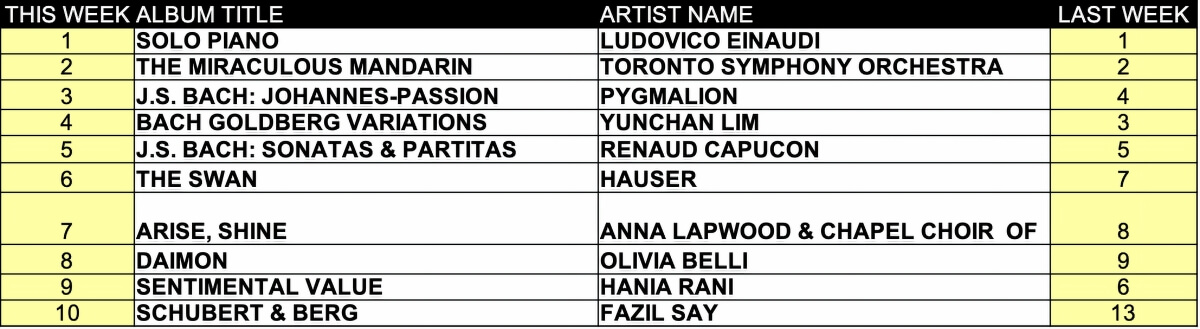

The top two positions in the Classical Chartz remain unchanged for a third week in a row. Ludovico Einaudi’s Solo Piano sits at No. 1, with the Toronto Symphony Orchestra and The Miraculous Mandarin at No. 2.
The Nos. 3, 4, and 5 positions are still taken up with recordings of J.S. Bach — proving his timeless appeal about 341 years after his birth — but with a bit of a shuffle. Yunchan Lim’s Bach Goldberg Variations falls from No. 3 to No. 4, while Pygmalion’s J.S. Bach: Johannes-Passion steps up fro No. 4 to take over that No. 3 spot. Renaud Capuçon’s J.S. Bach Sonatas and Partitas, stays the course at No. 5 for a second week.
The newcomer to the Classical Chartz Top Ten comes from pianist Fazil Say and his release Schubert & Berg: Piano Sonatas. It rises from No 13 last week to round out the Top Ten at the No. 10 position.
Both composers were Viennese, but that’s where most similarities end. The two works in question, Schubert’s Sonata in B flat major, D 960, and Alban Berg’s Piano Sonata in B minor, Op. 1, offer a study in contrasts.
Schubert composed the work not long before his untimely death in 1828, towards the end of the Romantic era of Western classical music. “Franz Schubert was only 30 when he died,” writes Fazil Say. “There is a unique depth of sorrow and melancholy here, the pain of parting from this world. Yet at the same time, we feel Schubert’s joy of life, his vitality, his attachment, his passion, and even his defiance.”
It’s a work that Say has only recently added to his repertoire. Conversely, he’s been playing Berg’s piece, a pioneering composition that helped to put modernism on the map — written in 1909, a scant 21 years after Schubert’s work — since he was a teenager.
“I first encountered Alban Berg’s piano sonata at the age of 15, and I performed it as a student in Ankara […] I listened to all of Berg’s works and he became one of the main figures who opened the door for me to contemporary music […] His opus 1, while anchored in B minor, sails boldly toward atonality and modern expression. It is a one-movement sonata, almost like a ballad or a single dramatic scene from an opera […] The piano is used almost orchestrally, full of colour and intensity. It is a remarkably beautiful piece.”
Are you looking to promote an event? Have a news tip? Need to know the best events happening this weekend? Send us a note.
#LUDWIGVAN
Get the daily arts news straight to your inbox.