
Enjoy new music with our classical music chart for this week. Our weekly selections are based on sales numbers and simply what albums we love and think you NEED to hear.
For the complete top 20, tune into Classical Chartz with the New Classical FM’s Mark Wigmore every Saturday from 3-5 p.m. Check out the whole Top 20 list here.
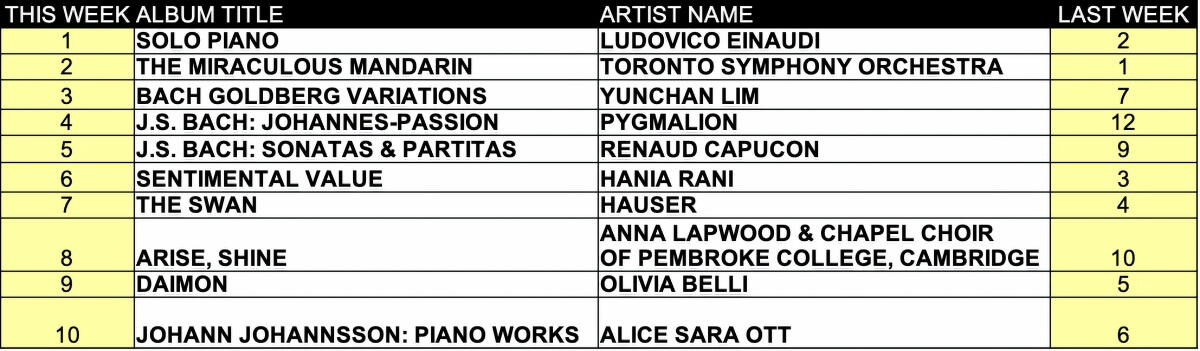

The first two spots on the Classical Chartz remain unchanged from last week, with Ludovico Einaudi’s Solo Piano maintaining its hold on the No. 1 spot, and the Toronto Symphony Orchestra coming in at No. 2 with The Miraculous Mandarin.
The next three positions on the Classical Chartz Top Ten prove that the timeless music of the 18th century still rules listener hearts.
The Nos. 3, 4, and 5 spots are taken up with three recordings of J.S. Bach. Yunchan Lim’s Bach Goldberg Variations climbs up from No. 7 to take over No. 3. French violinist Renaud Capuçon’s J.S. Bach: Sonatas & Partitas comes in at the No. 5 spot, up from No. 9.
The No. 4 position is taken by a newcomer to the Top Ten this week — Pygmalion’s J.S. Bach: Johannes-Passion. It makes the leap up from No. 12 to also become the fastest rising release in the Classical Chartz Top Ten this week.
Pygmalion was formed by French conductor Raphaël Pichon in 2006, while he was a student at the Paris Conservatoire. Pygmalion, consisting of a choir and period instrument ensemble, specializes in Baroque repertoire. Over time, that focus has grown to includes the links between Baroque and later composers, including Bach and Mendelssohn, Schütz and Brahms, and Rameau, Gluck and Berlioz.
In the new release, they return to their core repertoire as part of a series of recordings of Bach’s major choral works.
Their new Johannes-Passion features German tenor Julian Prégardien in the role of the Evangelist. Other soloists include German- Swiss bass-baritone Christian Immler, French mezzo-soprano Lucile Richardot, British tenor Laurence Kilsby, and British baritone Huw Montague Rendall in the role of Jesus. Instrumental accompaniment includes organ, harpsichord, and theorbo. The ensemble’s interpretation is characterized by its theatricality and intense sense of drama.
Bach’s Johannes Passion (or St. John Passion) BWV 245 is the composer’s earliest known Passion oratorio. He wrote the work during his first year in Leipzig as the director of church music. It was first performed on Good Friday in 1724. He’d later revise it in 1725, 1730, and 1749, including several new pieces within it.
The libretto is anonymous, but is known to have been compiled from works that narrate the Passion of Christ as told in the Gospel of John. The hymns, melodies, and texts would have been familiar to his German audience, but in its length and scope, it was unlike anything that had come before it.
It’s a very expressive and somewhat less polished work than Bach’s later Passions. The work tells the story of how Jesus was captured and appeared before Kaiphas and Pontius Pilate, then crucified and put to death. The Evangelist is sung by a solo tenor, and other roles include Jesus, Pilate, the disciples, and the crowd.
Are you looking to promote an event? Have a news tip? Need to know the best events happening this weekend? Send us a note.
#LUDWIGVAN
Get the daily arts news straight to your inbox.