
Tapestry Opera will present Ana Sokolović’s Love Songs, a theatrical adaptation of the composer’s song cycle, in a co-presentation with New Music Concerts. The event takes place from March 26 to 29, featuring soprano Xin Wang and dancer Rumi Jeraj, with Michael Hidetoshi Mori, who created the adaptation, directing.
It’s one of the first major works that has been staged at the Nancy & Ed Jackman Performance Centre, which opened about one year ago.
Ana Sokolović’s Love Songs
The production revolves around a woman (Xin Wang) who’s desperately trying to come to terms with the loss of her love, portrayed by tap dancer Rumi Jeraj. The woman creates a ritual made up of language and memories, attempting — as did Orpheus of Greek legend — to bring him back to life.
From the Composer’s Notes to the score:
“Love has always been and always will be an inexhaustible inspiration for human creativity. Love follows us everywhere; love is the cause and the result. Love evokes the strongest human emotions: love has led people to wars, but it has also inspired the most beautiful poems. All the languages sing about love the same way. Every happiness, worry, sadness and tenderness is similar to another.
“Love Songs is an intimate story about love in five “thematic” movements: pure love, tender love, children’s love, mature love and love for a person who has been lost. The lyrics are sung in five languages: English, French, Serbian, Irish and Latin. There are interludes between the movements in which the phrase “I Love You” is delivered in 100 different languages. While the movements are lyrical, the interludes are more rhythmic, inspired by the colours of these 100 languages, with the singer using various unconventional vocal techniques.”
The text draws from poems by Michael Hartnett, Paul Éluard, Émile Nelligan, Vasko Popa, Miroslav Antic, Laza Kostic, Elizabeth Barrett Browning, Shakespeare, Catullus, Walt Whitman and Amarusataka.
Rumi Jeraj’s choreography follows the words sung in five languages by Wang. “I love you” is repeated, in different ways, more than 100 times.
It premiered at the Canadian Opera Company’s Richard Bradshaw Amphitheatre in 2008, and has been presented in various forms since then. In 2020, a pandemic-era video adaptation, also by Michael Mori and Tapestry Opera, used a version of the work with saxophone accompaniment.

Mori’s new adaptation of the original work creates a fully staged opera with dance from what was initially a song cycle.
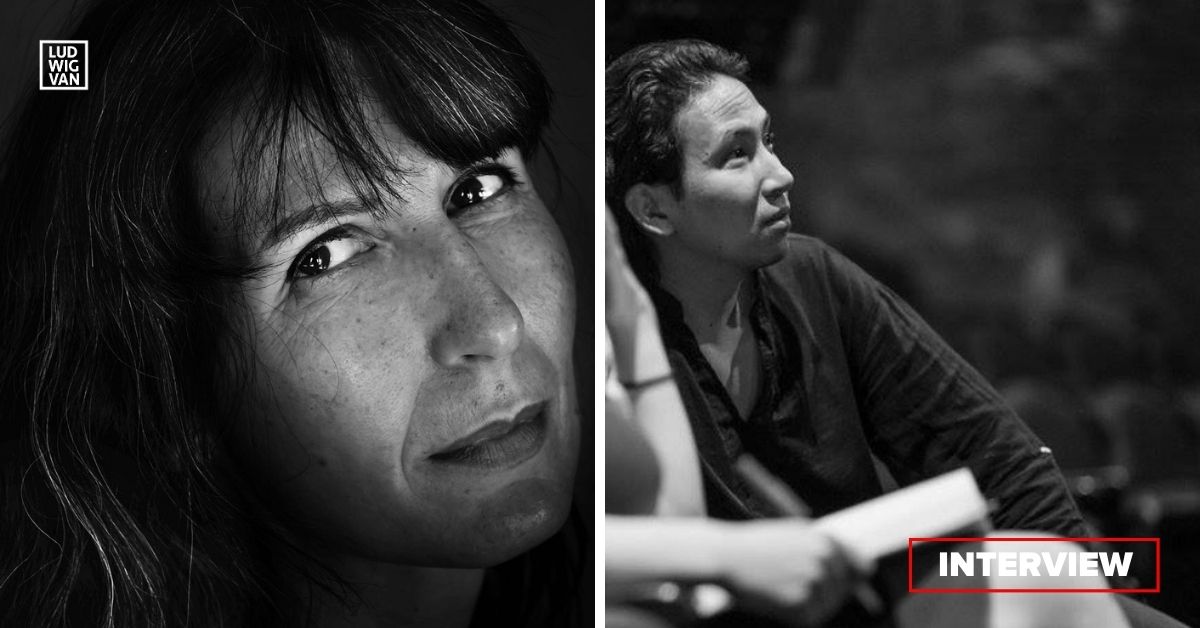
LV caught up with Ana Sokolović and Tapestry Opera’s Michael Hidetoshi Mori to talk about the production.
Ana Sokolović: The Interview
Ana Sokolović initially composed Love Songs as an art song cycle, taking text from diverse international sources, and expressing many facets of the emotion we call love. That first iteration was presented as a work for solo voice, with mezzo-soprano Lauren Phillips.
“It was a commission from The Queen of Puddings Music Theatre in Toronto,” Sokolović explains of the piece’s origins. “I wrote originally for mezzo soprano,” she says. As she notes, without accompaniment, it’s a work that could easily be transposed to another voice.
“I didn’t have any male [performers] for the whole opera.” That’s an aspect that has changed over the years. “In Aix-en-Provence [France], they did a [version] for eight performers. Some were male,” she adds.
“Later on, I had an idea from many sources to maybe write a version for saxophone.” An updated version added saxophone, as well as the interludes between songs. “So the singer could rest a little bit,” Ana says.
The piece demands a virtuosic performance from the vocalist. “It is [virtuosic],” Sokolović agrees. “It was probably the limit that I could do.” As she points out, with a work that takes some 50 minutes or so, she could be a little more demanding of the singer.
Poetry: The Text
Love as a theme wasn’t necessarily part of the commission. “Actually I had a carte blanche,” Ana explains. She was simply asked to put together a proposal for the commission. “I was thinking that the most clichéd but the most present piece in art is love,” she says.
At the same time, it’s one of the more mysterious of human emotions. “You cannot explain what is really love,” she says, “there is always part of mystery in it which we cannot explain, but we can feel it.”
Taking into account all of the ways we can experience love, she had to narrow the focus. “It could be enough for several operas,” she laughs. “I decided to put it in five categories.”
Narrowing down the texts she wanted to incorporate was the next challenge.
“I did really huge research. I read poetry in many, many languages,” she says. “It was really a huge work.”
After boiling her list down to about 30 or 40 poems she considered pursuing, she began to compose. Some worked out better than others. “I like poetry, but [some] were not poetry which is easy to put into music.There is some amazing and beautiful love songs which I could just not put into music.”
As she explains it, suitable poems had to be open to the point where the music could tell part of the story. “[If] all music is in the words, and all intention is in the words, then my music is not adding anything more.”
At times, she left a few pieces, such as How Do I Love Thee? (Sonnet 43) by Elizabeth Barrett Browning, in the piece, but as a recitative segment that the vocalist speaks.
The piece is often notes for its unconventional vocal techniques in program descriptions. “Of course, when we say these things — unconventional 40 years ago, 50 years ago, it is not the same now,” Ana points out. “Anything that the human voice can offer is available.”
That includes tongue clucking, whispering, screams and cries, and onomatopoeic treatments.
“The text is asking for it.”
The part that describes love between children, the love of young people for each other, for example, calls for a certain sensibility. “There are some witty sounds and rhythms. Kind of hide and seek,” she says. “When it’s playful, we can allow ourselves to do some what [of] we call unconventional sounds.”
The 2026 Adaptation
She’s excited for the latest version with vocalist and dancer.
“I’m so excited to see another presentation of the piece. Another vision of the piece,” Sokolović says. “I think that when we have the premiere, the piece has to be how it is at that moment in our head,” she adds. “It’s just beautiful to see how a vision of the same piece could change, even for me.”
It’s been a while since it premiered, after all. “It’s almost 20 years.”
Despite the new dimensions added to the work, Sokolović is happy that Xin Wang will be reprising the role she performed back in 2020.
“I’m thrilled to work with Xin again, and with Michael. I worked with Xin several times. She was singing my first opera,” Ana says.
“She has fantastic expression, technique. She has a thousand expressions,” she says. “I cannot wait to hear her.”

Michael Hidetoshi Mori: The Interview
What made Mori decide to come back to the work Tapestry staged some six years ago?
“I love Ana’s voice. She’s got a very distinct voice. There’s something about the tactility of language that’s always very interesting,” he says.
“A lot of composers sometimes compromise in order to sound maybe more cinematic,” Mori adds. Sokolović resists the pull of trying to be part of the musical landscape, choosing instead to strike out in her own directions.
He explains that he saw the possibilities in her work at first listen. “My problem is I always see a story everywhere.”
As he points out, the original art song cycle didn’t actually incorporate a narrative per se. It was simply an examination of various forms of love in the form of song. But, he saw other possibilities.
“This could be a really powerful story about something.”
The 2020 pandemic filmed version that Tapestry produced incorporated a saxophonist, but this new adaptation goes back to the original. “The saxophone was really interesting, but the saxophone player wasn’t really a [character],” he points out.
With a tap dancer, there is inherent musical accompaniment, along with a character in his story. “Essentially tap dancers are percussionists,” Michael says. “There’s more of a dialogue. “
He notes that Sokolović’s composition is already percussive by nature. That quality of the music is echoed in the ways that the dancer works with the vocalist.
Love As A Theme
“We all get to experience the journey of love through the course of our entire life,” Mori says. “That’s what I found so fascinating. All of those kinds of love can be encompassed within one life story.”
He chose to imbue the woman at the centre of the opera with the elements of an Orphean journey. “I refuse to accept that my partner has died.” Memories of a love lost open up the possibility of exploring the emotion in various forms. It’s her search to reclaim what she’s lost. “She’s channeling all of these love stories from all over the world.”
It’s also, ultimately, a journey of acceptance, as she realizes that a state of denial is not the way to honour the depth of her feelings for the one she’s lost.
“Truly loving Eurydice means having to let Eurydice go,” he notes.
The object of her love, the dancer in the upcoming production, is an artist, which adds another element to the story. “I’ve known many people who’ve fallen in love with artists as they perform,” Mori says.
Her attempts to evoke him via memory develops into a ritual. “This was inspired by Ana. There’s a recurring symbol of the dove in the story,” he says. The interludes play into the concept. “This sounds like an invocation, because there’s all these languages that you don’t understand, but it sounds really intentional,” he adds.
“She borrows from different rituals that she thinks will be powerful — and thinks it can help her tap into the afterlife. She’s making her own ritual to bring him back.”
Does it succeed? Is it all a dream? That becomes the question.
Filmed vs Live Performance
“The 2020 [version] was made for film,” Mori points out.
“I’m thinking of this for us, for Xin, the vocalist, and for Ana, to fully realize this for the first time.”
Live performance plays a vital role in this world where social media’s algorithms are constantly pushing listeners and viewers towards sameness and a homologous, mass produced vision.
“I think it’s really important to focus on […] to invest in unique voices,” he says. “All I get when I put music on Spotify or Apple music, is someone’s […] very generic idea of what classical music is.”
It ignores the truly diverse voices that make up the actual world of contemporary music. Ana Sokolović’s Love Songs is one of them.
“You will definitely not say that you’ve seen something like this before,” he says.
“No one is writing like this in Canada.”
Experiencing the work in a small space like the Nancy & Ed Jackman Performance Centre is part of the appeal.
“It’s going to be intimate,” he says. “You’re going to be able to feel the honest power of the artists because of that.”
- Find tickets and show details for Tapestry Opera’s Ana Sokolović’s Love Songs [HERE].
Are you looking to promote an event? Have a news tip? Need to know the best events happening this weekend? Send us a note.
#LUDWIGVAN
Get the daily arts news straight to your inbox.