
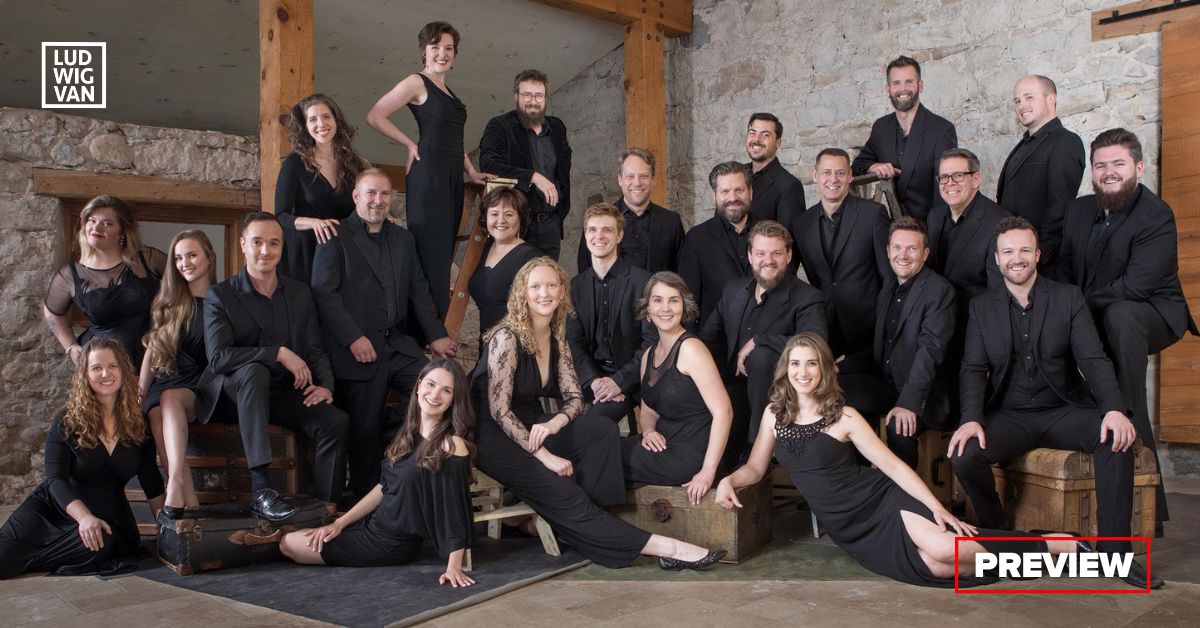
Soup is one of the better antidotes to cold winter days, and music is a tonic no matter what the time of year. The two come together when The Elora Singers present Soup & Song: Motets Through the Centuries on February 7.
The program features motets from the Renaissance to the 21st century, including works by G.P. da Palestrina and Josquin des Prez, J.S. Bach’s Komm, modern composers William Harris, James MacMillan, and Arvo Pärt, and more.
A delicious bowl of soup, and the acoustics of St. John’s Anglican Church in Elora will add to the experience.
Concert Program
The program ranges through five centuries of motets.
- Josquin des Prez: Gaude virgo Mater Christi
Josquin Lebloitte dit des Prez (c. 1450–1455 – 1521) was a French (or Franco-Flemish) composer, today considered among the masters of Renaissance music. He was an influential figure in the Franco-Flemish School, as well as to the music of 16th-century Europe as a whole.
The voicing of his Gaude virgo mater Christi matches with the distribution of the modern mixed–voice choir, unusual for the period, and for his music in particular. It’s a setting of a liturgical hymn, made up of six verses.
- Giovanni Pierluigi da Palestrina: Sicut Cervus — Sitivit Anima Mea
Italian composer and organist Giovanni Pierluigi da Palestrina (1525 – 1594) is considered one of the greatest composers of the Roman school of the 16th century. His work was innovative at the time due to his ability to integrate aesthetics into Catholic polyphonic music.
In Sicut Cervus and its secunda pars Sitivit Anima Mea, he sets the text of Psalm 42 to music. The four-voice motet is still a popular work among choral singers and ensembles.
- William Byrd: Vigilate
English composer William Byrd (1540 – 1623) is considered among the greats of the Renaissance period. He was enormously influential both in England and in broader Europe. He began by creating polyphonnic music for Anglican services, but converted to Roman Catholicism in the 1570s, and made the switch to Catholic sacred music.
It’s unknown when he composed In Vigilate, but it’s believed to be earlier in his career. In Vigilate, he borrows from the Italian madrigal tradition, and it’s also not clear whether it was meant for a religious audience per se.
- Thomas Weelkes: When David Heard
Thomas Weelkes (1576 – 1623) was an English composer and organist. His works were largely composed for voice, and include madrigals, anthems, and services. Not much is known about his early years, until he became organist of Winchester College in 1598.
When David Heard is one of two sacred madrigals that were published in 1622. In both, he explores the moments when King David grieves over the loss of his son Absalom, as depicted in the Bible in 2 Samuel 18:33. When David Hears is written in six parts, and is notable for its contrasting sections.
- Johann Sebastian Bach: Komm, Jesu, komm
Johann Sebastian Bach’s Komm, Jesu, komm (Come, Jesus, come), BWV 229, is a motet set to a text by Paul Thymich, rather than Biblical verses, as with his other motets. He composed the motet for double choir during his time in Leipzig, and it premiered in 1731–1732. It is believed to have been written for a funeral.
He composed the piece while he worked with the Thomanerchor, and around the same time as he worked on his Ratswahl (council election) cantata Wir danken dir, Gott, wir danken dir, BWV 29.
- Anton Bruckner: Locus iste
Bruckner composed his Locus ist (This place) in 1869. The first few words of the sacred motet flesh out its origin to Locus iste a Deo factus est, or “This place was made by God”. It was composed for four unaccompanied voices.
The work was intended for the dedication of the Votivkapelle (votive chapel) at the New Cathedral in Linz, Austria. Bruckner lived in Vienna at the time, but he had been the organist at the Cathedral in Linz earlier in his career. The motet is often performed by church choirs.
- Francis Poulenc: Timor et Tremor
Poulenc had made a return to composing sacred music in 1937. Timor et tremor is the first of Poulenc’s Four Penitential Motets, FP 97, (1938-39) or Quatre motets pour un temps de pénitence. They were composed to Latin texts on the topic of penitence, combining verses from Psalms 54 and 30, and written for four unaccompanied voices.
According to a review at the time, the first performance of Timor et tremor took place in 1939, likely in Paris, as performed by Les Petits Chanteurs à la Croix de Bois, and was repeated in several churches in Paris during the Holy Week.
- William Henry Harris: Faire is the heaven
William Henry Harris (1883-1973) composed Faire is the heaven in 1925 for SATB choir unaccompanied. It was written for the choir of New College, Oxford, and set to a text by Edmund Spenser (1552-1599), incorporating three lines from the author’s A Hymne of Heavenly Beauty, published in 1596.
The work is considered a masterpiece, and remains one of Harris’s most popular pieces in the Anglican repertoire. Several years later, Harris would become famous as the piano teacher for the young princesses Elizabeth and Margaret.
- Arvo Pärt: The Deer’s Cry
Estonian composer Arvo Pärt’s The Deer’s Cry is a sacred motet set to text from a traditional Irish lorica that is attributed to Saint Patrick himself. It is written for a four-part choir without accompaniment, and was first performed in County Louth, Ireland, in February 2008 by the State Choir Latvija
The music was commissioned by the Louth Contemporary Music Society, and consists of a single movement.
- James MacMillan: Miserere
Scottish composer James MacMillan (b. 1959) composed his Miserere to a Latin text. The monumental work was commissioned or a 2009 festival in Antwerp, where it was performed by The Sixteen, a choir he has long been associated with.
It incorporates a section of free chant in harmony that divides the work into two sections, each written in a different key. The Miserere mei, set to Psalm 51, has been set to music by many composers over the centuries.
Soup & Song: Motets Through the Centuries
The Elora Singers present Soup & Song: Motets Through the Centuries on February 7 at St. John’s Anglican Church in Elora.
- Tickets can be purchased for the concert and lunch separately; details [HERE].
Are you looking to promote an event? Have a news tip? Need to know the best events happening this weekend? Send us a note.
#LUDWIGVAN
Get the daily arts news straight to your inbox.