
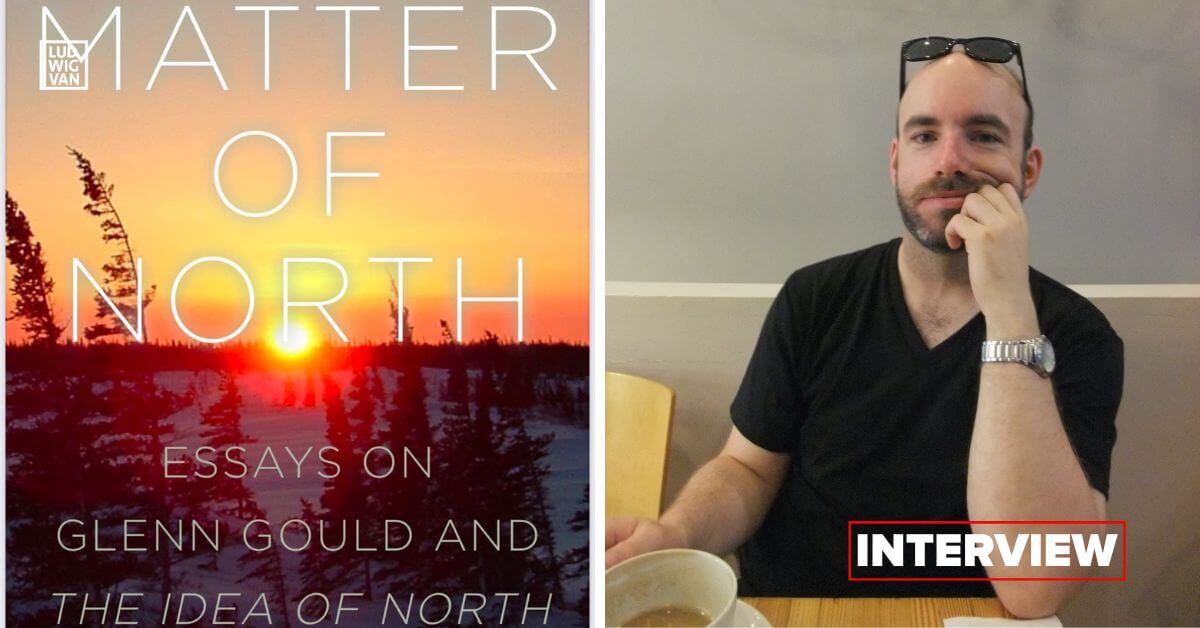
Toronto based academic and author Anthony Cushing and American professor and writer Brent Wetters are the editors of a new book about Glenn Gould. Matter of North: Essays on Glenn Gould and The Idea of North, published by the State University of New York Press, takes a deep dive into the seminal 1967 CBC radio documentary on the “idea of the north”.
In the broadcast, which first aired on December 28, 1967, Gould takes an experimental approach. He uses a technique he dubbed “contrapuntal radio”, which layers voices talking about the north and their experience of it on top of each other. It creates a unique effect that brings elements of musicality into what is essentially a conversation about the topic.
As a point of fact, Gould’s experience of the north consisted of one train trip in 1965 on the Muskeg Express from Winnipeg to Churchill, Manitoba. But, he was clearly struck by the north as an idea, and an influence.
Glenn Gould, despite his enormous successes and acclaim, retired from live performance at the age of 31. The train trip from Winnipeg to Churchill can be seen as a kind of dividing line between his career as a young international virtuoso and his new direction, where he would explore using technology in various ways instead. He preferred the recording studio, where he could alone, perfecting his work to his satisfaction, to the live concert stage.
The Idea of the North was one of three contrapuntal radio documentaries. In them, he explored themes that included ethics, social commentary, history, and more. Gould produced the three hour-long documentaries between 1967 and 1977, later collecting them into the Solitude Trilogy based on their shared theme of what he called “withdrawal from the world”. Gould said they were “as close to an autobiographical statement as I intend to get in radio”.
- You can get a taste of Gould’s 1967 radio documentary from the CBC audio archive [HERE].
LV talked to Anthony Cushing about the new book, which includes several essays, documents, and other materials revolving around Gould’s radio documentary.
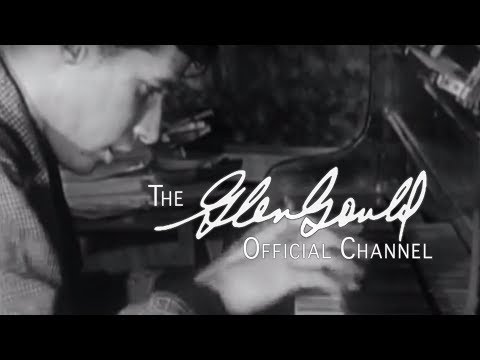
Gould rehearses Bach’s Partita No. 2 in 1958:
Anthony Cushing, Ph.D.: The Interview
How did he and co-editor Brent Wetters settle on this particular broadcast as a focus for the book?
“It’s one of the odd ducks in his creative output,” notes Cushing. Other than one Gould biography and a radio tribute by Mark Laurie (formerly of the CBC, and also a contributor to the book), it hasn’t received much attention. “Because it often gets short shrift.”
While Gould made only one foray into the north geographically, it remained an influence on his work as an artist.
“He was it’s no surprise that he was a big fan of solitude and the possibilities therein,” Cushing notes. “I think going north of Bloor for him was a real thing,” he laughs, noting that, of course, Gould actually lived lived north of Bloor in Toronto.
“That trip to Churchhill I think was almost a spiritual thing for him.”
Music critics and writers have often pointed out that Gould’s interpretations of Bach, in particular, embody his notions of the north — clean, abstract, and adding a layer of mystery rather than sensuality or emotion to the composer’s music.
Cushing’s solo contribution to the book is titled When a Fugue Isn’t a Fugue: Glenn Gould’s Musical Semiotics of Contrapuntal Radio and The Idea of North. Semiotics involves the study of symbols and signs, and how their meaning is communicated to society.
“This grew out of my graduate work,” Anthony explains. “When I started at Western, I was writing about mashups, music mashups, which is predominantly a pop music thing.”
He looked for a deeper element to add to his discussion of the phenomenon. In his search, he found a book of essays about Glenn Gould, including the pianist’s own writing about the north as a concept.
“It diverted my attention a little bit,” he says. “I had an aha moment.” It took over his direction as an academic.
Gould’s experiments with radio created a discussion of the north as a place and a concept, and so much more. “It’s also very musical. When he talked about the north, he used musical terms,” he notes. “He talked about it as an experimental texture.”
In his radio documentaries, he looked to play with the idea of form, and invent his own forms.
“There’s a very ambitious scene later in the documentary called the dining car,” Cushing says. It includes the voices of four people talking, layered over each other, and also layered with the sounds of the dining car itself.
Gould himself compared his idea of contrapuntal radio to music. “He likened it to the final fugue in Verdi’s Falstaff.” In Falstaff, Verdi creates a fugue with ten vocalists. Gould claimed that you couldn’t tell who was singing or saying what, but that was besides the point.
“I really wanted to highlight the musical aspects of the idea of north,” Anthony says. “It’s rife for those kinds of discussions. I could listen to this work at least twice a month.” In fact, he mentions that he has been listening to Gould’s radio documentary for more than a dozen years now. “I still hear new things. Every now and then I’ll have a little aha moment at some juncture.”

Essays
The other essays in the book delve into various topics around Glenn Gould, the north, and the radio broadcast itself. American music professor Lucille Mok’s piece A Conflicted Soundscape: Glenn Gould’s Idea of North opens the book with a discussion of his radio broadcasts and their context.
“We have a discussion from Jeffrey van den Scott — Glenn Gould and the Non-Imagined North,” Cushing says. It looks at the reality of the north from the perspective of Indigenous people and others who’ve lived in Canada’s northern regions.
Christopher DeLaurenti’s Rails of Protest in contrast, focuses on the technical aspects of the radio documentary.
Mark Laurie, one of the contributors to the book, was a CBC Radio contributor, and he also explored Gould’s radio work in a 2017 episode of the series IDEAS. Cushing notes that Laurie produced a film response to Gould’s radio piece as part of his Master’s thesis, as well as the audio version that was broadcast on CBC Radio. His contribution to the new book, “That Incredible Tapestry”: Revisiting Pilgrimage to Solitude, The Idea of North, and the Landscapes of Glenn Gould, talks about Gould’s work as well as his own responses to it.
Finnish scholar Markus Mantere wrote an essay titled North, History, and the Shadow of Hanslick: Glenn Gould’s Ideal of Musical North and Northern Listening. It examines Gould and his ideas in the context of northern aesthetic sensibilities on a global scale, and as a kind of aesthetic descendant of 19th century Austrian music critic Eduard Hanslick.
“A lot of these chapters came out of the American Comparative Literature Association conference which was held at the U of T in 2013,” Anthony notes.
Cushing was a panelist at the conference, as were many of the other contributors to the book. Many of them were already writing about Gould. “It’s funny when you start talking about the north and music, how often Glenn Gould’s name comes up.”
“There’s a chapter from Brent and I called The Genius Is in the Genesis: Demythologizing the Idea of Gould as Creative Outsider,” he says. It explores Gould’s creative process. “What is north in the broader creative context?”
Gould was the first Canadian to use radio with an experimental approach, but not the first worldwide. Cushing compares Gould’s radio work with global initiatives, like the German Hörspiel tradition, or the musique concrète of Radio France, which incorporated a variety of recorded sounds, as well as elements like looping, splicing, and tempo changes. What did Gould know of these other radio genres?
Paul Sanden’s De-Northing North: Thematic Continuity in Glenn Gould’s Solitude Trilogy looks at the 1967 documentary in the context of Gould’s other work in the trilogy relating to the theme of solitude.
The Book
“We’re positioning this book as a kind of companion to the idea of north,” Anthony says.
Despite its academic nature, it’s accessibly written.
“The average or maybe the ardent Gould enthusiast would get a lot out of the chapters themselves,” he says.
In addition to the essays, there is a veritable treasure trove of primary sources included as appendices:
- Letter from Jim Lotz Accepting Gould’s Interview Request (7 September 1967)
- Gould’s Interview Questions for Jim Lotz
- Introduction to Transcripts
- Jim Lotz Interview Transcript
- Walter “Wally” Maclean Interview Transcript
- Frank Vallee Interview Transcript
- Robert Phillips Interview Transcript
- Marianne Schroeder Interview Transcript
- Gould’s Preliminary Sketch of Form
- Janet Somerville’s CBC Publicity Memo (15 November 1967)
- Scene-by-Scene Analysis
- “Eskimo at the Piano” [“Eskimo am Flügel”]
- Anthony Cushing in Conversation with Marianne Schroeder
Gould’s list of questions is handwritten while the responses from his interviewees appear in transcript. In the radio documentary, you only hear the responses.
“I would argue that Gould’s questions are irrelevant,” Cushing says. “You have this discontinuity.” The appendices offer a glimpse at how the various elements of the raw material came together.
The Eskimo at the Piano is a translation of an article from the German publication Der Spiegel.
Cushing interviewed Marianne Schroeder, the only woman whose responses were included in Gould’s piece.
“I think those things are worth the price of the book itself,” he says.
Some observations from the appendix materials are perhaps peripheral to the topic of the book, but not entirely irrelevant, such as Gould’s handwritten sketches and notes.
“His handwriting is not tidy,” Cushing notes.
Because of course it isn’t.
The book was published on July 1, 2025 in a hardcover format that was largely destined for libraries. On January 2, the softcover edition was released, and it’s now available via the University of Toronto, or from your favourite online retailer.
- Find Matter of North: Essays on Glenn Gould and The Idea of North on the University of Toronto Press Distribution page [HERE].
Are you looking to promote an event? Have a news tip? Need to know the best events happening this weekend? Send us a note.
#LUDWIGVAN
Get the daily arts news straight to your inbox.