
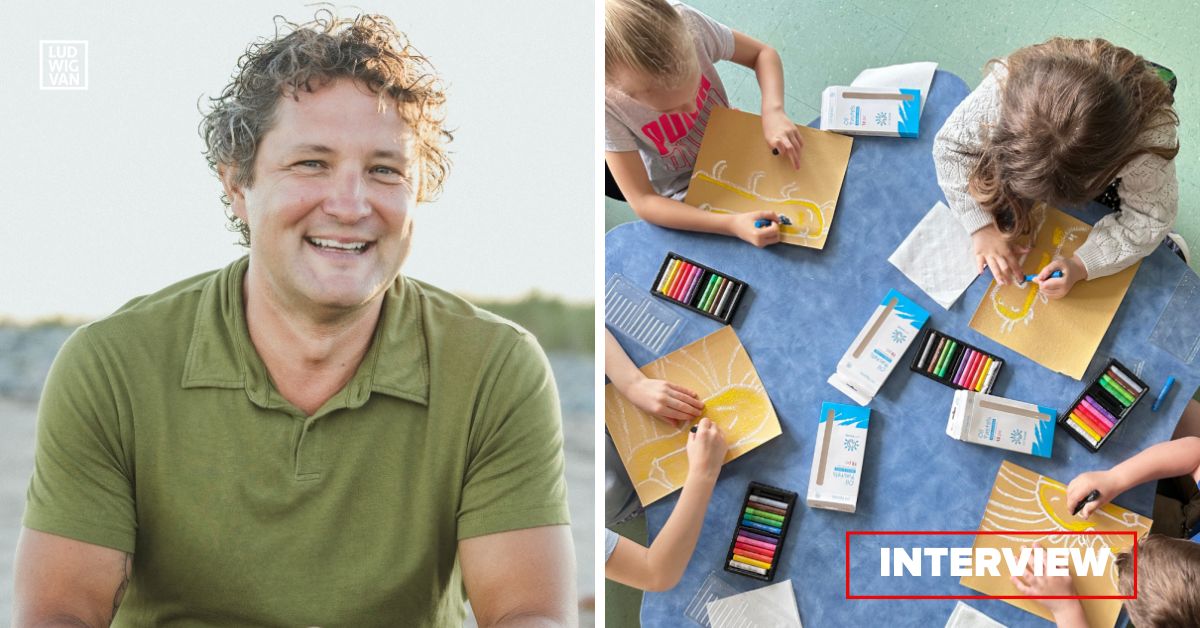
Artshine, an organization that offers visual arts instruction to children and others, is celebrating its 10-year anniversary in 2025. The organization was founded by Paul Field in 2015 to answer a need for arts education in an era of rapidly diminishing options available via school systems.
It’s a simple concept — make art available to kids anywhere, regardless of their family’s income and resources, ability or circumstances. The result has been thousands of programs that reach children, and in some cases adults, in many different forms.
LV spoke to Paul Field, Artshine’s founder and CEO, about the organization.
Paul Field: The Interview
“I did about a dozen years in social work before I started the company,” recalls Field. “I wasn’t an art therapist, but I loved what it did.” He would routinely involve his at risk youth clients or group home residents in visual arts as a way to build self esteem and confidence. Paul was involved with gang prevention programs, among other things. Sometimes, he’d help establish art studios that were then run by the young people themselves.
“I also did art for my own sanity at the end of long shifts,” he say, describing it as an ideal way to deal with daily stress. “It was my form of journaling.”
As he points out, those types of interventional programs require funding, typically through grants. Changes to grant funding models, though, put an end to such initiatives. “The grant money dried up.”
He began Artshine as a way of being able to offer accessible visual art programs without depending on fickle government support.


Building Artshine
“That first year, it was just me,” he recalls.
He began with after school programs, and by the end of the first year, had assembled a large team of art instructors. “I’ve got an amazing team. We just celebrated ten years,” he says, noting that some artists have been with his organization from the start.
His business model entails offering various programs billed at a regular price, and then using the profits to fund scholarships and other initiatives to make it accessible to anyone who is interested. Essentially, he operates a for profit business side that funds the non-profit side. His fees also employ a sliding scale based on the economic capacity of a given region or neighbourhood.
“We matched schools in affluent areas with schools in under privileged areas,” he explains. As he points out, there is precious little funding for any education related to the arts, a situation which even pits non-profits against each other in some ways. “We’re all chasing the same grant money.”
Field began his operation in the tech-heavy Kitchener-Waterloo, meaning arts-related organizations were relatively rare. From KW, Field expanded Artshine’s reach to most of Ontario.
“We’ve expanded to quite a few cities too.”
After a few years of steady growth, the COVID pandemic slowed operations considerably. “We were kicked out of 20 school boards,” Paul says. He had to lay off about 50 of the organization’s staff. “But, the […] subscription box and virtual programs saved it.
The subscription box program meant that Artshine could ship the requisite art supplies to students, and then schedule instruction via Zoom once it had been received. The organization expanded to the US until recently, when politics changed the landscape.
“We’re slowly growing all of our in person programs as well,” he notes. Artshine’s programs are currently available in Ontario, Québec, New Brunswick, and Nova Scotia, where he is now based. In each city where Artshine expands, he hires a manager and various ambassadors to spread the word. The organization partners with art and music schools, in addition to offering school-based and individual programs.
“It’s hard to franchise something like this,” he notes. “Nobody wants something where you’re giving your profits away,” he laughs. “I feel like it’s easier to make money than to ask for money.”
Nowadays, where so many people are struggling even to pay for food and shelter, the organization has been pushing for donations to increase its reach. “So we can take more kids off the wait list,” he explains.
“I don’t know how long this economy is going to last like this.”

Bringing Art Education To Children
“Our biggest core, I would say 80% of our programs are for kindergarten to grade six.” He notes that the organization is working to launch digital programs for older kids.
As he points out, it’s filling a gap in the educational system.
“There’s not always a dedicated art teacher in elementary schools.” He hears from some elementary teachers who’ve been using YouTube as their primary method of instruction in the absence of their own specific training in visual arts.
As a result, the Artshine programs tend to fill up very quickly. As Field mentions, it’s especially important to offer visual arts in an era when opportunities for getting kids off their screens to create something with their own hands are increasingly rare. “It’s hard to compete with these VR programs.”
Artshine teaches traditional arts like drawing and painting, but the emphasis is on using and developing students’ imaginations rather than learning and perfecting specific techniques.
Along with children, Artshine works with disabled adults and seniors, using a combination of virtual and in-person programming. “We also do intergenerational programs.” Artshine matches senior’s centres with local children, programming that peaked pre-COVID, and is still slow to relaunch.
The virtual programs, where supplies are shipped out and then instruction happens online, are crucial when it comes to remote areas such as Northern Canada. Artshine also offers summer camp experiences. “I launched a bunch of camps,” Field says. The camps keep up the momentum sparked with school based programs, and fill a gap when it comes to summertime options for kids. “There’s so many sports camps,” he notes. In Nova Scotia, one camp runs in a Dartmouth hockey arena. The organization’s best selling summer camp is run on a Treaty farm located just outside Waterloo.
Artshine partners with both public and private schools, along with the French and Catholic school systems. In Ontario, Artshine’s school based programs are offered in Barrie, Ottawa, Kanata, Toronto and the GTA, Hamilton, Burlington, and the Niagara Region, including St. Catharines. “We’re just launching in London,” he reports.
He’d also like to go back to his pre-COVID plans to expand west to Calgary and Vancouver. “There’s so much demand for this.”
Growth and expansion is a goal, but it can also be something of a distraction. “I sometimes get so focused on growing that I forget how much impact we’re making,” he says.
Many school boards promote Artshine’s programs, which are paid for by the parents, from within. Sometimes, principals of individual schools, or families who have heard of the organization, will request them. In other cases, it’s social media and word of mouth that spreads the word.
Along with schools and other institutions, Artshine offers birthday packages for private parties.
Partnerships and collaborations become key. “We’re in an after school program in Toronto, and we’re the art portion of their program.” At the Laurier Academy of Music and Arts, associated with Wilfrid Laurier University, Artshine collaborates with the school of music to offer art instruction to young students. It’s one of three music schools he’s partnered with (the others include Treble n Bass in Burlington, Ontario, and Marine Drive Talent Management in Halifax). Artshine also offers evening programs through community centres.
Artshine has partnered with Scholastic book publishers. After children read a specific book, they are asked to create an art project around the content and themes.

Testimonials
Paul recalls teaching in the Grand Valley Institution for Women in Kitchener, working with about 50 or 60 women. In speaking to one of the inmates there, they both realized Artshine was also teaching her granddaughter in a local school.
“Our method was really just to use their imagination.”
Feedback comes from both students and teachers.
“Artshine is an incredible program that helped shape my art career into what it is today. I started Artshine when I was around 8 or 9 and attended the camps, as well as the after school program, for a few years. It encouraged me to focus on my art more, explore new ideas, and hone in on my passion, as I got to create worlds and stories through my art. I genuinely consider Artshine to be one of the major foundational building blocks of my career,” says Zachary Hastie, a former student of an Artshine after school program in Waterloo, Ontario.
“Since then, I have taken my art to a professional level, where I graduated from Sheridan College with a Bachelor of Animation. I have gotten many opportunities to work with studios and clients alike to bring my art to life. Artshine has set me on the path of creating meaningful and amazing art, and I would fully recommend it to any students, whether they dream of becoming amazing artists or just want to flex their creative muscles and have fun!”
From a secondary school teacher in the Waterloo Region District School Board, “Great pace, the students were so engaged. They enjoyed it so much they want to do it again! (even my most challenging student! Yay!)”
Employing Art Grads
“We’ve got an amazing team.”
As Field points out, many people are under the impression that a visual arts degree is useless when it comes to employment opportunities, but it’s not nearly as limited a field as popular opinion would have it.
“You don’t have to be that starving artist,” he says. Artshine can offer a regular option. He provides his instructors with work schedules that often involve working with multiple groups in a single day. “We’ve provided part-time employment to more than 400 artists in ten years.”
- You can find out more about Artshine and its programs [HERE].
Are you looking to promote an event? Have a news tip? Need to know the best events happening this weekend? Send us a note.
#LUDWIGVAN
Get the daily arts news straight to your inbox.