
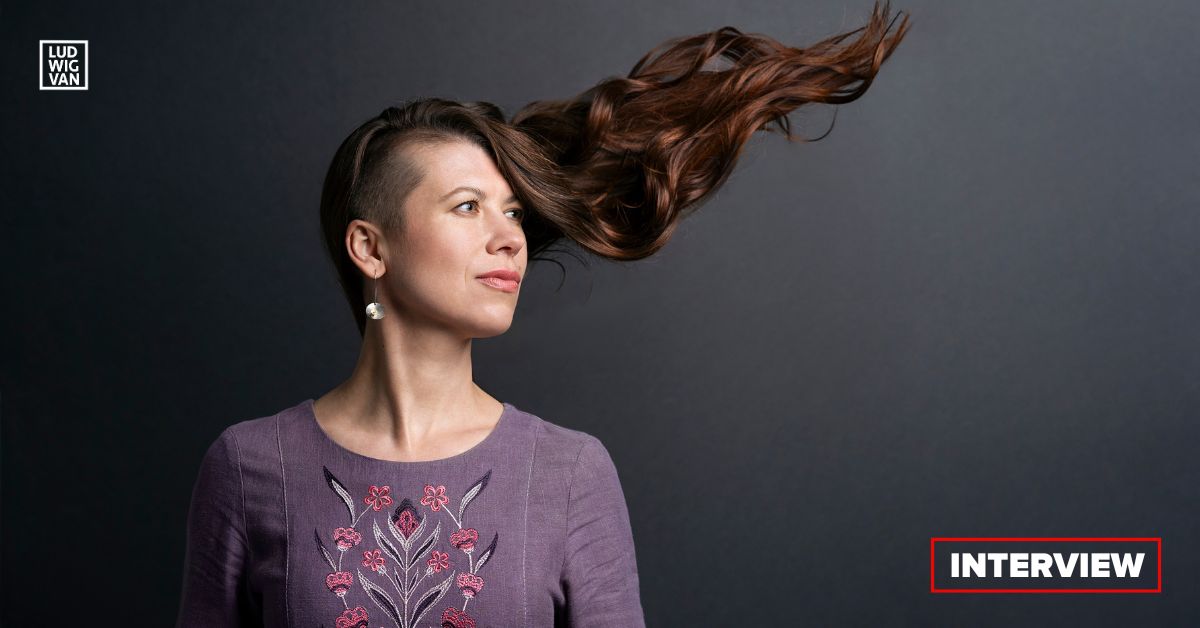
Invented Folksongs is a new album by Ukrainian-Canadian composer and musician Anna Pidgorna, to be released on Redshift Records November 21, 2025. The release, her first full-length album, will be available as an LP or CD as well as digitally.
While her music has often incorporated elements of Ukrainian music, the release marks a shift for the artist who is largely known in Canada for her contemporary classical music. In Invented Folksongs, Anna delves more deeply into her Ukrainian heritage.
Anna Pidgorna
Anna Pidnorna holds a PhD in composition from Princeton University, along with an MMus from the University of Calgary, and a BA from Mount Allison University. Her music has been recognized by two SOCAN Foundation Emerging Composers’ Awards.
Her compositions have been extensively performed, commissioned, and recorded by ensembles and artists such as So Percussion, Sandbox Percussion, Ensemble Mise-En, Soundstreams, 21C Festival, New Music Concerts, Gryphon Trio, Thin Edge New Music Collective, Architek Percussion, Ensemble Paramirabo, Katelyn Clark, Turning Point, Standing Wave, Kaleidoscope Chamber Orchestra, Wild Shore Festival, and Trio Klaritas.
Anna’s music was chosen to represent Canada at the ISCM World New Music Days 2013 festival in Vienna. She has written operas with writer and librettist Maria Reva, one titled Plaything that was developed through the Mécénat Musica Prix 3 Femmes 2020 Award, and another titled Our Trudy that was commissioned and premiered by the Ad Astra Festival in Russell, Kansas.
As an undergrad student, she sang in a choir, and began to develop her vocal skills, eventually taking classical singing lessons at Princeton alongside her composition studies.
In 2012, with funding from Canada Council for the Arts and the Shevchenko Foundation, she travelled to Ukraine to study and record traditional music practitioners.
In Invented Folksongs, she takes both her classical training and more recent knowledge of Ukrainian tradition, and creates her own unique sound — including the language and pronunciation. In her notes, she writes,
“Having encountered many dialects and differences in pronunciation during my song collecting expeditions in Ukraine, I have freely played with words to create my own invented dialect using vowels that feel best in my mouth. The result is the unrooted language of a transplanted child with an imperfect memory of a tongue that was only sort of native to begin with.”
LV caught up with the busy Vancouver-based artist (where she is General Manager of City Opera Vancouver) to talk about the album.
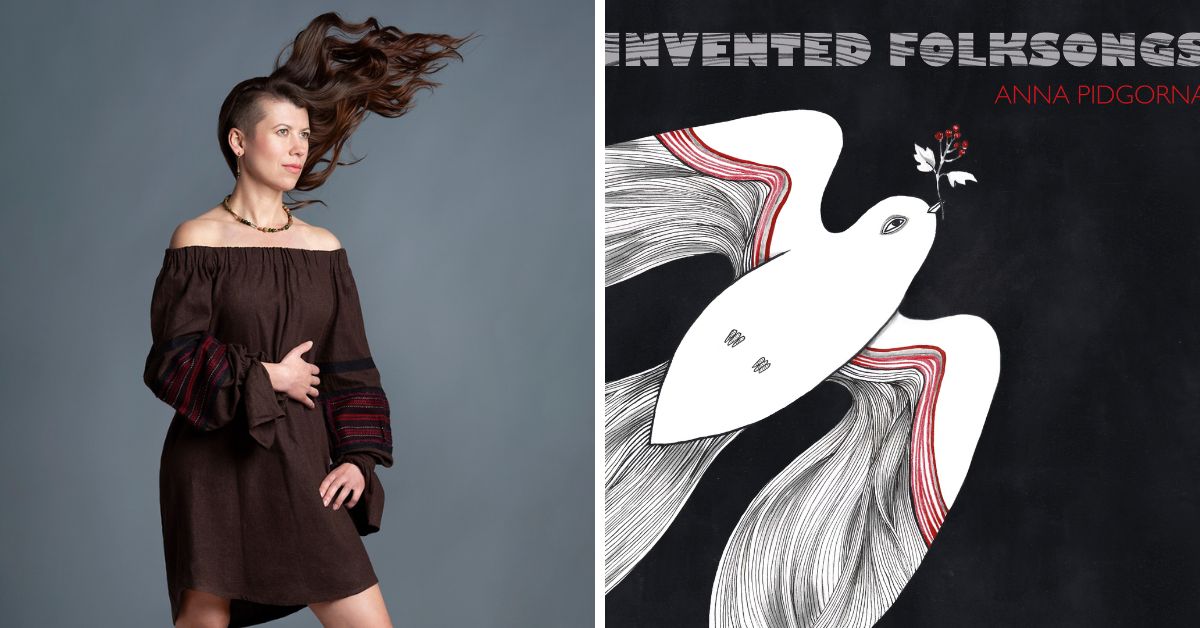
Anna Pigdorna: The Interview
Folk music is something of an ambiguous term. It can be used to talk about heritage music that has been passed down through generations via oral traditions. But, it can also be used by virtually anyone who picks up an acoustic guitar, or musical instruments associated with various ethnic traditions, and writes brand new music.
“It means different things to different people,” says Pidgorna. “For me, […] the reason I call it Invented Folksongs, I’m using the materials and approaches of Ukrainian folk music,” she explains. “I’m drawing on that as a soil for creating basically fully original works.”
Taking that as a base, she pushes past the strictly traditional via her training in Western classical composition. When it comes to the vocals, she’s likewise blending influences.
“I’m drawing on the Ukrainian folk singing style,” she says, “really expanding the range, going into a more operatic range, while still really reaching for that really chesty voice.”
During her trips to Ukraine, she found that music faculties at universities and conservatories generally incorporate distinct programs for classical and folk singing. “They’re kept very separate,” she notes. Classical singers, in particular, tend to shy away from folk music. “They’re told it will ruin your voice.”
During her own training while at Princeton, she worked with a classical soprano who came from a gospel background. “She had no problem reaching for that chest range.”
Coming up with a blended style wasn’t easy. “In the beginning if I really used that chest voice, I found it tiring.” She says it took the vibrancy out of her chest range. “Almost like I took out all the upper partials out of there.”
With time and practice, she learned healthier approaches that made it much easier to essentially alternate between and combine both techniques. “I think that’s a more traditional approach,” she adds, pointing out that contemporary singers outside the classical realm often do use both approaches.
Drown in the Depth: Anna Pidgorna, voice and electronics; Mark Eichenberger, percussion; Matthew McBane, violin; Ninfea Cruttwell-Reade, cello (2020):

Travelling To Ukraine
She made the first trip in 2012. “At that point it was exploratory.” She spent her time travelling to different villages to record folk musicians and singers, and took a few classes at a conservatory.
“This was really a trip to collect a bunch of material.”
It was the first time she’d heard authentic traditional singers first hand. “To sit next to them and watch their mouths — which was really helpful,” she says. “At that point, I wasn’t really planning on singing.” As her work progressed though, she began to feel like she wanted to compose her own music.
“I needed a singer who could do both. That’s a very impossible thing to find. I had to start doing it myself.”
She enjoyed the process of learning and stretching her vocal technique. “It made my composing really embodied,” Anna says. “The singer and the composer in me were really pushing each other.” As she learned more about singing, the composer in her would take over. “They would inform each other back and forth.”
The process of putting together the album took several years, and more than one visit. “I’ve been actively working on that process from 2014 to 2020,” she says. The material for the album was written between 2014 and 2018, and she continued working on and revising material for some time after that.
The album includes four songs based on her own texts, along with two instrumental pieces.
“I think of them as mini dramas, monodramas,” she says of the songs, “and then two shorter instrumental pieces. I call them meditations. They come in between the pieces to give you a reflective break.”
On the release, she’s accompanied by the Boston-based Ludovico Ensemble, including percussion, cimbalom, prepared piano, violin, cello, and bass.
She first became involved with the musicians at university. “The first piece emerged [when] Princeton brought in a guest cimbalom player to work with the composers who were interested,” she explains “It’s a Hungarian instrument that’s kind of rare in North America.”
After a presentation about the instrument, students in the composition program were offered the opportunity to write music for it. “That’s how I ended up with that first piece.”
Another piece was inspired by scenes from a novel. “The cycle developed piece by piece.” Other works were commissioned by individuals and festivals. “The cimbalom player actually came back and commissioned the last piece, Full of the Moon,” she recalls. “We did a full length concert with him and the Ludovico Ensemble in Massachusetts.”

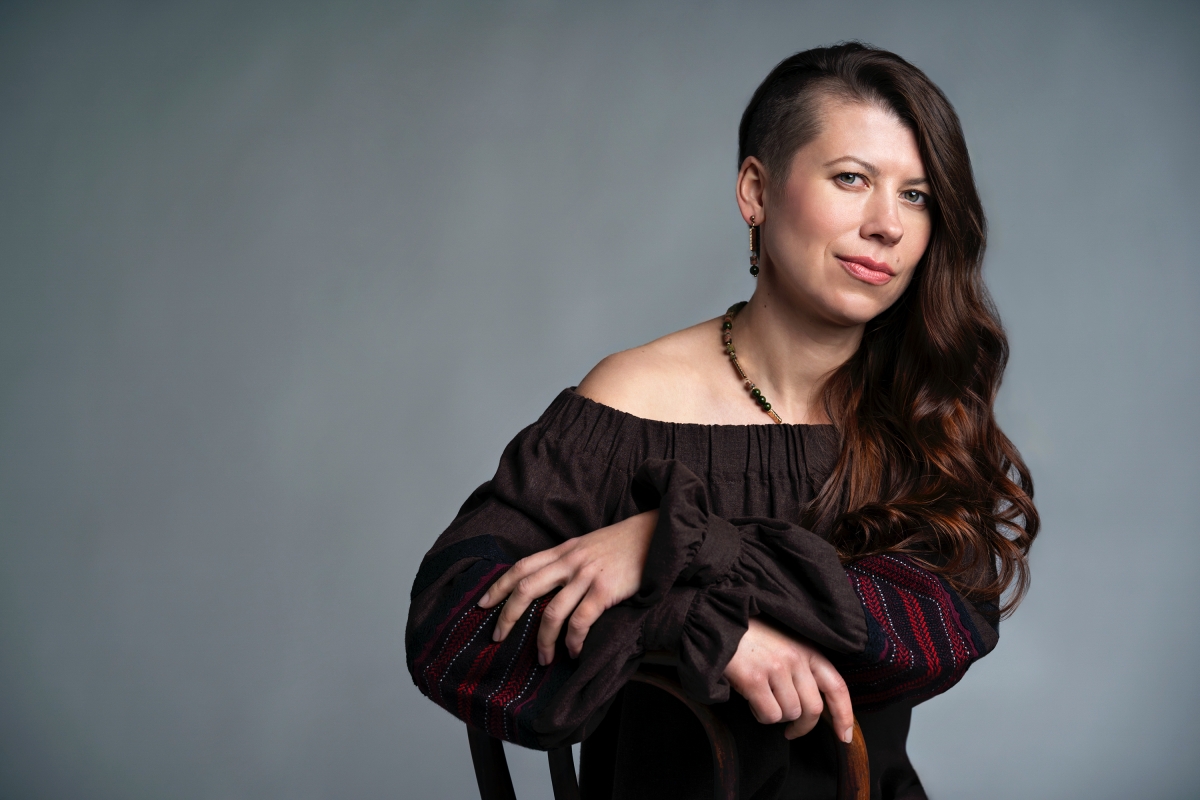
Lyrics
Pidgorna wrote the words to the four songs herself.
“When I listen to folk music, what I find really striking, it’s this sharing of really personal stories.” Folk songs are about sadness, relationships, work, troubles, and the realities of daily life. “But it’s all told through these symbolic metaphors.”
She notes that the songs may be framed around stories about birds and plants, but they symbolize themes from very human stories.
“That’s how I approached the lyrics.” She incorporated elements of her own life, along with news items that she found striking. “But I shaped it through these traditional metaphors, to disguise it a bit. It universalizes individual stories.”
One of the songs comes from a surprising discovery she made in Ukraine.
“One of the pieces, Teach Your Daughters, it does blend an existing folk song with original material,” she says. It’s based on a popular modern Ukrainian folk song that talks about the true story of Oksana Makar, an 18 year old woman who was attacked by three men in 2012, raped, strangled, set on fire, and left to die. As a news story, it garnered international attention, and sparked outrage and mass protests in Ukraine at the time. In an all too familiar story, only one of the attackers was ever charged by police — the other two having influential parents who were former government officials.
The horrific incident happened while she was in Ukraine, in the city of Mykolaiv in Southern Ukraine, the region where Anna is from.
“It profoundly affected me.”
In one of the villages she visited, she recorded a song that she says has a remarkably similar storyline. She played the recording for others, who recognized it as a song often sung at weddings.
“That’s crazy to me.”
She had discovered a distinct subgenre of folk music that revolves around the abduction and rape of maidens.
“It’s really disturbing,” she says.
For Teach Your Daughters, she wove the original folk song into original material. “It’s almost my misremembered version of that folk song.”
The Album
Invented Folksongs will be released on Redshift Records.
Anna Pidgorna In Toronto 2026
Toronto audiences will get a chance to experience Pidgorna in performance in 2026.
Anna was named as one of the winners of Soundstreams’ 2025/26 New Voices Curator Mentorship Program. She’ll be curating one of the main stage concerts on May 9, 2026, titled In Terra Pax, and featuring, in addition to Anna on vocals, Steven Dann (viola), Anna Sagalova (piano), Ensemble Soundstreams, and conductor Tania Miller.
- You can find more details and tickets [HERE].
Are you looking to promote an event? Have a news tip? Need to know the best events happening this weekend? Send us a note.
#LUDWIGVAN
Get the daily arts news straight to your inbox.