
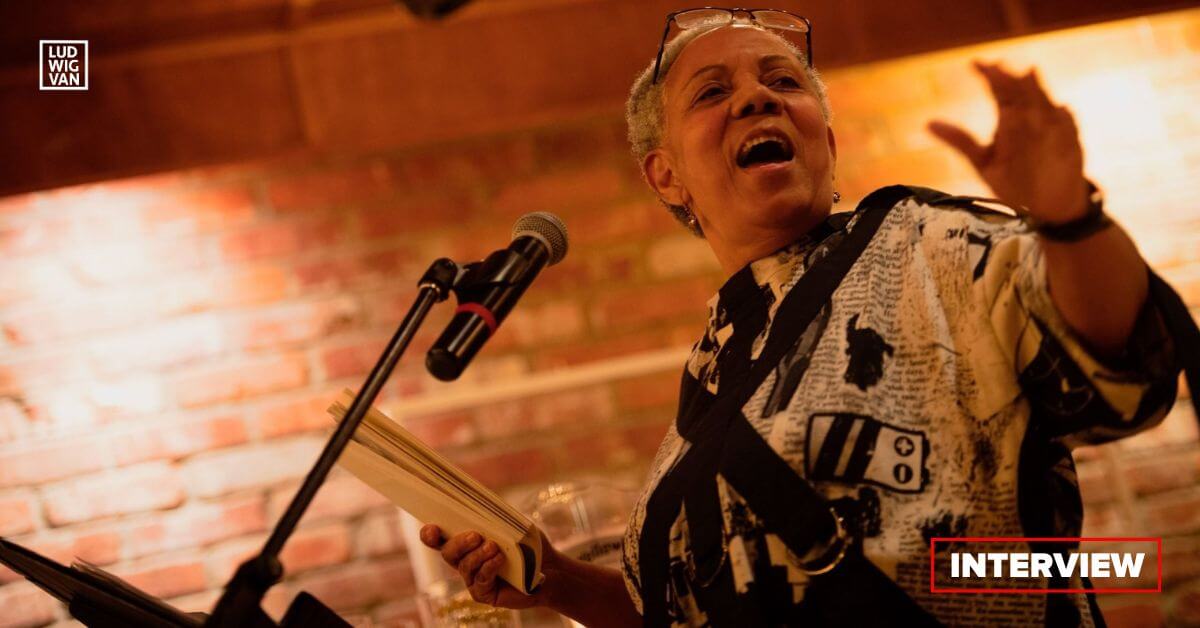
Two-time JUNO Award winner and pioneer of spoken word and dub poetry Lillian Allen has carved out a unique career as a performer, writer, and educator. Allen, the 7th Poet Laureate of Toronto, is a professor of creative writing at Ontario College of Art and Design University (OCAD), and she’ll be honoured at an event on October 3.
Called the Godmother of Dub Poetry in Canada, the free event will include dub poetry in performance by artists Dwayne Morgan, Andrea Thompson, Desiree McKenzie, Britta “Bee” Badour, and Mathew-Ray “Testament” Jones, the poet laureate for the Province of Ontario, as well as a special performance by Allen herself hosted by Toronto’s Youth Poet Laureate, Shahaddah Jack, with music by DJ Carl Allen.
The event will also incorporate a discussion on dub poetry and its legacy in Canada, with panellists Professor Michael Bucknor from the University of Alberta, Canadian spoken word artist and Order of Ontario recipient Dwayne Morgan, Toronto music historian Klive Walker, and award-winning author and Professor Natalee Caple from Brock University.

Lillian Allen: The Godmother of Dub Poetry in Canada
Lillian Allen was born in Spanish Town, Jamaica, and emigrated to the US as a teenager. She studied English at the City University of New York. Subsequently, she moved to Canada, first to Kitchener, Ontario, before coming to Toronto. She continued her studies at York University, where she earned a B.A. degree.
Her first album, titled Dub Poet: The Poetry of Lillian Allen, was released in 1983.
Allen’s poetry is woven into music and rhythm, developing a distinctive aesthetic that marries old and new, and puts her in the category of Canadian reggae pioneers. She’s recorded several albums of dub poetry, including the JUNO-winning releases Revolutionary Tea Party and Condition Critical.
Dub poetry is by its nature political, including social commentary, and Allen made it a space for Black feminist commentary. She’s published several books of poetry for adults as well as young people. Allen has also appeared on radio as a host, was featured in the film Unnatural Causes (1989) and co-produced and codirected the documentary Blakk Wi Blakk (1994), a film about Jamaican dub poet Mutabaruka which premiered at the Toronto International Film Festival.
In addition to her work as a performer, Allen has become recognized as an authority on diversity in culture and related issues, including arts in education, and has lectured and performed in North America, the Caribbean, and in Europe. She has also held the post of distinguished Writer-in-Residence at Canada’s Queen’s University and University of Windsor.
Allen has worked extensively with youth in Toronto, including initiating and creating programs, serving on boards, and she has played a key role in government policies related to arts and culture. She is a past member of the Racial Equity Advisory of the Canada Council for the Arts, the Experts Advisory on the International Cultural Diversity Agenda, and past executive member and member of the Sectoral Commission on Culture and Information of the Canadian Commission for UNESCO.
I came to Canada
I found the doors of opportunity well guarded
(from Lillian Allen’s I Fight Back)

Lillian Allen: The Interview
Allen was just a teenager when she landed in the US.
“I was just out of high school. I knew I wanted to be a writer.” She continued because of the response she got. “I was very surprised that people actually loved the work as much as they did,” she says, “and that it gained the kind of recognition and popularity that it did.”
Dub poetry, with its music and performance, comes as a stark contrast to the staid, stultifying way that poetry is often still taught in schools.
“The thing is, we got a bit of that too,” she points out. “I grew up in a British colony.” Jamaican high schools also taught poetry like it was something to be dissected, not enjoyed. “As if it wasn’t made by humans,” she laughs.
But, as she notes, at the same time, her culture was full of poetry, starting with the preacher at the pulpit on Sundays. “If I go somewhere, and there’s a Black preacher, I just slip into it,” she says. “It’s just that the language was so alive,” she adds.
“People appreciated the turn of phrase. Something put in a unique way. That was always there in the culture, but not recognized as poetry,” she says. “I knew that I loved the music.”
There were other influences, like Miss Lou, aka Louise Bennett-Coverley, a renowned Jamaican poet and folklorist, and Jamaican-American writer and poet Claude McKay.
“There is something in the musicality and the vernacular,” she says. It’s not the erudite speech of professors, it’s about the thoughts and feelings of everyday people.
“It really inspired me,” she says. “I started trying my hand.”
The Poetry of Everyday Language
The danger of teaching poetry without imbuing it with joy and passion is that it can turn people off the art form for a lifetime.
The rise of dub and performance poetry is an antidote. “Like different kinds of music,” she says. Dub appeals to anyone. “Ordinary people just say ya, that’s me. I feel that, and are inspired to write their own.”
Like any art form, it grows by developing at all levels, including the beginner. Elitism is a dampening influence that criticizes those who are just trying.
“As if anything good ever started out good,” she says. “We have to give people a space to try things out and to get feedback.”
Dub is an art form that can be taken in many different directions, as it has in her own career.
“You can’t be good at everything. But you become good at maybe one or two things, and you apply that strategy to other things,” Lillian says of her creative career. “Making things beautiful. It’s a journey with yourself,” she adds.
“It’s also a discovery for the writer. It’s one of those, as far as I’m concerned, our inherent rights, to express ourselves.”
The Event
The October 3 event includes a panel discussion of her work, and dub poetry in the city in general. It’s well deserved recognition.
“Most artists are actually very shy people,” she says. “I feel honoured.”
Black Music Archives brought together a multi-generational lineup of artists to perform. “They brought together some younger folks,” she says, “finding their way in life via poetry and spoken word.”
When it comes to the panel, she’s intrigued by what they will say.
“I’m interested in listening to them,” she says. “I love that, because, as an artist, you make your work, and you’re not thinking very much beyond being in the work, and making the work. They talk about it in a way that makes you sound brilliant,” she laughs.
She believes that the panel, and writing about culture, is also important. “That’s part of it,” Allen says. “The arts isn’t just from you, it’s from the culture, and the culture goes way back. I think that’s how we build culture — we get people to talk about, think about what the artist is doing.”
She’ll be reading a short passage of her work.
“I’ll do a little bit of a performance myself, reading,” she says. “I’ll just be there feeling good.”
- Find details and register for the free event on October 3 [HERE].
Are you looking to promote an event? Have a news tip? Need to know the best events happening this weekend? Send us a note.
#LUDWIGVAN
Get the daily arts news straight to your inbox.