
Self-discovery, finding your real calling, and family blend into a story about transitions. What Brings You In is based on the life and experiences of Leslie Ting, who made the leap from practicing optometrist to a musical career.
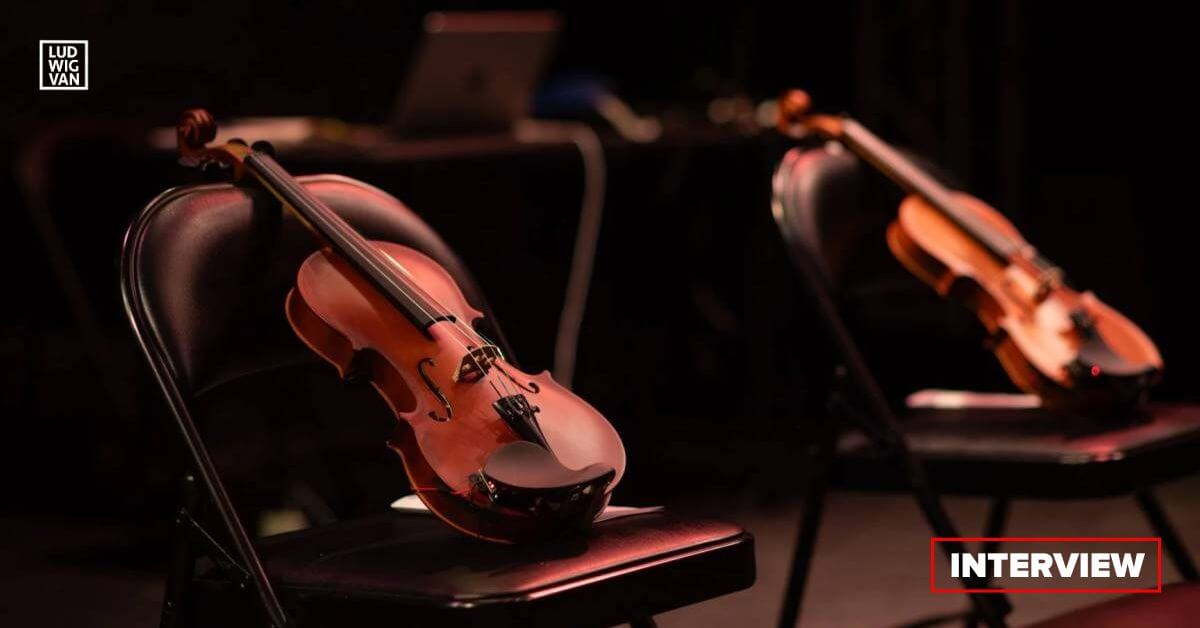
Performances run from October 17 to 27, 2025, with a special one-night-only installation of 40 violins to kick it off.
It’s part of Theatre Passe Muraille’s 2025/26 season, and a co-production between Passe Muraille and Leslie Ting Productions. You can find more about the other offerings of the Passe Muraille season, which kicks off with Butch / Femme on September 20 here.
From Leslie Ting’s Speculation:

Leslie Ting
Leslie Ting has fused a unique performance practice that combines the various elements of her life: her background as a classical musician, theatre, new media — even her experiences as a former practicing optometrist.
She has been artist-in-residence at Eastern Front Theatre (Dartmouth, NS), MITU580 (NYC), and the Durham Art Gallery (ON). Collaborations have included Diane Borsato at the National Arts Centre SPHERE Festival (Ottawa), experimental publication Caddisfly Project (NYC), and Race Cards (in Two Acts), a co-production by Prime Mover Theatre Company and Selina Thompson LTD (UK).
She’s been performing music-driven interdisciplinary performances since 2014 which have garnered multiple award nominations.
Leslie currently leads an arts practice research project called Anchoring Accessibility and is a mentor for Why Not Theatre’s ThisGen Fellowship.
We spoke to her about the intimate and personal project.
Leslie Ting: The Interview
“I’ve been playing since I was four,” Ting says. “The optometry part for me was the detour.”
The reasons for that detour will sound familiar to many. “I wanted to be a violinist, and my parents didn’t want me to do that for all the cliché reasons,” she laughs.
“Please do anything but music.”
She was patient. “Honestly, it was a feeling of biding my time until I could get back to what I wanted to do.”
Ting studied violin performance at the Université de Montréal, and obtained her Masters degree.
“It wasn’t an easy transition,” she says of going back to school. “It was hard to be an older student. Classical music is really ageist. There’s a real belief that you “won’t make it” if you are too old,” she adds.
“It’s not like optometry school was a walk in the park.”
While she was taking that detour into optometry, she was trying to keep her musical chops up. After six years of university, and then two years of working as an optometrist, she went back to music. As she points out, though, those years in your early 20s are when most classical musicians are beginning to build a career.
“I came back with a laser focus on catching up. That’s not how life really works — but boy, did I ever try.” Ting performed as part of the Kitchener Waterloo Symphony several years ago.
Around that time, however, her mother was losing her sight. Ting was developing a show about her relationship with her mother.
“It was a very difficult time for my family,” she says. “I was witnessing her go through this sensory experience.”
She couldn’t help but reflect on the irony of the situation, in that she was turning from optometry to music at the same time. “Our relationship was quite difficult. I was processing a lot of things at the time.”
That’s when a creative opportunity came along. She was considering a community concert project, and connecting with the Canadian National Institute for the Blind. Ting got help writing the grant proposal, and the grant writer asked her at one point why she was doing the project. Leslie opened up with details of her life story. The writer made the connection, but in the end, Ting at first rejected the idea that her performance was linked to her life experiences.
“My reaction was no, I’m just playing Beethoven; I don’t want to talk about it,” she says. “Although I had this clinical experience of optometry, the experience of watching someone lose their sight is quite different.”
That led to a kind of revelation, and a change in thinking about the audience experience. She began to incorporate lighting and other elements of staging into her musical performances. Dubbed a “theatrical concert with immersive visual design”, she worked on a performance project called Speculation for about seven years, supported by Theatre Passe Muraille.
“Learning about theatre and how theatre operates was a real learning curve,” she says. “Someone had to explain what a stage manager did,” she laughs.
Another revelation was that classical music and theatre audiences were quite different.
“Things on stage have a lot of meaning,” she points out of theatre. For a concert, anything on stage is largely functional. “It’s been really interesting to learn about how those pieces fit together”.
She added an emphasis on new media to her repertoire of skills during the pandemic. “There were a lot of grants with the word digital in them,” she laughs. She’d wonder, if someone is alone with a laptop, how do you make it a meaningful experience?
“What does it really feel like to be at home?” Accessibility adds another layer to that thinking. “Accessibility has always been a big part of [what I do]. Even in my last show, I was thinking about how people who are blind experience the show.”
As she notes, audio description in its traditional form doesn’t feel so connected to the material.
“Poetic audio description is something I worked on a lot,” she says. Leslie says that she tested out her ideas on a variety of audiences of blind people over the years. “Approaching it as a creative problem to solve rather than an add-on obligation is a very different thing.”
She was trying to consider the experience for blind people in her digital projects as well. “We went through several iterations of an online show.”
Leslie Ting and Matt Smith produce/perform composer Julia Mermelstein’s folds in crossings for solo violin & electronics:

Leslie Ting: What Brings You In
The basis of the show revolves around experiences Ting had undergoing therapy. Throughout the show, she uses a variety of music, including a piece by Linda Catlin Smith. Smith offered her 2006 piece Dirt Road for What Brings You In. Percussionist Germaine Liu performs with Ting in an improvised piece titled “What is the most yourself you can be with another?”
“A third piece is called Sand Play.” It’s based on sand play therapy, which uses a table with a layer of sand outfitted with contact mics, so the movement of Germaine’s hands in the sand are audible.
“It sounds like an ocean,” Ting says, calling it “ASMR on steroids”. Sound designer Matt Smith adds electronic sounds to the mix.
Ting also commissioned two new works for violin for the show from composers Rose Bolton (Beholding for solo violin & electronics) and Julia Murmelstein (folds, in crossings for solo violin & six-speaker surround sound electronics).
“The piece by Rose is about the idea of the black box of the mind,” Leslie says. “With Julia, we talked about sound as a kind of representation of collective consciousness,” she continues. “It’s all very conceptual.” She’s conceived of it as surround sound that flows around the audience, representing the connection between them.
“And then the pandemic really shut that down fast.” The project had been in workshop stage. “Okay, we’re digital project managing now.”
Transitions & Accessibility
Along the way to developing the project, she can see advantages to the position she originally thought of as a weakness.
“It’s kind of liberating to be an outsider.” You can ask really basic questions without fear, for example. “We would talk about the texture of sound and the engineer would say, I have no idea what you’re talking about.”
It became an exercise in learning each other’s specialties, and the pandemic offered the time to do it in.
“We focused on building this online show for two or three years.”
She was careful to focus on engaging the audience, and the music.
“Something I think about is the relationship between listening and sight,” she says. “If something is too visual, my feeling is that listening takes more and more of a back seat. It was an interesting balance to find.”
She worked with a software engineer, a sound engineer, and then finally blind Chicago-based media artist, writer, performer, and Disability advocate Andy Slater joined the project.
“We had a few interesting conversations.”
The online project was built so that cursor interactions were guided by sound, and viewers could follow along based on the sounds alone.
“That was a creative decision driven by accessibility.”
Improvising For Authenticity
Along with the multimedia elements, Leslie wanted to focus on delivering a high level of performance of new music.
“Germaine comes from an improvisation background,” she notes. “We spent a lot of time talking about improvised music.”
It’s one of the aspects of playing classical music as a professional musician she had questions about. She wanted to focus on being herself as an authentic artist, and when it came to music, performing and creating a sound only she could make. “What does that mean when you’ve spent 30, 40 years looking at a score?” she wondered.
“I was terrible,” she laughs of her first efforts at improvisation. “I could tell that I was really blocked.” Germaine assured her that she didn’t have to throw out her entire history in music in order to dive into improvisation. It was a matter of evolution.
“The process of making the show was a bit meta,” she says.
There have been several versions of it that have appeared online over the last six years or so. It’s available to stream or download in an audio-only version here. The Limited Edition “What Brings You In” Black Box is a 3D printed cube with braille writing that includes a QR code to download the album in stereo and binaural versions.
- Find tickets and show details [HERE].
Are you looking to promote an event? Have a news tip? Need to know the best events happening this weekend? Send us a note.
#LUDWIGVAN
Get the daily arts news straight to your inbox.