
“The future of classical instrumentation music is not in a museum. It is in the mud, in the fire, and in the streets.”
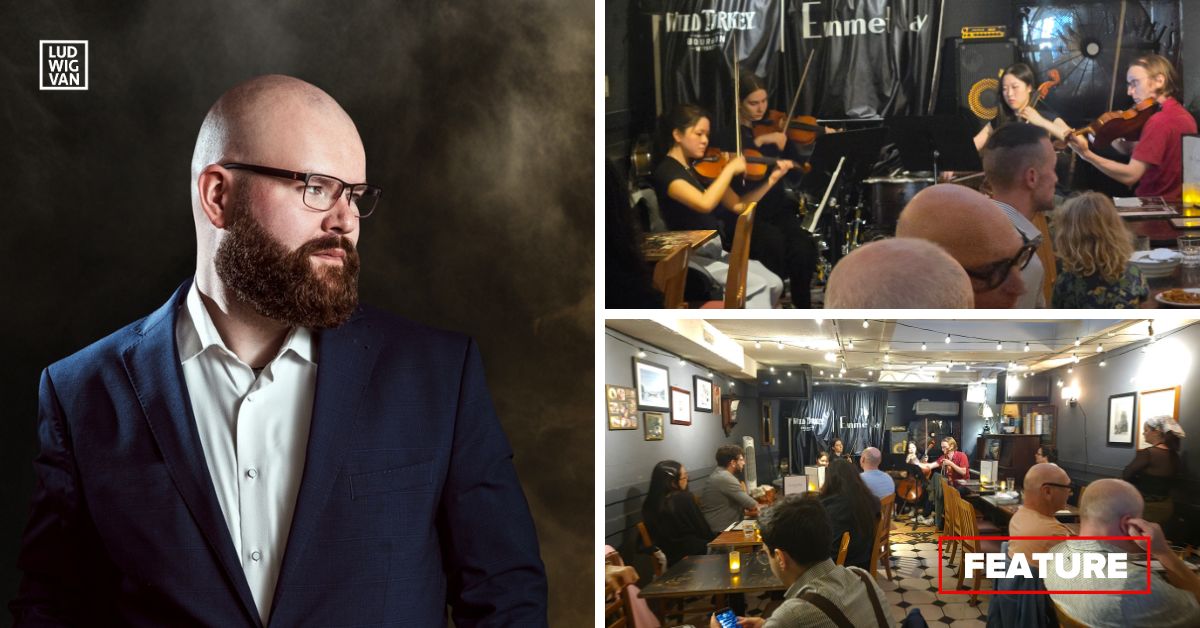
That statement comes from Corechestral Music Group, a new Toronto organization that’s looking to bring orchestral music to places — and people — beyond the concert hall. Last night, they presented the very first Strings & Spirits event at the Emmet Ray, a College Street bar typically better known for live jazz and rock bands.
As the first performers, a string quartet, began to play, horns blasted from traffic going by on College Street.
The Event
In terms of format, it was a classic open mic and jam set up, where musicians could sign up in advance to be added to the program. A setlist was available, and audience members who brought their instrument along — and who knew the piece in question — could join in. Mozart’s music doesn’t lend itself so well to free improvisation, after all.
It’s about walking the line between a casual, inclusive approach, and musical chaos of the kind that would turn off audience members.
Musical selections ran the gamut from the expected Mozart and Bach through Gardel, Rossini, and Poulenc, to contemporary Japanese composer Hayato Sumino, with a total of about a dozen instrumentalists, and a couple of vocalists. There were two sets of 45 minutes to an hour each.
Drinks were served, and dinners eaten as the music played.
Next Steps
Organizer Joël Blackshaw says the goal is to build momentum. “I wanted to start small,” he says. The Emmet Ray is an intimate space with table seating and a warm ambience. The crowd was mixed and multi-generational, and included unsuspecting passersby who wandered up towards the stage to see what was transpiring.
Conversations didn’t stop while the music was playing, perhaps the starkest contrast to the usual performance environment. It takes Western classical music and makes it part of the soundtrack to the everyday world.
Networking is another advantage of a casual format. It’s a good environment for meeting likeminded musicians and music lovers, where it’s easy to strike up a conversation.
Blackshaw would like to explore different venues, and eventually incorporate original contemporary orchestral music into the mix. Feedback from audiences and participants will help to guide future events.
The Goal
With Corechestral, Blackshaw is looking to blur the lines, and bring high art down to earth. Genres will be crossed, and elitism rejected as a limiting element that has brought orchestral music to the margins of the music industry, ignoring its broad appeal and potential.
The emphasis, Blackshaw believes, is on the emotional impact of the music. Listeners respond to it, and don’t care about the labels applied to it, or the fine distinctions and definitions. Classical crossover is really nothing more than the normal and organic evolution of the art form in a contemporary context.
Eventually, he’d like to be able to commission new music from emerging artists, and foster partnerships with organizations and institutions that will help support them.
It’s an ambitious plan, and one that warrants attention. Blackshaw ends his mission statement with optimism,
“… proving genre-blending artists can keep their masters and make rent.”
- You can stay on top of future events by following Joël’s Instagram here, and Strings & Spirits here.
Are you looking to promote an event? Have a news tip? Need to know the best events happening this weekend? Send us a note.
#LUDWIGVAN
Get the daily arts news straight to your inbox.