
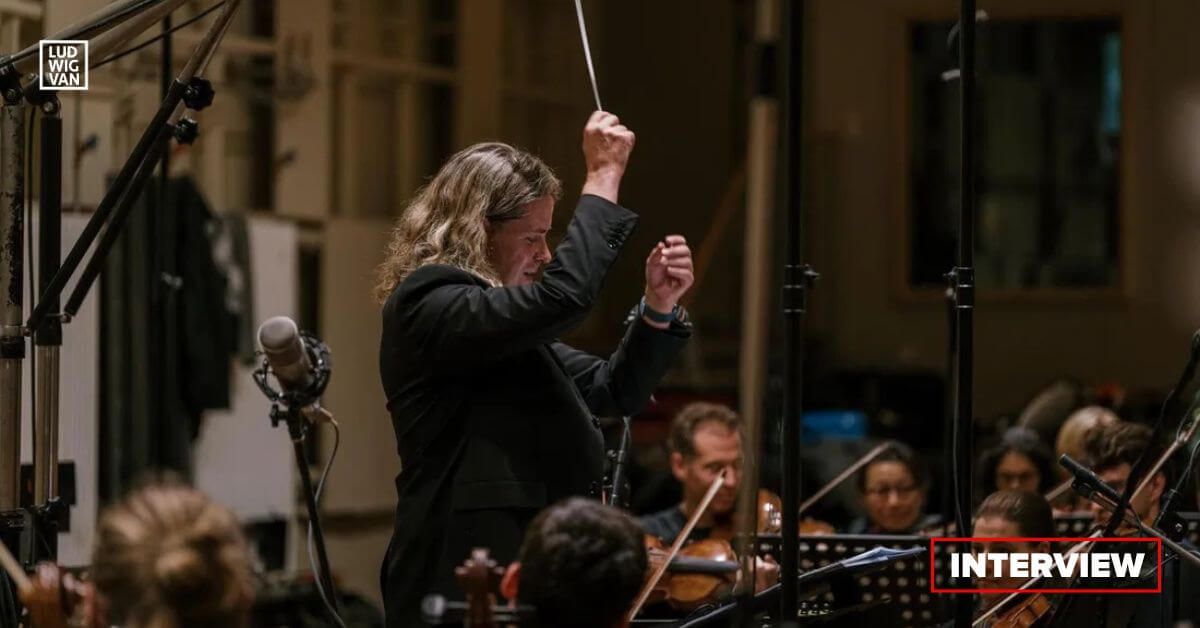
Originally from Toronto, where he spent formative years, Nathan Henninger has carved out a career as a composer and conductor for film and television, as well as concert music. He trained at the Juilliard School and the Film Scoring Academy of Europe, and studied piano with Taka Kigawa in New York.
He also plays the French horn, and has sung in many professional choirs that have performed at Carnegie Hall, the Lincoln Center, and many other prominent venues.
His debut album, Five Scenes for Orchestra, dropped on August 8.
The music was recorded back in 2023 at Teldex Studio in Berlin. Henninger is based in Europe these days, and performers on the album include musicians drawn from the Berliner Philharmoniker, the Deutsches Symphonie-Orchester Berlin, the Rundfunk Symphonieorchester Berlin, and the Deutsche Oper Berlin.
Henninger wrote the music for Five Scenes after relocating from New York City, where, in addition to his music and compositions, he worked in communications at the United Nations, to the Central Azores in Portugal shortly before the pandemic hit. There, he settled on the volcanic island of Terceira.
The differences in environment, and his eventual decision to stay in the Azores, colour his work.
He’s released several single tracks before this debut album, and has another full-length orchestral work titled Romanza already recorded and set for release in early 2026.
Nathan Henninger: The Interview
Nathan grew up in a musical family.
“My father was a music professor at the University of Toronto, and a composer also,” he explains.
His father was Richard Henninger, a composer and Assistant Professor of Theory and Composition at the Faculty of Music of the University of Toronto. When he eventually left Toronto, it was to study computer sound synthesis at Stanford University in California. Richard also worked in the computer field for nearly three decades as a software architect.
During his time in Canada. Richard’s compositions were often commissioned by the CBC, and his music was performed across North America and in the UK.
Nathan describes his music as being serialist, in tune with the Zeitgeist of the late 1960s and early 1970s.
“It was a big influence on me, in the sense of when I was a kid, having a composer for a father and going to see the orchestra […] was a huge influence,” Nathan says. “I got into Puccini operas in Toronto as a kid.”
He says the family attended the Metropolitan United Church, which then (as now) supported a prominent choral singing program. His mother was in the choir.
“They were always doing a Benjamin Britten or St Matthews Passion,” he recalls.
Nathan also began to study the French horn at Huron Elementary School (now Huron Street Junior Public School) in the Annex.
He has fond memories of his childhood in Toronto. “I was born there, and my formative elementary school years were there. My father had a real career there. My mother studied at OISE. She had a PhD in psychology. My sister played violin.”
His family’s roots are in Southern California. “My whole family is from Southern California,” he says. He’d spend summers going back and forth. He calls himself a sort of hybrid of Californian and Canadian. ”It’s really a fish out of water thing,” he says. When he spent time in California, he’d miss Canada, and vice versa.
After graduating from high school in St. Catharines, Ontario, he studied in California. “I got a scholarship to study music at Pomona College in California,” he says.
There, he studied with the same professors and departments that his father had years earlier. While studying composition, he played French horn in the college symphony. Nathan’s music, while different in style and approach than his father’s, was nonetheless influenced by Richard’s tastes.
“My father was a serial composer, but his interests were choir, Puccini, Bach,” he explains. “I’m very much in this melodic vein of writing.”
He has a simple rule of thumb. “It always comes back to, can I sing it?” Nathan says his music is also informed by cinema.
“I taught music for three years after university,” he says. That included working with kids in a musical theatre program. “We did Oliver,” he recalls. “It was a real band camp.”
With both parents in choirs, he also gravitated towards choral music.
“I was in every kind of vocal group.”
After moving to New York City, he began to sing with a number of professional choirs and a cappella groups, some of whom took him to sing at Carnegie Hall and other prominent stages. “Lots of great experiences doing professional choirs,” he says.
He studied at Greenwich Music Hall with Taka Kigawa for ten years, and performed on the piano there frequently.

Making The Move
It was just before the pandemic that he first came to Portugal.
“I came here on a vacation and immediately fell in love with the Azores Islands,” he says. It reminded him, in part, of the times he’d spent as a child on Catalina Island in California — even to the detail of a cross on the hilltop. “It was like déjà vu,” he says.
He loved the lifestyle of the island community. “I did it as an experiment,” he says. He arranged a temporary roommate for his New York apartment. “I got a job teaching piano in a conservatory, learned Portuguese.”
Less than a year into his experiment, the COVID pandemic took over the world. He chose to stay in the more remote and natural environment of the Azores. “I became rather attached to it.”
These days, he’s got an ideal situation of being settled in Portugal while maintaining ties on this side of the Atlantic. He visits the city about every six weeks or so.
“I don’t really miss living in New York,” he says. “When I go back, after a few days, I’m ready to return to the island.”
The more natural environment fuels him as a composer. “I feel as a composer [..]. it’s allowed me to feel — an invitation to think more about what was within me rather than what was around me,” he says. “For me, I felt like, this really helped. I always loved living near the ocean.”
The constant changes of the ocean and the weather are another perk, as well as the much older society he moved into. “On my street, there are houses that are from the 1500s.”
Five Scenes, which he composed in Portugal, is a kind of musical self portrait of Henninger, from his background in a musical family to his current situation. He’s dedicated to the music to Heidi and Lua — two cats who occupy a special place in his history. Heidi was his mother’s beloved cat, and he took over her care when his mother passed away. She became his support, especially during those first few years living in a new environment. Heidi passed away in 2023, and he adopted a young stray cat he named Lua while he was composing Five Scenes for Orchestra.
He recorded his second album in Budapest. “I was there for two weeks, and I loved it,” he says.
Influences
His influences are wide ranging within the realm of classical music. His music combines elements of the traditional symphonic music repertoire with impressionism, and a cinematic sensibility somewhere between John Williams and Gustav Holst.
“Debussy — how he orchestrated, and how he used the orchestra,” he says. “I think, more Prokofiev. I remember as a kid listening to Peter and the Wolf, the idea that the instruments are speaking to each other,” he adds. That element stuck with him as he began composing music of his own.
“I think, as an adult, the composer I feel most connected to is Puccini,” he says. He’s a fan of Puccini’s melodies, among other things. He feels that melody connects with audiences as a collective experience, a kind of recognition.
“Why are certain things familiar?” he asks. “I try to think, would this be something that I would want to listen to again? Would it feel like a welcome friend in the house?”
He calls his music somewhat impressionistic, incorporating passages of dissonance, and focused on creating atmosphere. “I like the idea that the instruments are sort of talking to each other,” he says. He mentions the idea of earning your listeners’ trust.
“I feel like melody is important.”
- You can stream or buy Five Scenes For Orchestra from your favourite service [HERE].
Are you looking to promote an event? Have a news tip? Need to know the best events happening this weekend? Send us a note.
#LUDWIGVAN
Get the daily arts news straight to your inbox.