

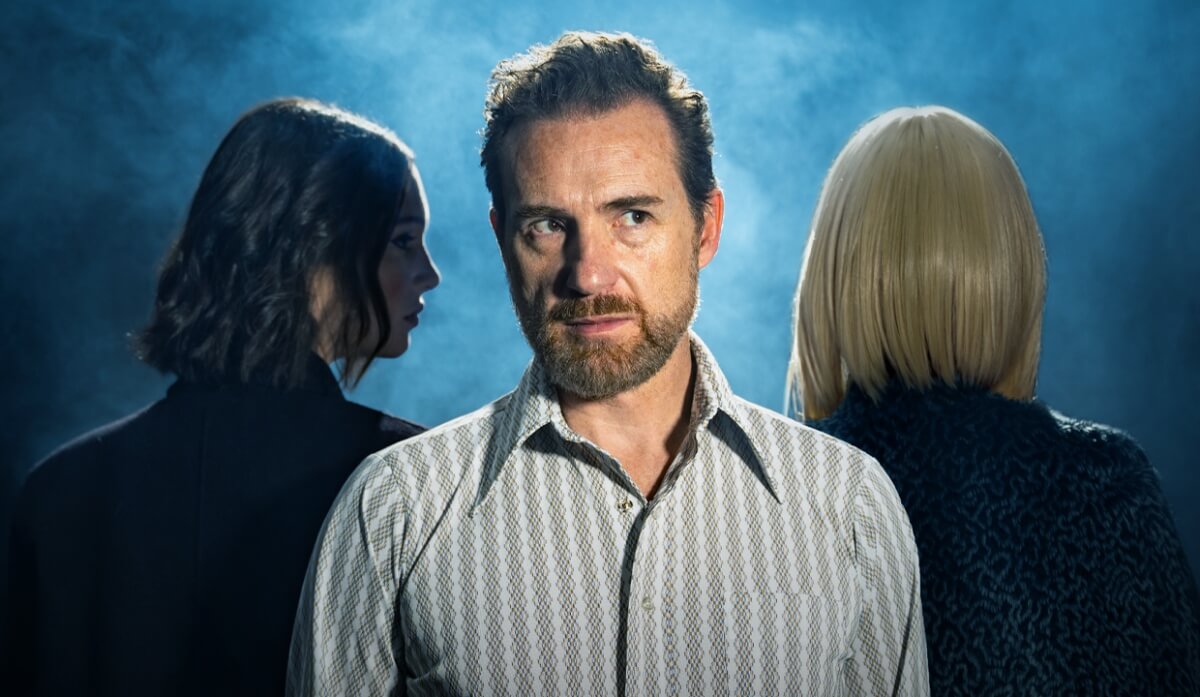
Director Peter Pasyk will direct the Soulpepper Theatre production of Harold Pinter’s Old Times, with previews beginning August 6, and opening night set for August 13. The production will continue until September 7 as an early opening to the fall season.
Pinter’s play is one of his lesser known titles on this side of the Atlantic. It sets up a scenario that’s full of potential: a married couple welcome one of the wife’s old friends for a visit.
As the visit progresses, stories about the past emerge and are disputed, and memory itself becomes suspect. What did or did not occur so many years ago? What does it mean to the present?
Pinter withholds certainty, leaving the ending ambiguous and open to interpretation.
Ludwig-Van talked to Pasyk about the production.
Director Peter Pasyk
Peter Pasyk has worked with some of Canada’s leading theatre companies, including the Stratford Festival, where he directed the flagship production of Hamlet in 2022, Royal Manitoba Theatre Centre, Tarragon Theatre, Soulpepper, and Canadian Stage. He’s led several world première productions, including Jordan Tannahill’s Late Company (Theatre Centre), and was nominated for Dora Awards several others, including for The Nether, Killer Joe, Dying City, When the World Was Green and The Jones Boy.
Peter is also a filmmaker, who co-wrote Planeta Singli (Planet Single), one of Poland’s highest grossing feature films, and he recently directed the pilot of a new Polish comedy TV series.
On stage, he directed The Seafarer starring Paul Gross at Alberta Theatre Projects in late 2024. His award-winning short film The Understudy (theunderstudyfilm.com) has screened at film festivals around the world.

Peter Pasyk: The Interview
The choice to direct Pinter at Soulpepper was an easy one.
“It’s considered a modern classic,” Pasyk says of the play. “And, Soulpepper is a company is also built on presenting modern classics. That’s the roots of the company. I was honoured to be asked,” he adds.
Pinter’s plays ask big questions whose significance doesn’t diminish with time or place. “Classics are considered so for a reason. There’s something enduring about them that keep us curious to see them.”
As he points out, most plays that are produced don’t last beyond their first season.
“This play has a timelessness because it asks big questions about what it is to be human, and the nature of memory, and identity, and love.”
Certainly, the nature of truth in our society is a question that many of us grapple with these days.
“Particularly with this play, I think that throughout Pinter’s work, I think that he’s always been investigating the nature of truth, and perhaps posing that it is subjective,” Pasyk says.
Everyone’s view comes from their own individual experience, as he points out. Truth depends on who sees it, and what they have lived through.
He mentions Pinter’s Nobel Lecture, delivered in 2005 and titled “Art, Truth & Politics”, which the playwright used to criticize American foreign policy, and how truth is manipulated in both politics and art.
“When he won the Nobel Prize, he gave a famous speech, [and he said] in my plays, I explore the nature of truth, and there is no finite truth — but when it comes to politics, there are,” Pasyk says.
It was undeniably a politically minded speech. “But his politics certainly aren’t reflected in his plays. They’re about something more fundamental.”
Minimalism on Stage
“It is a minimalist production,” Pasyk explains, “and that’s really dictated by the minimalist nature — the essential quality of Pinter’s writing.”
There are no wasted lines, superfluous or self-indulgent diversions away from the central plot and premise. “There’s no wastage,” he says. “We’ve taken that as a cue.”
There’s nothing to distract the audience from what’s taking place on stage.
“The play is a puzzle, a mystery,” Pasyk says. “It asks a lot of questions, it begs a lot of questions of the audience.”
Along the way, it engages with the audience’s imagination and sense of inquisitiveness. “There’s an ambiguity that’s baked into the premise of the piece that’s important for me to preserve.”
He was careful not to impose his own interpretation of the story on the production.
“That’s what I love about Pinter — he trusts the audience.”
The blanks can only be filled by the audience.
“Argue with your fiends on the way home on what the truth of the matter is,” Peter says. “The play is about contested truths.”
The Nature of Memory
The couple in the story of the play have been married for 20 years. That’s a lot of time for memories to percolate and change. The arrival of the wife’s old friend puts all of that to the test.
“There [are] a lot of discrepancies in each of their memories of the past,” Pasyk explains. “In some ways, it’s a mystery. It’s a psychosexual thriller.”
But, audiences should also expect a thread of humour to run through the story.
“He’s also — Pinter’s also very funny. He has a wry, sharp — a dark sense of humour.”
The turmoil is psychological. That’s why extensive sets aren’t needed for his stories. “All of Pinter’s play are set in a room. He didn’t write plays with expansive spaces,” Peter notes. “He was interested in people in a room.”
Pinter often uses the arrival of an outsider or intruder to upset the balance of that room. “He was interested in the human need for marking one’s territory,” Pasyk explains. “There’s a kind of territorial contest.”
Whose version of the truth will prevail?
“It reminds me of that saying, history is written by the winner.”
Memory is a kind of story we tells ourselves. In fact, we’re recalling a memory of a memory, and each time we do, Pasyk likens it to a kind of broken phone exercise, or a photocopy of a photocopy, where each iteration is more and more ambiguous.
“We play with our own past.”

Psychological Complexity on Stage
Pasyk refers to an oft-quoted passage of Pinter’s about speech.
“The speech we hear is an indication of that which we don’t hear. It is a necessary avoidance, a violent, sly, and anguished or mocking smoke screen which keeps the other in its true place. When true silence falls we are left with echo but are nearer nakedness. One way of looking at speech is to say that it is a constant stratagem to cover nakedness.”
“There’s something about Pinter’s work,” Pasyk says. “None of the characters make plain their true motives, and that’s part of the mystery.”
How to convey that kind of idea with actors on stage?
“There’s so much work we do in rehearsals with the subtext,” Pasyk says. It’s about finding the basis for what’s not stated, for the inner workings of the characters.
“Communication can be an uncomfortable thing. We use words to make ourselves sound erudite,” he notes. At the same time, we often use speech to hide emotions like fear and self consciousness.
“There’s always something going on underneath.”
Pinter was a master at depicting what is not said or spoken out loud.
“The thrill of rehearsal is making those discoveries and building that as they go,” he says. “It’s really a masterpiece, a really stunning play.”
Final Thoughts
While Old Times is often produced throughout the UK, it’s rarely seen on stage in Canada, Pasyk points out.
“It’s a rare opportunity,” he notes.
- Find tickets and other show details [HERE].
Are you looking to promote an event? Have a news tip? Need to know the best events happening this weekend? Send us a note.
#LUDWIGVAN
Get the daily arts news straight to your inbox.